

Your competitors are already spending more on cloud. Global cloud infrastructure spending hit $129 billion in Q1 2026 alone, growing 35% year over year. For small to mid-sized businesses, that number tells a clear story: the window to scale cloud infrastructure for business growth is open right now, and the companies moving deliberately will outpace the ones reacting to problems after they happen. This guide walks you through what to prepare, how to execute, and how to measure whether your scaling effort actually worked.
Table of Contents
- Key takeaways
- Scaling cloud infrastructure: what to do before you start
- Step-by-step execution for scaling cloud solutions
- Common challenges when growing cloud services
- Measuring business growth through cloud scaling
- My take on scaling cloud infrastructure
- How Ventisconsulting can help you scale
- FAQ
Key takeaways
| Point | Details |
|---|---|
| Assess before you scale | Map your current infrastructure and growth projections before adding any new cloud resources. |
| Governance prevents chaos | Modular architectures paired with standardized governance frameworks reduce complexity and technical debt. |
| Hybrid cloud cuts costs | A hybrid cloud strategy can reduce capital expenses by 20 to 30% and operating expenses by up to 50% in year one. |
| Containers beat VMs for speed | Containers on pre-warmed nodes scale in under 30 seconds versus 60 to 180 seconds for virtual machines. |
| Measure what matters | Track uptime, deployment frequency, and cost per workload to verify that scaling is delivering real business value. |
Scaling cloud infrastructure: what to do before you start
Most scaling efforts fail not during execution but during planning. Or more accurately, the absence of planning. Before you add a single new resource, you need a clear picture of where you stand today.
Start with a full audit of your current infrastructure. Document what workloads you are running, where they live, how they perform under load, and what they cost. This is not optional groundwork. It is the difference between scaling deliberately and spending money to make existing problems bigger.
Next, get clear on your cloud service model. The three main options are:
- IaaS (Infrastructure as a Service): You manage the operating system, middleware, and applications. The provider manages the physical hardware. Best for teams that want control.
- PaaS (Platform as a Service): The provider manages the infrastructure and runtime. You focus on building and deploying applications. Best for development speed.
- SaaS (Software as a Service): The provider manages everything. You use the software. Best for non-core business functions.
Hybrid environments that combine on-premises systems with public and private cloud are increasingly common for mid-sized businesses that need to balance compliance requirements with scalability.
Pro Tip: Before committing to any cloud model, map your application dependencies. Knowing which systems talk to each other prevents outages during migration and scaling events.
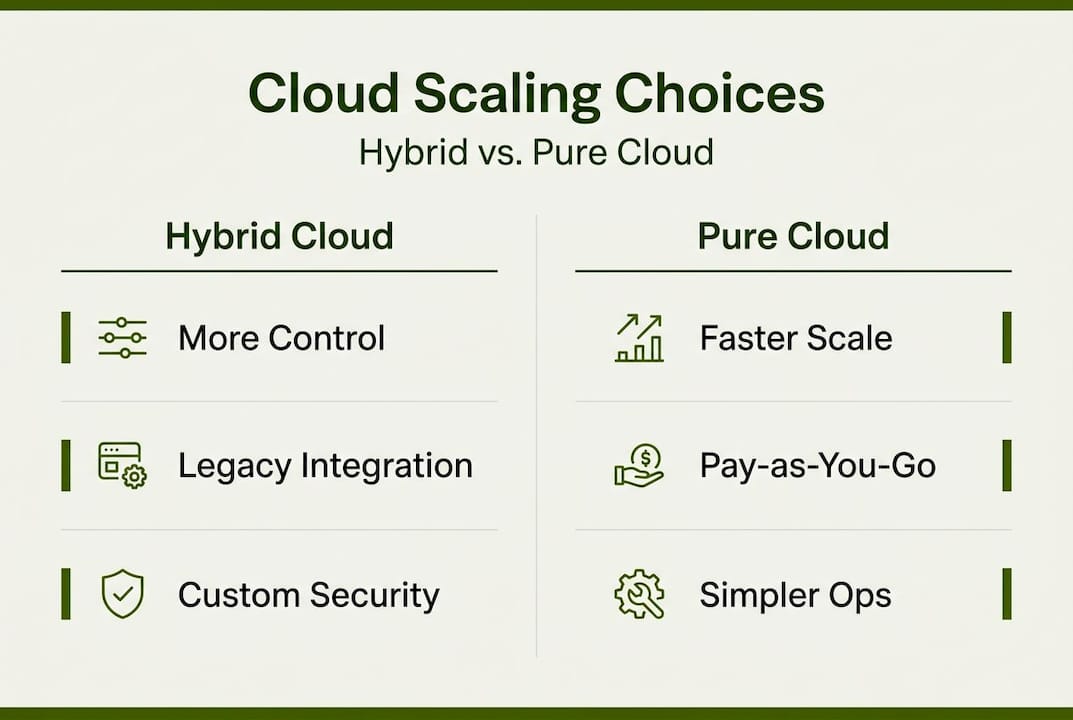
Once you know your current state and your target model, establish a governance framework. Modular, interoperable architectures with clear governance reduce complexity and accelerate delivery. That means defining who owns what, how changes get approved, and what security responsibilities sit with your team versus your cloud provider. Ventisconsulting's security responsibility framework is a practical starting point for businesses working through this division.
Finally, adopt Infrastructure as Code (IaC) tools like Terraform or AWS CloudFormation before you scale. IaC lets your team deploy environments consistently, reduces human error, and makes scaling repeatable rather than a one-time scramble.
Step-by-step execution for scaling cloud solutions
With your foundation in place, you can move to execution. Here is a practical sequence that works for most small to mid-sized businesses.
-
Deploy a hybrid cloud strategy first. Moving workloads to a hybrid environment before full cloud migration gives you flexibility. Hybrid cloud adoption can reduce capital expenses by 20 to 30% and operating expenses by 30 to 50% in the first year by shifting from hardware ownership to consumption-based pricing.
-
Break monolithic applications into microservices. A monolithic application scales as a single unit. That means if one component needs more resources, you scale everything. Microservices let you scale individual components independently, which is faster and cheaper. It also means a failure in one service does not bring down your entire application.
-
Containerize your workloads. Containers package your application and its dependencies together, making them portable across environments. Docker is the most common containerization tool. Once containerized, your workloads become much easier to scale.
-
Implement Kubernetes for orchestration. Kubernetes manages your containers at scale. It handles deployment, scaling, and recovery automatically. For businesses running multiple containerized workloads, Kubernetes is the standard choice for keeping everything coordinated.
-
Add autoscaling with serverless where appropriate. Serverless compute with adaptive autoscaling reduces operational costs by up to 25% by dynamically allocating resources based on actual workload patterns rather than fixed rules. Use serverless for event-driven workloads, batch processing, and APIs with variable traffic.
-
Automate deployment pipelines. Manual deployments are a bottleneck at scale. CI/CD pipelines (Continuous Integration and Continuous Deployment) automate testing and deployment, letting your team ship faster with fewer errors.
Pro Tip: Avoid over-provisioning by setting autoscaling thresholds based on actual usage data from the past 90 days, not on worst-case estimates. Most teams provision for peaks that happen less than 5% of the time.
Here is a quick comparison of scaling approaches to help you choose the right fit:
| Approach | Best for | Cost profile | Scaling speed |
|---|---|---|---|
| Virtual machines | Legacy workloads, full OS control | Medium to high | 60 to 180 seconds |
| Containers | Microservices, portability | Low to medium | Under 30 seconds |
| Serverless | Event-driven, variable traffic | Pay-per-use | Near instant |
| Hybrid cloud | Compliance-sensitive workloads | Variable | Depends on setup |

Common challenges when growing cloud services
Even well-planned scaling efforts run into problems. Knowing what to expect lets you address issues before they become expensive.
The most common technical problem is latency during scaling events. Reactive autoscaling suffers from provisioning delays of 60 to 180 seconds for virtual machines. For latency-sensitive applications like customer-facing web apps or real-time data processing, that delay is unacceptable. The fix is pre-scaling: set minimum instance thresholds so your infrastructure is never starting from zero during a traffic spike.
A second challenge is infrastructure fragmentation. As teams move fast and add resources independently, you end up with ungoverned sprawl. Different teams using different tools, different naming conventions, and different configurations creates a system that is nearly impossible to audit or optimize. Architectural drift and fragmented tooling cause scaling fragility. The solution is guardrail governance: policies embedded directly into your CI/CD pipelines that enforce standards automatically.
"Scalability is not the same as scaling. Scalability is a design property. Scaling is an operational action. You cannot reliably do the second without building the first into your architecture from the start."
Technical debt is the third major risk. Poor architectural decisions compound over time. A shortcut taken during a fast growth phase becomes a structural weakness that limits future scaling. Continuous architecture audits, scheduled quarterly, catch drift before it becomes a crisis.
- Watch for services with no clear owner
- Flag any workload that cannot be deployed independently
- Identify dependencies that cross team or service boundaries without documentation
- Review cost anomalies monthly to catch resource waste early
Pro Tip: Use CPU-aware load balancing to shift traffic away from bottlenecked nodes. Done well, this increases effective capacity by over 10% without adding hardware.
Measuring business growth through cloud scaling
Scaling is only valuable if you can prove it. Post-implementation measurement tells you whether your investment is working and where to focus next.
| KPI | What it measures | Target |
|---|---|---|
| Uptime percentage | System reliability | 99.9% or higher |
| Deployment frequency | Development velocity | Multiple times per week |
| Mean time to recovery (MTTR) | Incident response speed | Under 1 hour |
| Cost per workload | Spending efficiency | Decreasing quarter over quarter |
| Autoscaling event success rate | Scaling reliability | Above 95% |
Beyond the numbers, conduct a post-implementation review 30 and 90 days after any major scaling change. Ask your team what broke, what surprised them, and what they would do differently. These conversations surface operational risks that dashboards miss.
Use your monitoring data and dependency maps to spot emerging risks. A workload that is consistently hitting 80% CPU utilization is not a future problem. It is a current one. AI-driven infrastructure demand is accelerating this need, with enterprise spending on generative AI growing from $11.5 billion in 2024 to $37 billion in 2025. Your infrastructure needs to be ready for that kind of growth trajectory.
The businesses that get the most out of cloud scaling treat it as an ongoing practice, not a one-time project. Review your architecture quarterly. Adjust autoscaling rules based on real usage data. Leverage vendor analytics tools like AWS Cost Explorer or Azure Advisor to find optimization opportunities you would otherwise miss.
My take on scaling cloud infrastructure
I have worked with enough small and mid-sized businesses to know that the biggest mistake is not technical. It is organizational. Teams rush to scale because growth demands it, and they skip the governance work because it feels slow. Then six months later, they are paying for three times the resources they need and nobody can explain why.
What I have learned is that scalability must be a design property, not an afterthought. The businesses that scale well are the ones that built modular, documented, and auditable systems before they needed to scale. The ones that struggle built fast and figured they would clean it up later.
My honest advice: do not let urgency skip the architecture conversation. A week spent mapping dependencies and establishing governance standards will save you months of firefighting later. And if you are considering serverless, serverless architectures that analyze workload patterns outperform rule-based scaling in both cost and stability. That is not a trend. It is where the industry is heading, and the sooner you build toward it, the better your position.
The cloud market has grown for ten straight quarters. That growth is not slowing. The question is whether your infrastructure is designed to grow with your business or whether it will become the thing holding you back.
— Greg
How Ventisconsulting can help you scale

Scaling cloud infrastructure is not something most small to mid-sized businesses should tackle alone. The decisions you make about architecture, governance, and security have long-term consequences that are hard to reverse. Ventisconsulting works directly with business leaders and IT teams in Pittsburgh and the surrounding region to build cloud strategies that fit your actual requirements, not a generic template.
From hybrid cloud planning and Network as a Service to security responsibility frameworks and managed IT support, Ventisconsulting offers the hands-on guidance that makes scaling practical and cost-effective. Explore managed IT solutions built for businesses like yours, and reach out to start a conversation about what scaling cloud infrastructure could look like for your specific situation.
FAQ
What does it mean to scale cloud infrastructure for business growth?
Scaling cloud infrastructure means expanding your computing resources, storage, and services in a way that matches your business demand without overspending. Done well, it supports faster deployments, higher reliability, and lower cost per workload as your business grows.
What is the fastest way to scale cloud resources?
Containers on pre-warmed nodes scale in under 30 seconds, compared to 60 to 180 seconds for virtual machines. For latency-sensitive applications, containerization combined with Kubernetes orchestration is the most reliable path to fast, consistent scaling.
How does a hybrid cloud strategy reduce costs?
A hybrid cloud approach shifts spending from fixed hardware ownership to consumption-based pricing. Businesses that adopt this model typically see capital expense reductions of 20 to 30% and operating expense reductions of 30 to 50% in the first year.
How do I know if my cloud scaling is working?
Track uptime percentage, deployment frequency, mean time to recovery, and cost per workload. A post-implementation review at 30 and 90 days after any major scaling change will surface operational gaps that dashboards alone will not catch.
What is the biggest risk when scaling cloud infrastructure?
The biggest risk is scaling without governance. Fragmented tooling, undocumented dependencies, and ungoverned resource growth create technical debt that compounds over time and makes future scaling harder and more expensive.