

A data classification policy is the short, approved document that tells your organization how to sort information by sensitivity and who's responsible for protecting each type. At minimum, yours needs four things: defined classification tiers, named data owners, handling rules for each tier, and a set review cadence. Later sections map those pieces to NIST and ISO expectations so your policy holds up under audit.
TL;DR:
- Most organizations adopt a four-tier classification scheme: Public, Internal, Confidential, and Restricted, based on the potential impact of data disclosure.
- Clear ownership roles for data owners, stewards, security, and compliance are essential to ensure accurate classification and enforcement.
- Handling rules vary by tier, with Confidential and Restricted data requiring encryption, role-based access, and secure disposal aligned with recognized standards like NIST SP 800-88.
- Regular review cycles, at least annually or after major changes, are critical to keep classifications current and effective.
- Implementation should start with a business-led inventory, automation for initial discovery, and ongoing validation to maintain classification accuracy as business needs evolve.
Table of Contents
- Data Classification Policy Template: Required Sections
- What Should the Policy's Scope Statement Cover?
- Who Owns Data Classification Decisions?
- What Are the Four Data Classification Levels?
- How Do Handling Rules Change by Classification Level?
- How Do You Implement a Data Classification Policy?
- How Does Data Classification Map to NIST, ISO, and HIPAA?
- How Often Should You Review a Classification Policy?
- Sample Policy Language and a Copy-Ready Template
- A Practitioner's View on Building Policies That Actually Get Approved
- Get Your Classification Policy Built and Operational
- Sources
- FAQ
Data Classification Policy Template: Required Sections
Every official policy needs the same skeleton, whether you're a five-person accounting firm or a 500-employee manufacturer. Auditors and regulators expect to see these sections in order, with clear ownership attached to each one.
- Purpose: One or two sentences stating why the policy exists. Example: "This policy establishes a framework for classifying company data to ensure appropriate protection based on sensitivity and regulatory requirements."
- Scope: What systems, data types, and people the policy covers.
- Authority: Who approved the policy and who can amend it. Example: "This policy is issued under the authority of the Chief Information Security Officer and applies to all employees, contractors, and third-party vendors."
- Definitions: Plain-language glossary of terms used throughout (see the glossary later in this guide).
- Classification levels: A reference to your classification table, not a restatement of it. Example: "Data must be classified according to the four-tier scheme defined in Appendix A."
- Handling requirements: Rules for storage, transmission, and disposal by tier.
- Roles and responsibilities: Who owns, stewards, and enforces classification.
- Review and revision history: A dated log of changes and the approver for each version.
Auditors specifically look for a visible revision history table with version numbers, dates, and named approvers. Skip this and even a solid policy can look unmanaged.
What Should the Policy's Scope Statement Cover?
A scope statement fails most often by being too vague ("all company data") or too narrow (only covering servers, missing laptops and SaaS apps). Write it to name systems, data types, and environments explicitly, then list exceptions.
- In scope: on-premises servers, employee laptops and phones, cloud storage (Microsoft 365, Google Workspace, AWS), email systems, physical records, and backup media.
- Out of scope (with justification): publicly available marketing materials already classified as Public, or systems explicitly governed by a separate, more restrictive policy (such as a dedicated HIPAA data policy).
- Special cases: cloud services (who classifies data once it leaves your network?), backups (do they inherit the classification of the source data?), and third-party processors (does your policy bind vendors contractually, or only internal staff?).
The scope statement should explicitly state that classification travels with the data, including into backups and third-party systems, not just the originating environment.
Who Owns Data Classification Decisions?
Ambiguous ownership is the single biggest reason classification policies fail in practice. Every dataset needs a named owner, and every owner needs specific, checkable duties.
- Data owners (typically department heads or system owners) approve the initial classification for data under their control and re-approve it whenever the data's use changes materially.
- Data stewards maintain the day-to-day inventory, process classification requests from staff, and escalate ambiguous cases to the owner or a governance committee.
- Security operations implement the technical controls tied to each tier, monitors for policy violations, and retains logs as audit evidence.
- Compliance/legal maps classification tiers to regulatory obligations (HIPAA, PCI DSS, state privacy laws) and signs off on exception requests.
- End users apply the correct label at creation, follow handling rules for the tier they're working with, and complete classification training annually.
Build a lightweight escalation workflow: a user unsure how to classify a file submits a request to their steward, who has five business days to respond before it auto-escalates to the data owner. Retain evidence of these decisions. Auditors will ask for them.
What Are the Four Data Classification Levels?
Most organizations that get classification right use a four-tier scheme: Public, Internal, Confidential, and Restricted. IBM's guidance recommends exactly this structure as the practical baseline for businesses, and it's echoed by ComplyJet's policy template research, which found most organizations settle on three to five tiers with this four-level version being the most common.
The decision criteria should always tie back to one question: what happens if this data is disclosed to someone who shouldn't see it? Not "how embarrassing would it be," but a concrete impact assessment covering financial loss, regulatory penalty, competitive harm, or safety risk.
| Tier | Definition | Example Data | Impact of Disclosure |
|---|---|---|---|
| Public | Approved for release with no restrictions | Marketing brochures, press releases, published pricing | None or negligible |
| Internal | Business information not meant for outside release, but low harm if leaked | Internal memos, org charts, meeting notes | Minor reputational or competitive impact |
| Confidential | Sensitive business or personal data requiring controlled access | Customer contracts, employee records, financial forecasts | Moderate to significant financial or legal harm |
| Restricted | Highly sensitive data where exposure creates severe consequences | Social Security numbers, health records (PHI), payment card data | Severe legal, financial, or safety consequences |
A few practical notes on applying this table:
- SSNs and payment card numbers default to Restricted, not Confidential, because regulatory penalties for their exposure are severe and immediate.
- Multi-dimensional labels become necessary once you operate across jurisdictions. A dataset might carry both a sensitivity label (Confidential) and a jurisdiction tag (EU, meaning GDPR rules apply) because the same content can trigger different legal obligations depending on where the data subject lives.
- Structured data in databases can often be classified at the column level and enforced automatically in the application layer. Unstructured content, like contracts sitting in a shared drive, usually needs metadata tagging and human review instead.
Resist the urge to add a fifth or sixth tier before you've operated the four-tier version for at least a year. Extra granularity sounds thorough on paper, but it multiplies the number of judgment calls your staff has to make daily, and that's usually where classification programs quietly break down.
How Do Handling Rules Change by Classification Level?
Classification only matters once it changes behavior. Each tier needs explicit, checkable rules for storage, access, transmission, and disposal, or the labels become decoration.
- Public: No special storage or transmission controls required. Disposal can use standard deletion.
- Internal: Store on company-managed systems only. Access limited to employees; no external transmission without a business reason. Standard deletion is acceptable on disposal.
- Confidential: Encrypt at rest and in transit. Access restricted by role-based permissions. Transmission only through approved business channels, never personal email or unmanaged personal devices. Retain access logs.
- Restricted: Encrypt with strong, current algorithms both at rest and in transit. Access limited to a named, minimal list of individuals with a documented business need. All access logged and reviewed periodically. Multi-factor authentication required for any system holding Restricted data.
A short list of practices that should be explicitly prohibited in the policy text, not just implied:
- Sending Confidential or Restricted data through personal email accounts or consumer file-sharing tools.
- Storing Restricted data on removable media without encryption.
- Retaining classified data beyond its defined retention period "just in case."
- Disposing of media containing Confidential or Restricted data through standard deletion instead of secure erasure.
Pro Tip: When it comes to secure disposal, reference NIST SP 800-88 media sanitization guidelines by name in your policy rather than describing your own erasure method. It gives auditors an immediate, recognized standard to check your process against instead of evaluating your description from scratch.
Failure to apply differentiated controls is where most breaches turn expensive. Classification without enforcement gives you a false sense of governance. A file labeled Restricted that still lives on an unencrypted laptop hasn't been protected at all. It's just been labeled.
How Do You Implement a Data Classification Policy?
Moving from an approved policy document to actual daily practice is where most programs stall. The sequence matters, and skipping steps almost always shows up later as inconsistent labeling.
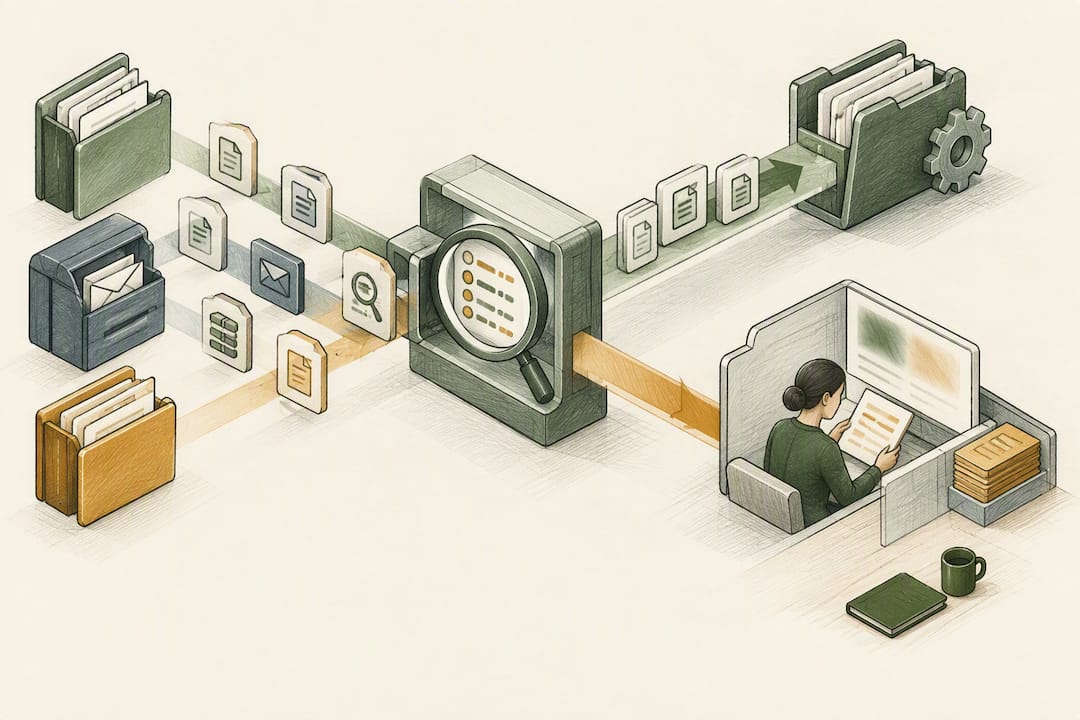
- Run a business-led data inventory first. Before touching any discovery tool, ask department leaders what data they create, receive, and store. This surfaces context automated scanning misses, like which spreadsheet actually contains merger negotiation terms.
- Use automated discovery for the first pass. Tools like Microsoft Purview or similar platforms can scan repositories and flag likely sensitive content (Social Security number patterns, credit card formats, health record keywords) far faster than any manual review.
- Mandate manual validation for anything automation flags as ambiguous. Microsoft's own well-architected guidance is direct on this point: automated classification scales discovery, but its accuracy depends entirely on the underlying discovery logic, and unclear or judgment-based cases still need a human data owner to confirm the label.
- Apply labels as persistent metadata, not just a folder name or a note in a spreadsheet. Labels need to travel with the data through copies, exports, and system migrations, or protection stops the moment the file moves.
- Integrate label checks into existing workflows rather than building a separate classification process. If your team already reviews new vendor contracts, add a classification field to that existing intake form instead of creating a standalone classification queue nobody remembers to use.
- Set a recurring validation cycle to catch labels that go stale as data ages or business use changes.
One nuance worth flagging explicitly in your implementation notes: when your organization receives data from an external partner or acquired company, preserve that data's original classification metadata rather than overwriting it, and prefix the label with the source organization's identifier. Otherwise your team ends up guessing whether "Confidential" was applied under your own criteria or someone else's.
Pro Tip: Don't let automated discovery run unsupervised on unstructured content like shared drives and email archives. It's genuinely good at pattern matching (SSNs, card numbers) but weak at context, like distinguishing a real customer contract from a training template that happens to contain sample data.
How Does Data Classification Map to NIST, ISO, and HIPAA?
Auditors don't just want a classification table. They want to see it wired into the compliance frameworks that actually govern your industry. Build that mapping once, document it clearly, and reuse it across every audit cycle.
- NIST: NIST IR 8496 frames classification as a governance function, and it explicitly recommends mapping classification tiers to protection requirements rather than baking specific controls into the taxonomy itself. That distinction matters for your policy structure: keep classification definitions separate from control specifications so either can change independently.
- ISO 27001: Clause A.8.2 covers "information classification," requiring organizations to classify information in terms of legal requirements, value, criticality, and sensitivity, then apply handling procedures consistent with that classification. Map your four tiers directly to this clause in your audit documentation.
- HIPAA: Protected Health Information (PHI) should default to Confidential or Restricted, depending on volume and context. A single patient's appointment date might land at Confidential; a full medical record with diagnosis and treatment history belongs at Restricted.
- PCI DSS: Full payment card numbers and cardholder authentication data map to Restricted without exception. Masked or tokenized card data may qualify for Confidential, depending on your specific tokenization method.
Audit evidence you should collect and retain includes: the signed policy document with version history, the data inventory showing classification assignments, access logs for Confidential and Restricted systems, training completion records, and documented exception approvals. Keep these organized by classification tier, since that's how most auditors will request them.
How Often Should You Review a Classification Policy?
Classification isn't a one-time labeling exercise. Data changes purpose, regulations shift, and businesses acquire new systems, so the policy needs a defined maintenance rhythm, not an assumption that last year's labels still hold.
- Annual review at minimum, covering the full policy document and a sample audit of classification accuracy across departments.
- Event-driven reviews triggered by mergers, new product launches, new regulatory obligations, or a security incident involving misclassified data.
- Training refreshers at least annually, with new-hire training completed within the first 30 days of employment. Keep training focused on practical scenarios employees actually encounter, not abstract policy language.
- Exception and waiver process: any deviation from standard handling rules requires a written request specifying the business justification, the compensating control in place, an expiration date, and sign-off from the data owner and CISO. No open-ended exceptions.
Treat labels as living metadata rather than a fixed decision made once at data creation. A document created as Internal can become Confidential the moment it's attached to a legal dispute, and your review cadence is what catches that drift before it becomes an incident.
Sample Policy Language and a Copy-Ready Template
Below is language you can adapt directly, followed by a skeleton structure for the full document.
Sample purpose statement: "This Data Classification Policy establishes the framework by which [Organization Name] identifies, labels, and protects data according to its sensitivity and regulatory obligations. Compliance is mandatory for all employees, contractors, and third-party data processors."
Sample classification reference: "All data created, stored, or processed by [Organization Name] must be classified according to one of four levels defined in Appendix A: Public, Internal, Confidential, or Restricted. Where classification is unclear, the data owner must be consulted before the data is shared or stored."
Sample owner declaration: "The [Department/Role] is designated as the data owner for [data type] and is responsible for approving its classification, authorizing access, and reviewing that classification annually."
Template skeleton to adapt:
- Policy title, effective date, version number, and approving authority (name and title)
- Purpose and scope sections (adapted from earlier in this guide)
- Definitions and glossary
- Classification table (four tiers, with your organization's specific examples)
- Handling requirements table (storage, access, transmission, disposal by tier)
- Roles and responsibilities section, with named titles, not just generic descriptions
- Exception process, with a link to the request form
- Review and revision history table
- Contact information for the policy owner and a designated point of contact for classification questions
For smaller organizations, a state government's published policy can be a useful structural reference: Delaware's data classification policy shows how to assign minimum classifications to specific data elements (like tagging Social Security numbers as Confidential by default) and how to build in a formal waiver process, both of which translate well regardless of organization size. Scale the granularity to your risk profile: a 20-person firm needs the same four sections but far less procedural detail than a regulated 500-employee company handling health records across multiple states.
A Practitioner's View on Building Policies That Actually Get Approved
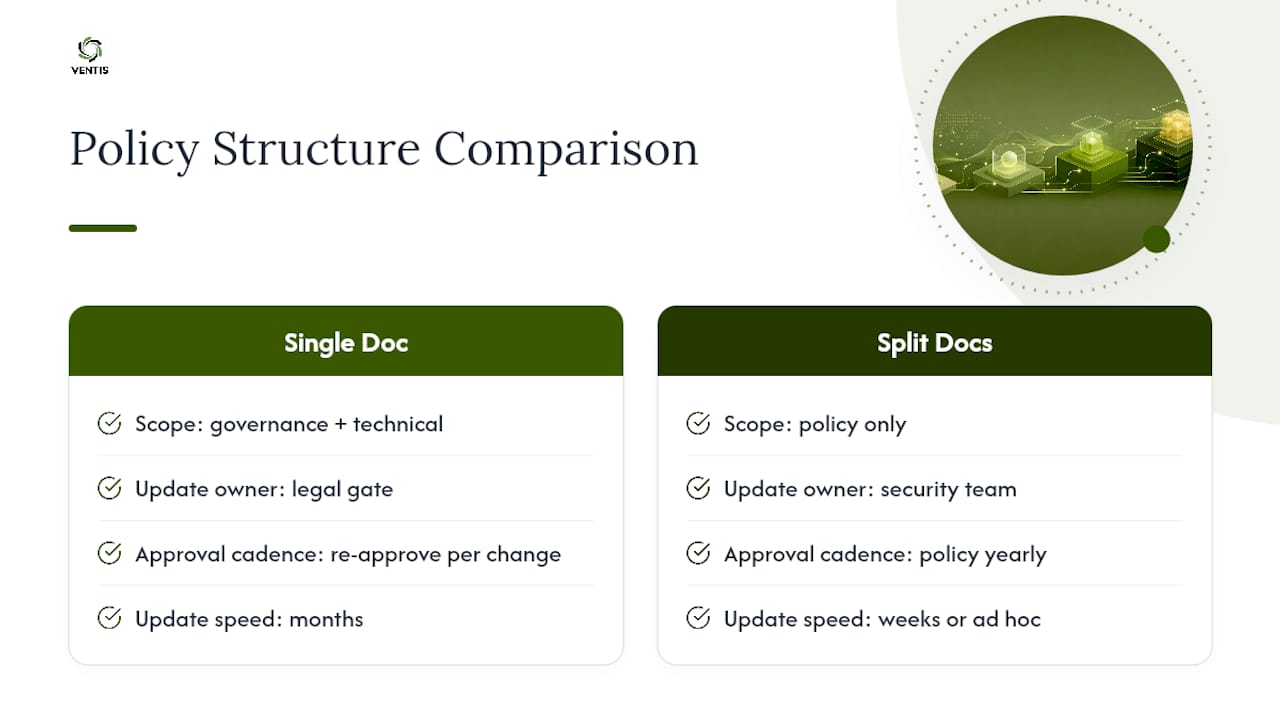
The pattern we see most often in SMB security programs isn't a missing policy. It's a bloated one that tries to define governance and technical controls in the same 40-page document, then stalls in legal review for months because every control change requires re-approving the whole thing.
Separating the policy (who owns what, what the tiers mean) from a shorter handling standard (specific technical controls per tier) fixes that. Leadership approves the policy once a year. Your security team updates the handling standard as tools and threats change, without waiting on a signature chain. We've watched this single structural choice cut approval cycles from months to weeks for clients who'd been stuck on the "one giant document" model. Classification programs don't fail because the taxonomy is wrong. They fail because nobody maintains them, and a policy nobody can update quickly is a policy nobody updates at all.
— Greg
Get Your Classification Policy Built and Operational
Writing the policy is the easy half. The harder part is the inventory, the labeling rollout, and the ongoing validation that keeps classifications accurate as your business changes, and that's where most in-house teams run out of time before they run out of intent. A consultative, hands-on approach is more effective than handing over a generic template and walking away: this includes running the inventory, drafting the policy language, and helping operationalize the labeling plan alongside your existing team.
A typical engagement starts with a free cybersecurity assessment to map your current data footprint, followed by policy drafting tied to the standards your industry actually enforces. From there, our managed IT services and cybersecurity solutions cover the operational side: access controls for Confidential and Restricted systems, email security for approved transmission channels, and managed detection and response to monitor for policy violations after rollout. If you're a Pittsburgh-area business ready to move from a policy draft to a working program, reach out through Ventis Consulting Group's contact page to schedule your assessment.
Sources
The recommendations in this guide draw on a small set of documents worth bookmarking directly.
- NIST IR 8496 — Data classification concepts and considerations
- IBM — Data classification guidance
- Microsoft Azure Well-Architected Framework — Data classification
- ComplyJet — Data classification policy guide + template
FAQ
What Are the Five Data Classifications?
Most frameworks use four tiers, Public, Internal, Confidential, and Restricted, though some organizations add a fifth tier (often "Highly Restricted" or "Top Secret") for extremely sensitive government or defense data. For most businesses, the four-tier model covers the full range of risk without adding unnecessary complexity.
What Is a GDPR Policy?
A GDPR policy isn't a classification policy itself. It's a broader data protection policy documenting how an organization collects, processes, and safeguards personal data of EU residents under the General Data Protection Regulation. Your classification policy supports GDPR compliance by identifying which datasets contain personal data that needs Confidential or Restricted handling.
What Are the Four Types of Data Classification?
The four common types are Public, Internal, Confidential, and Restricted, ordered by the severity of harm if the data is disclosed without authorization. This structure is recommended by IBM and reflected in most practical policy templates in use today.
What Do NIST Data Classification Standards Recommend?
NIST IR 8496 recommends treating classification as a governance function and mapping classification levels to specific protection requirements, rather than embedding technical controls directly into the taxonomy. This keeps your classification scheme stable even as the technical controls behind it evolve.
Does Ventis Consulting Group Help Write Classification Policies?
Yes. Ventis Consulting Group works with small to mid-sized businesses to run data inventories, draft classification policy language, and implement the technical controls that make the policy enforceable. Contact Ventis through its end-to-end IT solutions page to scope an engagement; pricing is provided based on your organization's size and needs.