

A cybersecurity audit is a structured evaluation of your organization's security controls, policies, and processes to identify vulnerabilities, verify compliance, and confirm that your defenses actually work. With 3,158 reported data compromises in the U.S. in 2024 alone, small and mid-sized businesses can no longer treat security reviews as optional. This guide walks you through exactly how to conduct a company cybersecurity audit, from assembling your team to translating findings into a remediation plan your leadership can act on. Whether you're preparing for HIPAA, PCI-DSS, or simply want to know where your gaps are, this process gives you a clear path forward.
How to conduct a company cybersecurity audit: prerequisites and tools
Before you run a single scan or review a single policy, you need the right foundation in place. Skipping this step is one of the most common reasons audits produce incomplete or misleading results.
Start by assembling a cross-functional team. Your audit group should include IT staff, a legal or compliance representative, and at least one person who understands your core business operations. Each perspective catches blind spots the others miss. A compliance officer, for example, will flag a policy gap that your network administrator never thought to look for.

Next, define your scope and objectives in writing. Are you auditing your entire network, a specific application, or a subset of data covered by a regulation? Vague scope leads to vague results. Tie your objectives to specific compliance frameworks like ISO 27001, NIST CSF, GDPR, HIPAA, or PCI-DSS. Integrating relevant regulations into your audit structure from the start keeps you aligned with the standards that regulators and insurers actually care about.
Prepare your documentation before day one. This means current asset inventories, network diagrams, user access lists, and existing security policies. Tools like vulnerability scanners, Security Information and Event Management (SIEM) platforms, and audit management software such as Hyperproof make evidence collection and control validation far more reliable than spreadsheets.
Pro Tip: Build your asset inventory before the audit starts, not during it. A missing server or forgotten cloud instance discovered mid-audit can derail your entire scope and timeline.
Key preparation items to have ready:
- A complete hardware and software asset register
- Network topology diagrams showing all connections and entry points
- User access control lists and privilege levels
- Existing security policies, incident response plans, and vendor contracts
- Log files from firewalls, endpoints, and identity management systems
What does the step-by-step cybersecurity audit process look like?
A well-run security audit follows a repeatable sequence. Each step builds on the last, and skipping any one of them creates gaps that undermine the whole effort.
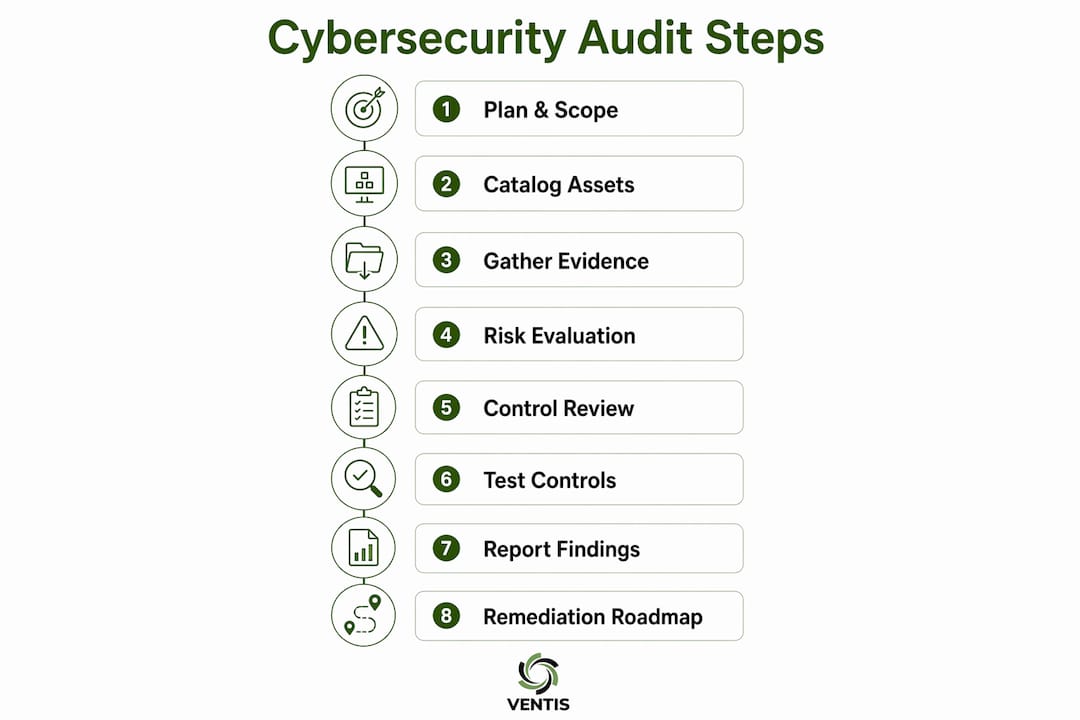
Step 1: Plan and scope the audit. Define what systems, data, and processes fall inside the audit boundary. Document this formally so all stakeholders agree before work begins.
Step 2: Identify and catalog assets. Map every hardware device, software application, data store, and third-party vendor that touches your environment. You cannot protect what you have not counted.
Step 3: Gather evidence and documentation. Collect firewall logs, access control records, patch histories, and written policies. Auditors also observe business processes like employee onboarding to confirm that your written policies match what actually happens day to day. This is where many SMBs get caught off guard.
Step 4: Conduct a cyber risk evaluation. For each asset, identify realistic threats and score them by likelihood and potential business impact. A customer database exposed to the internet carries a different risk profile than an internal printer.
Step 5: Evaluate existing controls. Review technical controls like firewalls, multi-factor authentication, and endpoint protection. Also review administrative controls like access approval workflows and security training records. Security audits validate control effectiveness rather than simply listing vulnerabilities. That distinction matters because a vulnerability scanner tells you what is exposed, while an audit tells you whether your defenses are actually stopping threats.
Step 6: Test and validate controls. Run vulnerability scans and, where appropriate, penetration testing to confirm that controls work under real attack conditions. Tools like SentinelOne provide real-time threat detection data that feeds directly into this phase.
Step 7: Report findings with a prioritized risk matrix. Organize findings by severity and business impact. Use a table like the one below to communicate clearly.
| Finding | Severity | Business Impact | Recommended Action |
|---|---|---|---|
| Unpatched remote access software | Critical | Data breach, regulatory fine | Patch within 48 hours |
| Shared admin credentials | High | Unauthorized access | Enforce MFA and unique accounts |
| No offboarding process for departing staff | Medium | Insider threat exposure | Create formal offboarding checklist |
| Outdated firewall rules | Medium | Network intrusion risk | Review and update rule sets |
Step 8: Develop a remediation roadmap. Convert audit results into a prioritized action plan with a named owner and a deadline for every finding. Without assigned accountability, high-severity issues sit unresolved for months.
Pro Tip: Schedule your next audit date before you close the current one. Audits conducted at least annually or after major changes like a merger, infrastructure upgrade, or security incident keep your security posture current rather than reactive.
What are common mistakes to avoid during a cybersecurity audit?
Even well-intentioned audits fail when common errors go unchecked. Knowing what to watch for saves you time, money, and credibility with regulators.
- Treating the audit as a one-time event. Audits work best as continuous risk management components that evolve with your business, not annual checkboxes filed away until the next compliance deadline.
- Relying on manual, scattered evidence collection. Centralized evidence repositories reduce errors and make it far easier to demonstrate control validity to external auditors or regulators. Manual collection risks disqualifying your compliance efforts entirely.
- Writing reports only for technical readers. If your CEO cannot understand the audit report, security investments will be deprioritized. Translate every technical finding into a business impact statement.
- Skipping vendor assessments. Third-party vendors with access to your systems or data are part of your attack surface. Leaving them out of scope is a gap that attackers actively exploit.
- Failing to track remediation. Identifying a problem and fixing it are two different things. Without a tracking system, findings from last year's audit reappear in this year's.
- Ignoring employee training. Technology controls alone do not stop phishing attacks. Cybersecurity awareness training for staff is a control that auditors look for and regulators expect.
"Audit integrity depends on having verifiable, readily accessible evidence. Manual collection risks errors that can disqualify compliance efforts entirely." — Hyperproof
How do you turn audit results into an ongoing improvement plan?
A completed audit report is the starting point, not the finish line. The real value comes from what your organization does with the findings.
Translate technical vulnerabilities into business language first. A finding like "TLS 1.0 still enabled on the payment gateway" means nothing to your CFO. "Our payment system uses outdated encryption that could expose customer card data and trigger a PCI-DSS fine" gets the budget conversation started. Quantifying risks using financial and operational impact metrics is the single most effective way to get leadership to act.
Assign clear ownership for every remediation task. Each item on your roadmap needs one named person responsible for closing it, a deadline, and a verification step confirming the fix worked. Shared ownership means no ownership.
Use your audit cycle to feed your Key Risk Indicators (KRIs). Boards should receive cyber-risk reporting at least quarterly using business-aligned metrics. That means your audit findings should flow directly into the dashboards your leadership reviews, not sit in a PDF no one opens.
Practical steps for building a continuous improvement cycle:
- Update security policies and controls after each audit cycle based on new findings
- Schedule internal audits quarterly and external audits annually or when regulations require
- Review your cybersecurity compliance practices against updated regulatory requirements at least twice per year
- Incorporate audit lessons into employee training refreshes
- Use frameworks like NIST CSF or ISO 27001 to organize improvements and benchmark progress year over year
Pro Tip: Tie your remediation deadlines to your next board meeting. When leadership knows they will be asked for a status update, remediation tasks get completed on time.
Key takeaways
A cybersecurity audit is only as valuable as the remediation actions it drives, the business language it uses, and the frequency at which it repeats.
| Point | Details |
|---|---|
| Define scope before starting | Document audit boundaries and objectives in writing before any evidence is collected. |
| Use centralized evidence tools | Platforms like Hyperproof reduce errors and strengthen compliance validity with regulators. |
| Translate findings into business risk | Convert technical vulnerabilities into financial and operational impact statements for leadership. |
| Assign owners to every finding | Each remediation task needs one named person, a deadline, and a verification step. |
| Audit on a regular schedule | Run internal audits quarterly and external audits annually to maintain a current security posture. |
Why most SMB audits miss the point
I have worked with dozens of small and mid-sized businesses in the Pittsburgh area, and the pattern I see most often is this: the audit gets done, the report gets filed, and nothing changes. The findings sit in a shared drive until the next compliance deadline forces everyone back to the table.
The problem is not the audit itself. The problem is that most SMBs treat it as a documentation exercise rather than a decision-making tool. When I review audit reports with business owners, the first question I ask is: "Which of these findings would you fund fixing today?" If the answer is "I don't know," the report has failed its audience, not the other way around.
The most effective audits I have seen are the ones where the IT team and the business owner sit in the same room and walk through findings together. Not a 40-page technical report handed over a conference table. A direct conversation: here is what we found, here is what it costs you if it goes unaddressed, here is what it costs to fix it. That conversation changes behavior.
Leadership engagement is not a soft skill add-on to the audit process. It is the mechanism that turns findings into funded fixes. If your board or ownership group does not understand what the audit found, you have not finished the audit yet.
— Greg
How Ventisconsulting helps you audit and protect your business

Ventisconsulting works directly with small and mid-sized businesses in Pittsburgh and surrounding areas to plan, execute, and follow through on cybersecurity audits that produce real results. The team brings structured methodology aligned with NIST CSF and ISO 27001, handles evidence collection, and translates findings into a remediation roadmap your leadership can understand and act on.
If you are ready to move from uncertainty to a clear picture of your security posture, explore Ventisconsulting's managed IT and security services to see how the team supports businesses at every stage of the audit process. From initial scoping to ongoing monitoring, Ventisconsulting provides the guidance and hands-on support that turns a one-time audit into a continuous security improvement program. Reach out and let's get started.
FAQ
What is a cybersecurity audit?
A cybersecurity audit is a formal evaluation of an organization's security controls, policies, and processes to verify they are effective and compliant with relevant standards. Unlike a vulnerability assessment, an audit validates control effectiveness rather than simply identifying weaknesses.
How often should a company conduct a security audit?
Companies should conduct internal audits quarterly and external audits at least annually. Audits should also be triggered by major events like infrastructure changes, mergers, or security incidents to keep defenses current.
What tools are used in a cybersecurity audit?
Common tools include vulnerability scanners, SIEM platforms, and audit management software like Hyperproof. Real-time threat detection platforms like SentinelOne also provide data that supports the control testing phase of the audit.
What compliance frameworks apply to SMB cybersecurity audits?
The most relevant frameworks for SMBs include NIST CSF, ISO 27001, HIPAA, PCI-DSS, and GDPR, depending on your industry and data types. Aligning your cybersecurity audit checklist to the frameworks that govern your business keeps you audit-ready for regulators and insurers.
What happens after a cybersecurity audit is complete?
Audit findings should be converted into a prioritized remediation roadmap with named owners and deadlines for each item. Leadership should receive quarterly risk reporting using business-aligned metrics to track progress and fund fixes.