

Your employees are your biggest security risk. Not because they're careless, but because attackers know it's far easier to trick a person than break through a firewall. When you train employees on cybersecurity awareness, formally known as a security awareness program, you shift that equation. Staff who recognize phishing attempts, report suspicious activity, and follow smart password practices become your first line of defense rather than your weakest link. This guide walks you through every step: assessing where your team stands today, building training that actually works, rolling it out effectively, and proving it's making a difference.
Table of Contents
- Key Takeaways
- How to train employees on cybersecurity awareness: start with a baseline
- Building a cybersecurity training program that sticks
- Rolling out training and building a security-aware culture
- Measuring whether your security training is actually working
- My honest take on what actually moves the needle
- How Ventisconsulting can help you get this right
- FAQ
Key Takeaways
| Point | Details |
|---|---|
| Start with a baseline assessment | Survey your team and run a phishing test before building any training program. |
| Use realistic, role-specific content | Generic training gets ignored; tailor modules to the actual risks each department faces. |
| Make reporting frictionless | Easy, judgment-free reporting channels matter more than any training platform you buy. |
| Measure behavior, not completion | Phishing report rates and time-to-report reflect real improvement; completion rates do not. |
| Build ongoing culture, not one-off events | Quarterly touchpoints and leadership modeling sustain awareness far better than annual sessions. |
How to train employees on cybersecurity awareness: start with a baseline
Before you spend a dollar on cybersecurity training programs, you need to know where your team actually stands. Most SMB owners skip this step and build training based on assumptions. That's how you end up with expensive content that teaches people what they already know while missing the gaps that matter.
Start with a short survey or a quiz sent to all staff. Ask questions about how they handle password resets, what they'd do if they got a suspicious email, or how they share files with outside vendors. You'll spot patterns fast. Then layer in a baseline phishing simulation to see what percentage of employees click on a mock malicious link. That number becomes your benchmark.
From there, identify which roles carry the most risk. Your finance team is a prime target for invoice fraud. HR staff handle sensitive data and get spoofed job application emails. Employees with admin access to your systems are especially valuable to attackers. These groups need more focused attention than your general workforce.
You'll also want to check whether your business has compliance obligations. Frameworks like NIST, HIPAA, and PCI DSS specify formal awareness program requirements, including annual training cadence and documentation. PCI DSS v4.0, for example, requires security awareness training for all employees at hire and every year after. Getting clear on these requirements before you design your program saves you from building twice.
Pro Tip: Use a free cybersecurity readiness checklist to map your baseline against known SMB risks before selecting any training content.
Here's a simple framework for defining your training goals:
- Reduce phishing click rates by a specific percentage within 90 days
- Increase the number of employees who report suspicious emails each month
- Achieve full compliance documentation for your applicable regulatory framework
- Improve password hygiene scores tracked through your identity management tools
Concrete goals like these make it possible to prove your program is working, which matters when you're justifying the investment to yourself or a board.
Building a cybersecurity training program that sticks
Most employee security training fails for one reason: it treats adults like students sitting through a lecture. People forget abstract information fast, especially under pressure. The goal of effective awareness training for staff is to build automatic habits, not test scores.

Start by looking at free, credible resources before buying anything. CISA Learning offers free, on-demand cybersecurity courses covering everything from recognizing phishing to understanding ransomware. These are solid building blocks, especially for smaller teams with tight budgets.
From there, follow these design principles to build something your team will actually engage with:
- Keep modules short. Ten-minute microlearning sessions outperform hour-long courses for retention. People complete them during downtime and retain more.
- Use real scenarios. Show employees a screenshot of an actual phishing email that targeted a business like yours. Concrete beats abstract every time.
- Add phishing simulations with immediate feedback. When someone clicks a simulated malicious link, show them right away what the red flags were. Simulations paired with immediate coaching create real behavioral improvement. Without that feedback loop, employees may just learn to avoid tests rather than recognize threats.
- Build role-specific tracks. Your accounting team needs training on wire transfer fraud. Your IT staff needs deeper content on access management. One-size-fits-all content wastes time.
- Update content when systems change. If you roll out a new email platform or file sharing tool, update training to reflect the new interface. Training content should evolve whenever workflows change to maintain relevance and retention.
- Make reporting fast and simple. A single button in the email client to flag suspicious messages removes friction. The easier you make it, the more near-misses get reported before they become incidents.
Pro Tip: Avoid overloading employees with too many simulations at once. Tuning simulation frequency is critical. Too many tests too fast leads to avoidance and gaming, not learning.
Rolling out training and building a security-aware culture
A program that runs once a year and gets forgotten by February isn't a program. It's a checkbox. If you want to genuinely improve cybersecurity awareness across your organization, training needs to become part of how you operate, not an annual interruption.
Here's what that looks like in practice:
- Integrate training into onboarding. Every new hire should complete a security awareness module in their first week, before they have access to sensitive systems.
- Schedule quarterly touchpoints. These don't need to be long. A 10-minute update on a new phishing trend or a refresher on password practices keeps the topic alive.
- Use real incidents as teaching moments. When a major breach hits the news, send a short internal message explaining what happened and what your team can learn from it.
- Remove the fear of reporting. Employees who are afraid of being blamed for clicking a phishing link will hide it instead of reporting it. Only 19% of cybersecurity leaders say their organizations have fully embedded human-risk models. The gap between employees feeling safe to report and organizations actually building that culture is significant.
Leadership involvement is the single most underutilized lever in small business security culture. When the owner or a manager visibly participates in training, acknowledges their own learning, and praises employees who report suspicious emails, the message lands differently. Practical training succeeds when leadership turns it from a punitive obligation into an enabling habit.
"Embed cybersecurity into your business strategy with leadership involvement. It can't live only in IT." — Adapted from guidance in Poland's 2026 national cybersecurity campaign
The NIST Cybersecurity Framework 2.0 reflects this thinking too. It promotes continuous workforce adaptation to emerging threats rather than static annual reviews. Think of security awareness as a living practice, not a completed task.
Measuring whether your security training is actually working
This is where most SMBs drop the ball. They track whether employees finished the module and call it done. Completion rates are a participation metric, not a behavioral change indicator. Knowing 95% of your team watched a video tells you nothing about whether they'd recognize a real attack.
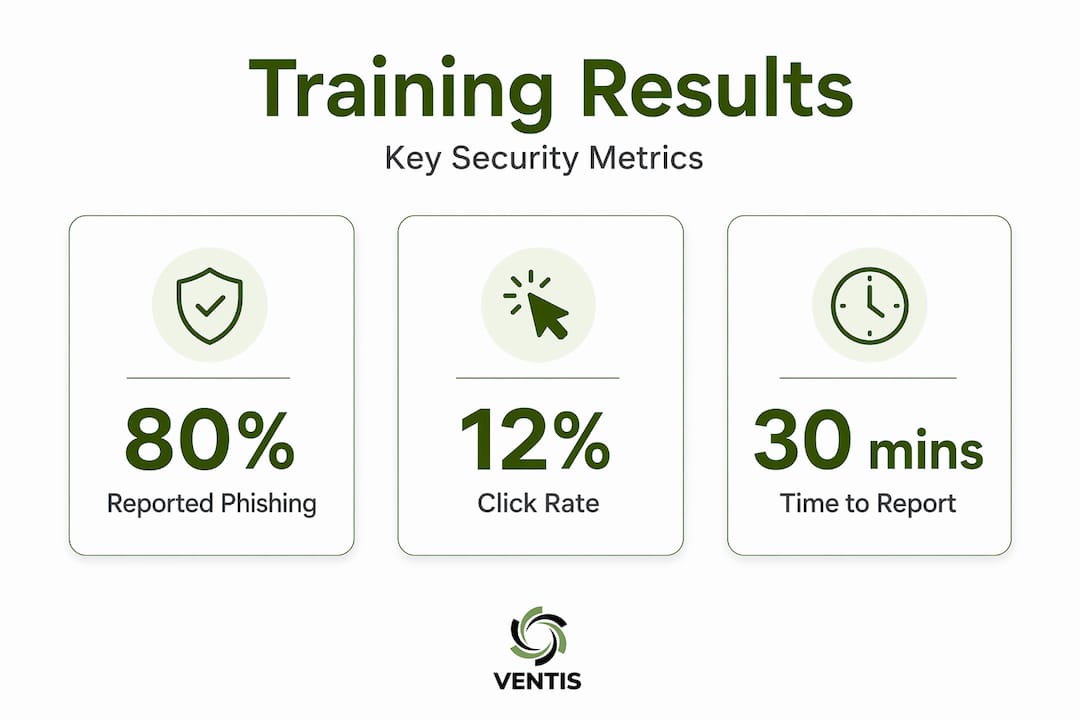
The metrics that actually matter look like this:
| Metric | What it measures | Target |
|---|---|---|
| Phishing simulation click rate | Susceptibility to phishing attacks | Decreasing trend over time |
| Phishing report rate | Employee willingness to escalate threats | Increasing month over month |
| Time-to-report | Speed of response to real threats | Under 30 minutes ideally |
| Near-miss reports | Culture of open reporting | Steady or rising volume |
| Training completion rate | Participation baseline | 100% per department |
Reporting rate is the better measure of real security posture than click rates alone. A team that reports 80% of simulated phishing emails is more valuable than a team that clicks 0% but never flags anything.
Build a simple dashboard with these numbers and share it with leadership monthly. When you can show that your phishing click rate dropped from 28% to 9% in six months, you've made a business case for continuing the investment.
Pro Tip: Collect qualitative feedback too. Ask employees whether training felt relevant to their actual job. If the answer is "not really," the content needs adjusting, not the employees.
Use behavioral data to drive iteration. If a department's click rate isn't improving, run a targeted session for that group. If a new threat category appears in the wild, add a module. The threat environment shifts constantly, and your training content needs to shift with it.
My honest take on what actually moves the needle
I've seen a lot of SMB owners buy a security awareness platform, set it up once, and assume the problem is solved. It isn't. What I've learned working with businesses in this space is that the software is almost never the bottleneck. The culture is.
Annual training events don't change behavior. They create the illusion of progress. Real behavior change happens through repetition, reinforcement, and visible leadership buy-in. When a business owner treats a reported phishing attempt as good news rather than an embarrassing admission, the entire team's willingness to report shifts.
The hidden cost I've seen trip up SMBs most often isn't the platform fee. It's the time and effort required to build a responsive reporting process that actually closes the loop. When an employee reports something suspicious and hears nothing back for three days, they stop reporting. That silence is more damaging than skipping the training entirely.
My practical recommendation: start small. Run one baseline phishing simulation. Measure it. Train the people who clicked. Run it again in 60 days. Add technical controls like MFA and email filtering alongside your training because they reduce the blast radius when someone does make a mistake. Security awareness at Makkari Security rightly frames it as a continuous cultural practice, not a product you install.
If you do those things consistently, you'll be ahead of most SMBs in your market. Not because your tools are fancier, but because your people are prepared.
— Greg
How Ventisconsulting can help you get this right
Building an effective security awareness program takes time you probably don't have. That's where Ventisconsulting comes in. We work with small and mid-sized businesses in Pittsburgh and surrounding areas to design, implement, and manage cybersecurity training and managed IT services that fit your team's actual risk profile, not a generic template. From phishing simulations and role-based training to compliance documentation and real-time reporting dashboards, we handle the operational side so you can focus on running your business. Our consultative approach means you get a program that scales with you. Reach out to Ventisconsulting to find out how we can reduce your cyber risk starting this week.
FAQ
What is cybersecurity awareness training?
Cybersecurity awareness training is a structured program that teaches employees how to recognize and respond to security threats like phishing, malware, and social engineering. It turns general staff into active participants in your organization's security posture.
How often should you train staff on cybersecurity?
Annual training is the regulatory minimum under frameworks like PCI DSS and HIPAA, but best practice is quarterly touchpoints supported by ongoing phishing simulations and real-time threat updates throughout the year.
What metrics actually show training is working?
Phishing simulation report rates and time-to-report are better indicators of real improvement than completion rates. A rising report rate signals that employees are engaged and willing to escalate threats rather than ignore them.
How do small businesses afford cybersecurity training programs?
Free resources like CISA Learning provide solid foundational content at no cost. Managed IT providers can also bundle phishing simulations and training modules into an existing service package, making programs accessible without a large upfront investment.
What's the biggest mistake SMBs make with employee security training?
Treating it as a one-time annual event. Without ongoing reinforcement, leadership involvement, and easy reporting channels, training completion rates climb while real security behavior stays flat.