

A cybersecurity framework is a standardized set of guidelines, best practices, and controls that gives organizations a structured way to manage and reduce cybersecurity risk. Think of it as a methodology, not a product you buy or a tool you install. Frameworks like NIST CSF 2.0, CIS Critical Security Controls, and ISO/IEC 27001 give your business a repeatable, auditable program for protecting data, managing threats, and demonstrating accountability to customers and regulators. For small and mid-sized businesses, understanding cybersecurity frameworks is the first step toward building security that actually holds up under pressure.
What is a cybersecurity framework, and why does it matter?
A cybersecurity framework definition starts with one core idea: structure. Without a framework, most businesses patch security gaps reactively, spending money on tools without a clear picture of what they are protecting or why. A framework changes that by giving you a shared language, a set of priorities, and a way to measure progress over time.
HITRUST describes frameworks as actionable and auditable methodologies that turn cybersecurity into measurable governance. That distinction matters for decision-makers. Buying a firewall is not a security program. A framework tells you what the firewall is protecting, who owns that decision, and how you will know if something goes wrong.

Frameworks also serve a communication function. When a customer asks about your data security practices, or when a regulator reviews your compliance posture, a recognized framework gives you documented evidence of due diligence. That is worth more than any single security tool on your network.
What are the main types of cybersecurity frameworks?
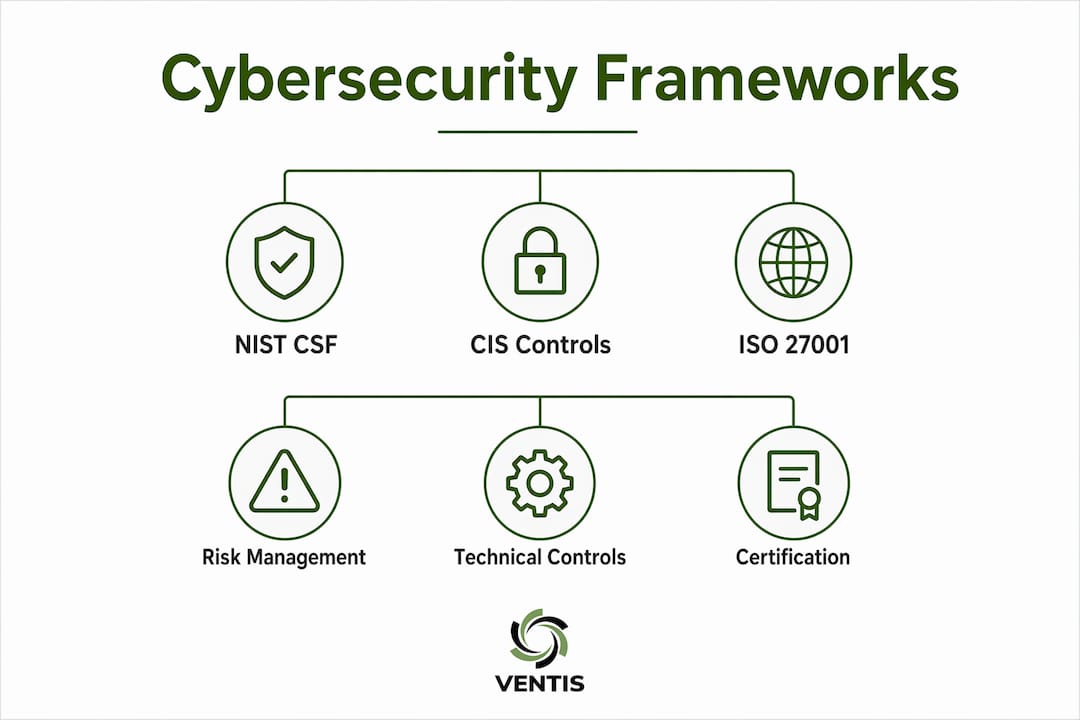
Three frameworks come up most often for small and mid-sized businesses, and each serves a different purpose.
| Framework | Primary Focus | Best For |
|---|---|---|
| NIST CSF 2.0 | Risk management lifecycle | Organizations at any maturity level |
| CIS Critical Security Controls | Prioritized technical safeguards | Businesses needing concrete control steps |
| ISO/IEC 27001 | Certifiable ISMS governance | Companies seeking formal certification |
NIST Cybersecurity Framework 2.0 is the most widely adopted starting point for SMBs. NIST CSF 2.0 helps organizations of all sizes manage cybersecurity risk through six core functions: Govern, Identify, Protect, Detect, Respond, and Recover. Its flexibility is the key advantage. You do not need a mature security program to start using it. You tailor it to your mission, your assets, and your risk tolerance.
CIS Critical Security Controls take a more tactical approach. The framework provides 18 prioritized controls and 153 safeguards covering asset inventory, access control, and vulnerability management. CIS Controls map directly to NIST CSF functions, so many businesses use both together. The controls are concrete enough that a small IT team can act on them immediately.
ISO/IEC 27001 is the right choice when certification matters. It is a certifiable ISMS standard built around 14 control domains, risk-based security, and continuous improvement. If your business handles sensitive client data or operates in regulated industries like healthcare or finance, ISO 27001 certification signals a level of rigor that customers and partners recognize.
Pro Tip: Start with NIST CSF 2.0 to build your overall risk picture, then layer in CIS Controls for specific technical actions. Add ISO 27001 only if certification is a business requirement, not just a goal.
How does the cybersecurity framework lifecycle work?
Understanding cybersecurity frameworks means understanding that security is a cycle, not a project. NIST CSF 2.0 maps this cycle across six functions that work together continuously.
- Govern sets the foundation. This is where you define your risk strategy, assign ownership, and establish policies. Without governance, the other five functions lack direction.
- Identify means knowing what you have. You catalog assets, map data flows, and assess your current risk exposure before you can protect anything.
- Protect covers the controls you put in place. Access management, data encryption, employee training, and system hardening all live here.
- Detect focuses on visibility. You need monitoring tools and processes that surface threats before they become breaches.
- Respond is your incident response plan. Who gets called, what gets shut down, and how do you communicate with affected parties?
- Recover brings operations back to normal and captures lessons learned to improve the next cycle.
"Effective cybersecurity requires integrating enterprise risk management, workforce communication, and cybersecurity responses into one agile program." — NIST CSF 2.0 Quick Start Guide
The lifecycle matters because threats change. A framework you set up in 2024 and never revisit will have gaps by 2026. NIST CSF 2.0 also addresses workforce planning, recognizing that your people and their decision-making habits are as much a part of your security posture as your technology stack. Reviewing your employee cybersecurity awareness practices is a direct extension of the Govern and Protect functions.
Why are cybersecurity frameworks important for small businesses?
The importance of cybersecurity frameworks for SMBs comes down to three practical realities: limited resources, growing threats, and increasing compliance pressure.
Small businesses often assume frameworks are built for enterprises with dedicated security teams. That assumption is wrong and costly. NIST CSF 2.0's flexibility enables organizations without mature cybersecurity programs to begin effective risk management tailored to their mission. You do not need a full security operations center to use it well.
Here is what a framework actually delivers for an SMB:
- Structured prioritization. You stop guessing which security gaps to fix first and start working from a risk-informed list.
- Audit-ready documentation. Every control you implement and every risk decision you make becomes evidence you can show to customers, insurers, or regulators.
- Scalable security spending. Frameworks help you align budget to actual risk rather than buying tools that overlap or miss critical gaps.
- Stakeholder confidence. Customers and partners increasingly ask about your security practices. A recognized framework gives you a credible, specific answer.
Reviewing your cybersecurity compliance practices alongside a framework also helps you identify where regulatory requirements like HIPAA, PCI DSS, or state data privacy laws intersect with your existing controls. That alignment saves time and avoids duplicate work.
How to implement a cybersecurity framework for your business
Selecting and implementing the right framework starts with one question: what are you protecting, and what happens if you lose it? That answer shapes everything else.
NIST CSF 2.0 practitioner guidance recommends starting with your "profile," which means defining your assets, your risk tolerance, and your current security state before applying any controls. Businesses that skip this step spend months writing generic policies that do not reflect how their systems actually work.
Follow these steps to move from theory to practice:
- Map your assets first. List every system, application, and data type your business relies on. You cannot protect what you have not identified.
- Define ownership. Every control needs a named person responsible for it. Governance without accountability fails quickly.
- Select controls that match your risk profile. Use CIS Controls as a concrete starting point, then map them to NIST CSF functions to confirm coverage.
- Build evidence as you go. Document policy decisions, configuration changes, and incident responses. This creates audit-ready records without extra work later.
- Schedule regular reviews. Set a quarterly or semi-annual review cycle to update your profile as your business and threat environment change.
Pro Tip: Use a cybersecurity assessment checklist to benchmark your current posture before selecting a framework. Knowing your gaps upfront prevents you from over-investing in areas that are already covered.
One common mistake is treating framework adoption as a one-time compliance exercise. Frameworks require ongoing tailoring to remain relevant as your systems and threats evolve. A framework that is not reviewed is a false sense of security. The goal is a living program, not a filed document.
CIS Controls also require governance integration to work properly. Technical controls without clear ownership, escalation paths, and incident response procedures leave critical gaps even when the controls themselves are configured correctly. Pairing CIS Controls with NIST CSF's Govern function closes that gap. For additional context on applying controls in secure IT environments, data center security practices offer useful reference points for understanding how controls translate to physical and cloud infrastructure.
Key takeaways
A cybersecurity framework gives SMBs a structured, repeatable, and auditable program for managing risk, and NIST CSF 2.0 is the most practical starting point for businesses at any maturity level.
| Point | Details |
|---|---|
| Framework definition | A framework is a structured methodology for managing cybersecurity risk, not a product or tool. |
| Top frameworks for SMBs | NIST CSF 2.0, CIS Critical Security Controls, and ISO/IEC 27001 each serve different needs and can be combined. |
| Lifecycle approach | Security is a continuous cycle across Govern, Identify, Protect, Detect, Respond, and Recover. |
| Start with your profile | Define what you are protecting and your risk tolerance before selecting or applying any controls. |
| Avoid checklist thinking | Frameworks require ongoing updates to stay effective as threats and business systems change. |
Why I think most SMBs are solving this problem backwards
After working with small and mid-sized businesses across Pittsburgh and the surrounding region, I have seen the same pattern repeat itself. A business owner hears about a breach, buys a security tool, and considers the problem handled. Six months later, they have three overlapping tools, no clear ownership of any of them, and no idea whether their most critical data is actually protected.
The frameworks exist precisely to break that cycle. But the mistake I see most often is treating framework adoption as a compliance checkbox rather than a management discipline. A business that completes a NIST CSF assessment once and files it away has not improved its security. It has produced a document.
What actually works is starting with governance. Who owns security decisions in your organization? What is the risk story you are telling your leadership team? Those questions come before any technical control. The Govern function in NIST CSF 2.0 is listed first for a reason. Without it, the other five functions have no anchor.
The other thing I would push back on is the assumption that frameworks are too complex for small businesses. CIS Controls, in particular, are designed to be approachable. The first control is simply knowing what devices are on your network. That is not complex. It is disciplined. The businesses that do this well are not the ones with the biggest IT budgets. They are the ones that treat security as an ongoing management responsibility rather than a one-time project.
— Greg
How Ventisconsulting helps you put frameworks into practice
Understanding a framework is one thing. Implementing it across your actual systems, policies, and team is another. Ventisconsulting works directly with small and mid-sized businesses to build cybersecurity programs grounded in NIST CSF 2.0, CIS Controls, and ISO/IEC 27001 guidance. The approach is consultative, not generic. That means your program reflects your assets, your risk tolerance, and your industry requirements, not a template built for someone else's business.
Whether you need a full managed IT and security program or a focused assessment to identify your highest-priority gaps, Ventisconsulting provides the expertise and local support to move you from uncertainty to a defensible, documented security posture. Reach out to start the conversation.
FAQ
What is the simplest cybersecurity framework definition?
A cybersecurity framework is a standardized methodology of guidelines, best practices, and controls that helps organizations manage and reduce cybersecurity risk in a structured, repeatable way. It is a program design tool, not a product.
Which cybersecurity framework is best for small businesses?
NIST CSF 2.0 is the most practical starting point for SMBs because it is flexible, free to use, and designed to work at any maturity level. CIS Critical Security Controls can be layered in for concrete technical steps.
Is ISO/IEC 27001 required for compliance?
ISO/IEC 27001 is not universally required, but it is a certifiable standard that demonstrates formal security governance. Businesses in regulated industries or those handling sensitive client data often pursue it to satisfy customer and partner requirements.
How long does it take to implement a cybersecurity framework?
A basic NIST CSF profile and initial control mapping can be completed in four to eight weeks for most SMBs. Full implementation across all six functions, with documented evidence and review cycles, typically takes six to twelve months depending on organizational complexity.
What is the difference between a cybersecurity framework and a cybersecurity standard?
A framework provides flexible guidance and a risk management structure you tailor to your organization. A standard like ISO/IEC 27001 defines specific requirements that can be formally audited and certified. Many organizations use both together.