

Network penetration testing is one of the most misunderstood practices in cybersecurity. Many organizations assume a vulnerability scan covers the same ground. It does not. Network penetration testing goes further by actively exploiting weaknesses to show exactly how an attacker could move through your systems. If you manage IT security for a small to mid-sized business, knowing the difference between a scan and a real attack simulation is not academic. It determines whether your defenses hold up when someone actually tries to break through.
Table of Contents
- Key takeaways
- What network penetration testing actually is
- Internal vs external network penetration testing
- Periodic vs continuous penetration testing
- How to apply penetration testing in your security program
- My honest take on where pen testing programs go wrong
- Strengthen your security with Ventisconsulting
- FAQ
Key takeaways
| Point | Details |
|---|---|
| Pen testing goes beyond scanning | Unlike a vulnerability assessment, penetration testing actively exploits weaknesses to prove real-world impact. |
| Internal and external tests serve different goals | Internal tests simulate insider threats; external tests target your perimeter defenses facing the internet. |
| Periodic testing leaves gaps | Annual or quarterly tests miss new exposures that emerge between engagements, making continuous testing more reliable. |
| Scope and assumptions shape results | Realistic attacker assumptions, including compromised credentials, directly determine how useful the test findings are. |
| Results should drive remediation | Penetration test reports are most valuable when used to prioritize fixes based on actual exploitability, not just severity scores. |
What network penetration testing actually is
The clearest penetration testing definition comes from SANS: authorized professionals simulate real-world attacks to exploit vulnerabilities before malicious actors do. That word "authorized" is doing a lot of work in that sentence. The entire exercise is a controlled, scoped engagement where ethical hackers are given permission to attack your systems using the same tactics, techniques, and procedures a real threat actor would use.
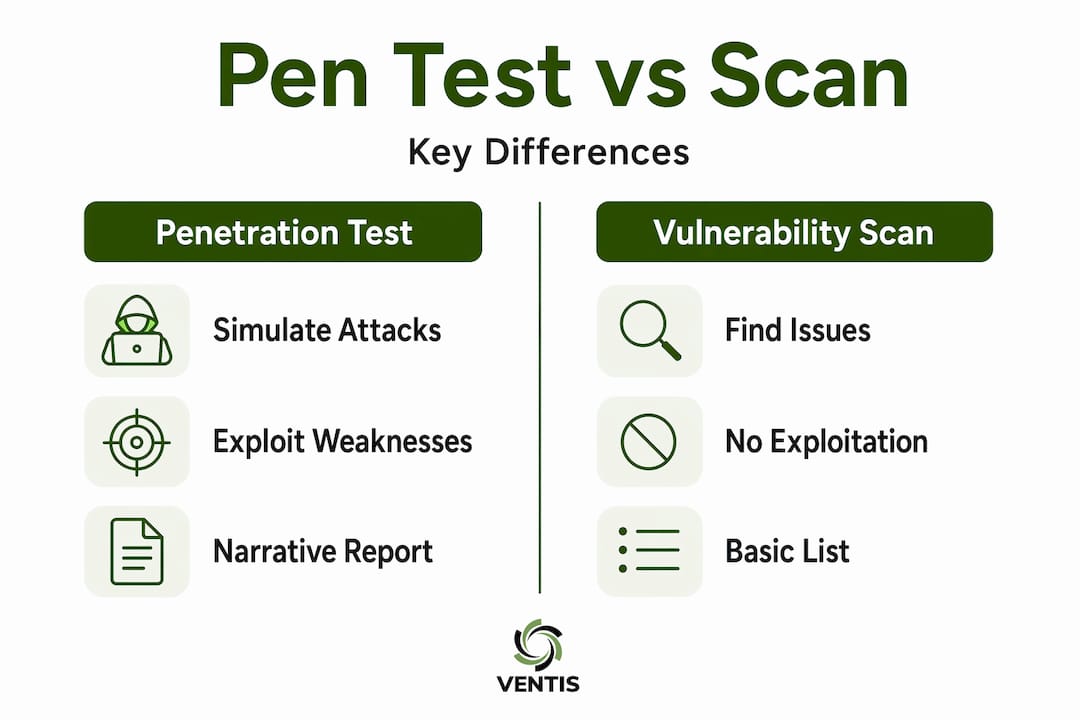
This is what separates penetration testing from what most people mean when they say "network security testing." A vulnerability assessment scans your systems and produces a list of potential weaknesses. A penetration test takes those weaknesses and tries to actually use them. Pen tests prove exploitability and demonstrate real impact, whereas vulnerability assessments are scan-focused detection. The difference matters because many vulnerabilities that look critical on a scan are not actually reachable or chainable in practice. Others that look low severity turn out to be the entry point to your most sensitive data.
Here is what a standard engagement typically covers:
- Reconnaissance: Gathering information about your network, domains, open ports, and exposed services before any active probing begins.
- Scanning and enumeration: Identifying live hosts, open services, and software versions to map the attack surface.
- Exploitation: Actively using discovered vulnerabilities to gain access, escalate privileges, or move laterally across the network.
- Post-exploitation: Assessing what an attacker could do after gaining a foothold, including data access, persistence, and pivot potential.
- Reporting: Documenting findings with clear exploitation narratives and prioritized remediation recommendations.
Pen testing delivers deeper insights on attack paths versus general vulnerability scanning. That narrative quality is what makes the report actually useful to your team rather than just another list to file away.
Pro Tip: When evaluating a penetration testing vendor, ask specifically for sample reports. A strong report shows the full attack chain, not just a CVE list. If you cannot trace a path from initial access to the final impact, the report will not help you prioritize.
Internal vs external network penetration testing
Not all penetration tests are the same, and the distinction between internal and external testing is one of the most important to understand before you commission an engagement.

External tests focus on internet-facing assets like firewalls, web servers, VPN gateways, and public-facing applications. The tester starts with no access and attempts to breach your perimeter, exactly like an outside attacker would. Internal tests assume the attacker is already inside your network. This could simulate a compromised employee account, a malicious insider, or an attacker who has already bypassed perimeter defenses.
| Aspect | External testing | Internal testing |
|---|---|---|
| Starting position | No network access | Assumed internal access or credentials |
| Primary goal | Test perimeter defenses | Test lateral movement and privilege escalation |
| Simulates | Outside attacker | Compromised insider or credential theft |
| Common findings | Exposed services, misconfigured firewalls | Excessive permissions, unpatched internal systems |
| Regulatory relevance | PCI DSS, HIPAA perimeter controls | Insider threat compliance requirements |
Beyond these two core types, there are additional scopes worth knowing:
- Web application penetration testing: Focuses specifically on your web apps using methods aligned with the OWASP testing guide.
- Wireless penetration testing: Tests the security of your Wi-Fi infrastructure, rogue access point detection, and wireless authentication.
- IoT and OT testing: Evaluates connected devices and operational technology that increasingly appear on business networks.
- Social engineering tests: Simulates phishing and pretexting attacks against your staff rather than your systems.
Each type addresses a different attack surface. A mature security program tests all of them over time, not just the external perimeter once a year.
Periodic vs continuous penetration testing
Here is where most organizations fall short. Traditional penetration testing is typically conducted once a year or before a major compliance audit. You get your report, you remediate what you can, and then you move on. The problem is that your network does not stay static for twelve months. New assets are added. Software updates introduce new vulnerabilities. Developers push code changes. Staff turnover creates credential risks.
Annual pen tests miss new exposures that emerge between engagements. New CVEs, new domains, new cloud workloads, and asset changes can all go completely untested until the next scheduled engagement arrives. That gap is exactly where real attackers operate.
Continuous penetration testing addresses this directly. Rather than a single point-in-time assessment, the model involves ongoing testing that adapts as your environment changes. SANS describes this evolution through the concept of the Offensive Security Operations Center, or Offensive SOC, which applies real-time monitoring and SIEM alerts to trigger targeted testing engagements when changes occur. If you want to understand how SIEM fits into this model, the concept connects directly to how security event data drives offensive testing priorities. You can explore SIEM for SMBs to see how that works in practice.
Pro Tip: You do not need a full Offensive SOC to benefit from continuous testing principles. Start by scheduling shorter, more frequent targeted tests tied to deployment cycles and major network changes rather than waiting for an annual engagement.
How to apply penetration testing in your security program
Knowing what network penetration testing is only gets you halfway there. Using it effectively requires a deliberate approach. Here is how to build that into your security program.
Step 1: Define scope and objectives clearly. Your pen test is only as useful as its scope. Work with your tester to identify which systems, IP ranges, and applications are in scope. More importantly, define what business risk you are trying to validate. Testing your payment processing network before a PCI DSS audit is different from testing your remote access infrastructure after a phishing incident.
Step 2: Set realistic attacker assumptions. Starting position assumptions critically affect test usefulness. If your internal test assumes an attacker with no credentials, it will produce different findings than one that assumes a compromised standard user account. Credential-based assumptions mirror the most common real-world attack path: phishing leads to stolen credentials, which leads to lateral movement.
Step 3: Balance automated tools with manual testing. Automated scanners are fast and good at catching known vulnerability patterns. But effective penetration testing blends automation with manual testing to uncover hidden attack paths that no scanner would catch. Logic flaws, misconfiguration chains, and multi-step privilege escalation paths require human judgment.
Step 4: Use results to drive prioritized remediation. This is where most programs fail. The report lands, gets reviewed once, and sits in a folder. Pen testing simulates attacker TTPs to guide better defense prioritization. Use exploitability and business impact, not just CVSS scores, to sequence your remediation work. A medium-severity finding that leads directly to your customer database deserves more attention than a critical finding on an isolated test server.
Key questions to ask your pen testing provider before the engagement begins:
- What methodology do you follow?
- How do you handle out-of-scope findings discovered during the test?
- What does your final report include beyond a list of CVEs?
- Do you offer a debrief or post-remediation retest?
Understanding your security responsibilities as a business and what your provider covers is critical before any engagement starts.
My honest take on where pen testing programs go wrong
I have watched organizations invest in penetration testing and walk away with almost nothing to show for it. Not because the testers were bad, but because the program was set up to check a box rather than find real problems.
The most common mistake I see is treating a pen test like a vulnerability scan with a fancier price tag. Teams expect a list of findings. They get a list. They close a few tickets. Done. But the real value of a penetration test is in the attack narrative. How did the tester get in? What could they have done next? Could they have reached your most sensitive data without triggering a single alert? Those answers change how you build your defenses.
The second problem is scope that is too narrow. Real attackers do not respect scope boundaries. When you define a test so tightly that the tester cannot probe adjacent systems or simulate realistic lateral movement, you are testing a sanitized version of your network, not the one attackers will actually face. I have seen internal tests constrained so heavily that a tester was not allowed to simulate a compromised admin credential. That is the single most realistic attack scenario in 2026, and it was off the table.
What actually works is treating penetration testing as part of an ongoing security validation cycle, not a one-time event. Pair it with cybersecurity compliance practices that enforce baseline controls between engagements. Use the findings to inform your detection capabilities, not just your patching queue. And push for a retest after remediation so you know your fixes actually worked.
Penetration testing done right is one of the most honest assessments your security program will ever get. Do not waste it by treating it as paperwork.
— Greg
Strengthen your security with Ventisconsulting
If this article raised questions about how well your network would hold up against a real attack, that reaction is worth acting on. Ventisconsulting works with small to mid-sized businesses across Pittsburgh and the surrounding area to build security programs that actually work, not just on paper but in practice.

From managed IT services to network monitoring and security assessments, Ventisconsulting brings a consultative approach to every engagement. You get clear guidance, local support, and a team that knows your environment. Explore managed IT and security services to see what proactive protection looks like for a business your size. Or visit Ventisconsulting to start a conversation about your current security posture. No pressure. Just practical advice from people who take your security seriously.
FAQ
What is network penetration testing?
Network penetration testing is an authorized, simulated cyberattack conducted by security professionals to find and exploit vulnerabilities in your network before real attackers can. Unlike a vulnerability scan, it actively demonstrates how weaknesses can be used to breach your systems.
How is penetration testing different from a vulnerability assessment?
A vulnerability assessment scans for potential weaknesses and lists them. A penetration test goes further by actively exploiting those vulnerabilities to prove they are exploitable and show the actual business impact of a breach.
What is ethical hacking and how does it relate?
Ethical hacking is the broader practice of using attacker techniques with permission to test security defenses. Network penetration testing is one specific form of ethical hacking focused on identifying and exploiting network-level vulnerabilities under a controlled engagement.
How often should you run a penetration test?
Most compliance frameworks require at least annual testing, but annual tests miss emerging exposures between engagements. A more effective approach combines scheduled tests with shorter targeted assessments tied to significant changes in your environment.
What tools do penetration testers use?
Common network penetration testing tools include Nmap for network scanning, Metasploit for exploitation, Burp Suite for web application testing, and Wireshark for traffic analysis. Testers also use proxy tools to intercept and manipulate application traffic, which is where app testing proxies can support specific testing workflows.