

Cybersecurity is defined as the primary defense layer that keeps critical business functions running when threats strike, making it the foundation of any credible business continuity strategy. The role of cybersecurity in business continuity extends far beyond protecting servers. It covers your workflows, your supply chain, and your ability to serve customers when attackers target your operations. Organizations with Cyber Essentials certification are 92% less likely to file a cyber insurance claim. That single statistic tells you everything about how cybersecurity posture directly determines operational stability. For small and mid-sized businesses in particular, where one serious incident can halt revenue for days or weeks, this connection is not theoretical. It is the difference between surviving a breach and shutting your doors.
How cybersecurity integrates with business continuity planning
Business continuity planning (BCP) and disaster recovery planning (DRP) are related but distinct disciplines. A BCP focuses on keeping minimum viable operations running during a disruption. A DRP focuses on restoring systems and data after the disruption ends. Cybersecurity connects both, because a cyber incident triggers both simultaneously and complicates each one.
| Framework | Primary goal | Cybersecurity's role |
|---|---|---|
| Business Continuity Plan (BCP) | Maintain operations during disruption | Defines fallback workflows and access controls |
| Disaster Recovery Plan (DRP) | Restore systems after disruption | Validates clean data before restoring production |

Traditional recovery models assume a clean restore point. Ransomware destroys that assumption. Ransomware response requires coordination across four separate operational timelines: incident response, crisis management, business continuity, and disaster recovery. Each runs concurrently and each has different owners, different tools, and different success criteria. Most SMBs plan for one or two of these timelines and leave the others to chance.
Security validation after ransomware can stretch recovery from hours to days or weeks, because forensic teams must confirm that restored data is clean before production systems go back online. This is the gap that most continuity plans miss entirely. You cannot simply roll back to yesterday's backup and call it done. You need to know that backup was not already compromised before the attack was detected.
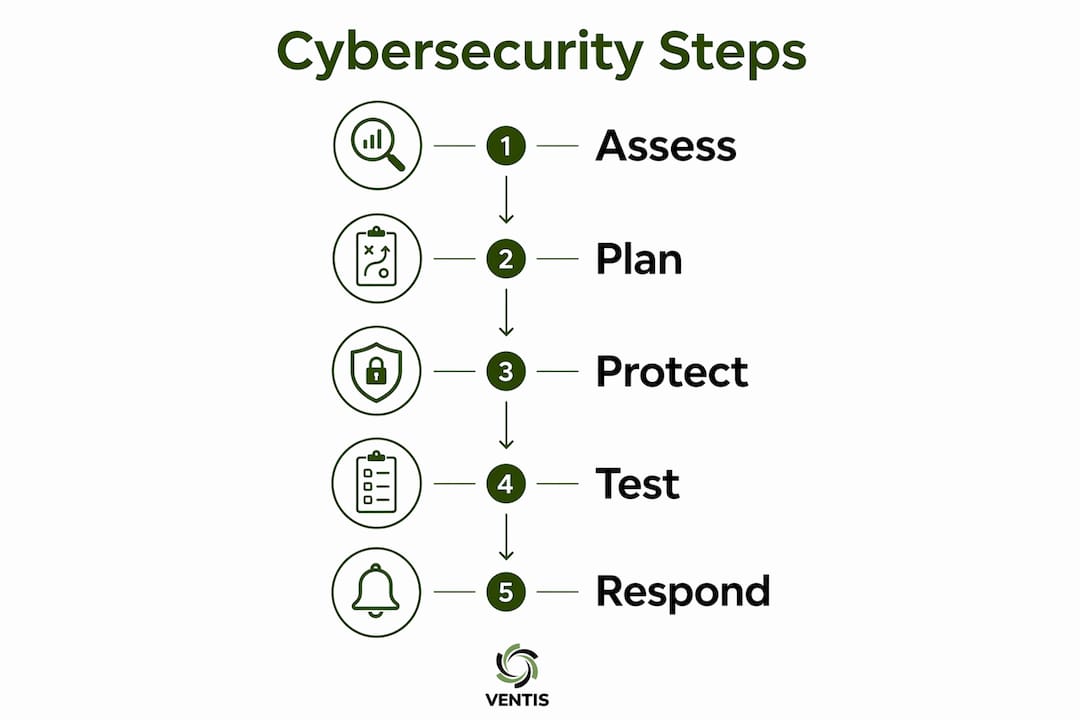
Here is a practical sequence for integrating cybersecurity into your continuity plan:
- Map your critical business functions and identify which IT systems each one depends on.
- Assign a recovery time objective (RTO) and recovery point objective (RPO) to each function.
- Document manual workarounds for each function in case systems are unavailable during forensic validation.
- Invest in immutable backups and data vaulting solutions that attackers cannot encrypt or delete.
- Test the full four-timeline response at least once per year with all relevant teams present.
Pro Tip: Immutable backups stored in an air-gapped or write-once environment are the single most effective technical control for ransomware recovery. Without them, your RTO is whatever the attacker decides it is.
Why cybersecurity matters beyond your IT systems
Most SMB leaders think of cybersecurity as an IT problem. Operational technology (OT) security proves that framing is dangerously narrow. OT refers to the hardware and software that controls physical processes: manufacturing equipment, HVAC systems, building access controls, and industrial machinery. These systems run your business in ways that a server outage simply cannot replicate.
| Environment | Security priority | Typical lifespan |
|---|---|---|
| IT systems | Confidentiality and integrity | 3 to 7 years |
| OT systems | Availability and safety | 20 to 30 years |
Legacy OT equipment generally cannot be patched through conventional methods, yet it must remain continuously available and safe. This creates a unique challenge. You cannot take a manufacturing line offline for a security update the same way you patch a laptop. Compensating controls, such as network segmentation using the Purdue Model and zero-trust access policies, become the primary defense strategy instead.
The financial and safety implications of OT downtime are severe. A compromised HVAC system in a data center can cause physical hardware damage. A breached access control system can create safety risks for employees. These are not IT incidents. They are operational crises with direct business continuity consequences. The importance of cybersecurity in operations becomes undeniable the moment a physical process stops because of a digital attack.
Pro Tip: If your business relies on any equipment older than ten years that connects to a network, treat it as a high-priority continuity risk. Map its network connections, isolate it where possible, and document a manual fallback procedure.
How do governance and testing build real cyber resilience?
Cyber resilience sets a higher standard than recovery alone. Systems must maintain meaningful operations during an incident, not only resume after one ends. Achieving that standard requires governance structures that connect your security team, business unit leaders, legal counsel, and communications staff under a shared framework. No single department can own this problem.
Cross-functional friction between IT and operations teams is one of the most underestimated risks to continuity. Joint planning to synchronize IT patching schedules with operational downtime windows prevents the scenario where a critical security update gets delayed for months because no one coordinated the timing. That delay is exactly the window attackers exploit.
Effective governance for business resilience through cybersecurity includes:
- A cross-functional incident coordination body with defined roles before any incident occurs.
- A shared dashboard that gives IT, operations, and leadership real-time visibility during a disruption.
- Supplier and third-party risk assessments integrated into your continuity plan, because a supplier compromise impacts your entire value chain, not just their systems.
- Documented escalation paths so decisions get made quickly without waiting for approval chains to clear.
Testing is where governance either proves itself or falls apart. Scenario-based validation involving all relevant teams consistently outperforms abstract tabletop briefings. A realistic ransomware lockdown simulation, where teams actually attempt to operate using manual workarounds while IT works a mock recovery, reveals gaps that no written plan ever surfaces. Schedule one annually and treat the findings as a board-level priority.
Pro Tip: Engage a cyber incident response retainer before you need one. Having a pre-contracted specialist on call cuts response time significantly and ensures forensic validation happens correctly the first time.
Practical steps SMBs can take right now
Cybersecurity risk management for SMBs does not require an enterprise budget. It requires prioritization and a clear sequence of actions. The following steps are ordered by impact and practicality for businesses with limited internal IT resources.
-
Pursue Cyber Essentials certification. The 92% reduction in insurance claims is compelling, but the certification process itself forces you to audit your current controls and close the most common gaps. Use the cybersecurity compliance checklist from Ventisconsulting as a starting point.
-
Run a cybersecurity assessment. Before you can protect your operations, you need to know what you are protecting. A structured SMB security assessment maps your assets, identifies your highest-risk exposures, and gives you a prioritized remediation list.
-
Validate your backups. Most businesses discover their backups are incomplete or corrupted during an actual incident. Test your restore process quarterly, confirm your backups are immutable, and verify that your RTO is achievable with your current setup.
-
Train your employees. Human error remains the most common entry point for attackers. A structured employee awareness program reduces phishing susceptibility and teaches staff what to do the moment they suspect an incident.
-
Build a multi-cloud or hybrid redundancy strategy. Relying on a single hosting environment for critical systems is a single point of failure. Understanding how hosting supports continuity helps you design an architecture where one failure does not take everything down.
-
Document degraded operations procedures. True cyber resilience planning accepts that systems will sometimes be unavailable. Write down how your team handles orders, communications, and customer service manually. Most operational paralysis after a cyber incident happens not because IT cannot recover, but because no one planned for the hours between attack and restoration.
Key takeaways
Cybersecurity is not a support function for business continuity. It is the mechanism that determines whether continuity is possible at all.
| Point | Details |
|---|---|
| Cybersecurity drives continuity | Protecting systems and data directly determines whether operations survive a cyber incident. |
| Four recovery timelines matter | Ransomware response spans incident response, crisis management, BCP, and DRP simultaneously. |
| OT security is a continuity risk | Legacy operational technology with 20 to 30 year lifespans requires compensating controls, not patches. |
| Governance beats technology alone | Cross-functional coordination and scenario testing close gaps that technical tools cannot address. |
| Supplier risk is your risk | A third-party breach can halt your operations as effectively as a direct attack on your own systems. |
Why most SMBs are planning for the wrong kind of recovery
After working with small and mid-sized businesses across a range of industries, the pattern I see most often is this: leadership assumes that if IT can restore the systems, the business will be fine. That assumption is wrong, and it is expensive to learn that lesson during an actual incident.
The real problem is not system restoration. It is the hours and days between when an attack is detected and when systems are confirmed clean and back online. During that window, your team needs to keep operating. Orders still come in. Customers still call. Payroll still runs. If you have not documented how to handle those functions manually, you will experience operational paralysis even after IT has technically solved the problem.
I also see businesses treat supplier cybersecurity as someone else's concern. It is not. If your primary supplier gets hit with ransomware and cannot fulfill orders for two weeks, your continuity plan needs to account for that. Cyber resilience must extend beyond your own walls.
The most surprising thing I find in scenario testing is how often the gaps are not technical. They are human and procedural. Who has authority to approve a manual workaround? Who communicates with customers during an outage? Who decides when systems are safe to bring back online? These questions need answers before the incident, not during it. If your continuity plan does not address them, you are planning for a world that does not exist.
— Greg
How Ventisconsulting helps you build a resilient operation

Ventisconsulting works directly with small and mid-sized businesses in Pittsburgh and the surrounding region to build cybersecurity programs that actually support operational continuity. That means more than installing software. It means assessing your risk, designing your recovery architecture, training your team, and staying engaged as your business grows and threats evolve.
If you are ready to move from reactive to prepared, explore the managed IT and security solutions Ventisconsulting offers for SMBs. For businesses that want to understand their shared security responsibilities and build a continuous risk management practice, the team is ready to help you get there. Reach out for a no-pressure conversation about where your continuity plan stands today.
FAQ
What is the role of cybersecurity in business continuity?
Cybersecurity protects the systems, data, and workflows that business continuity plans depend on. Without it, a single ransomware attack can invalidate your recovery plan entirely by corrupting backup data or extending restoration timelines from hours to weeks.
How does ransomware affect business continuity timelines?
Ransomware forces organizations to run four simultaneous response timelines: incident response, crisis management, business continuity, and disaster recovery. Forensic validation of restored data can extend total recovery time significantly beyond what traditional continuity plans anticipate.
Why do small businesses need cybersecurity in their continuity plans?
Small businesses are frequent targets precisely because their continuity plans tend to be less mature. A breach that halts operations for even two or three days can cause irreversible financial and reputational damage, making cybersecurity integration a direct business survival issue.
What is the difference between cyber resilience and disaster recovery?
Disaster recovery focuses on restoring systems after an incident ends. Cyber resilience requires that meaningful operations continue during the incident itself, using manual workarounds and degraded-mode procedures while recovery is still in progress.
How often should SMBs test their cyber continuity plans?
Scenario-based testing should happen at least once per year, with tabletop exercises conducted more frequently for key teams. Testing should simulate realistic events like ransomware lockdowns and involve all relevant departments, not just IT.