
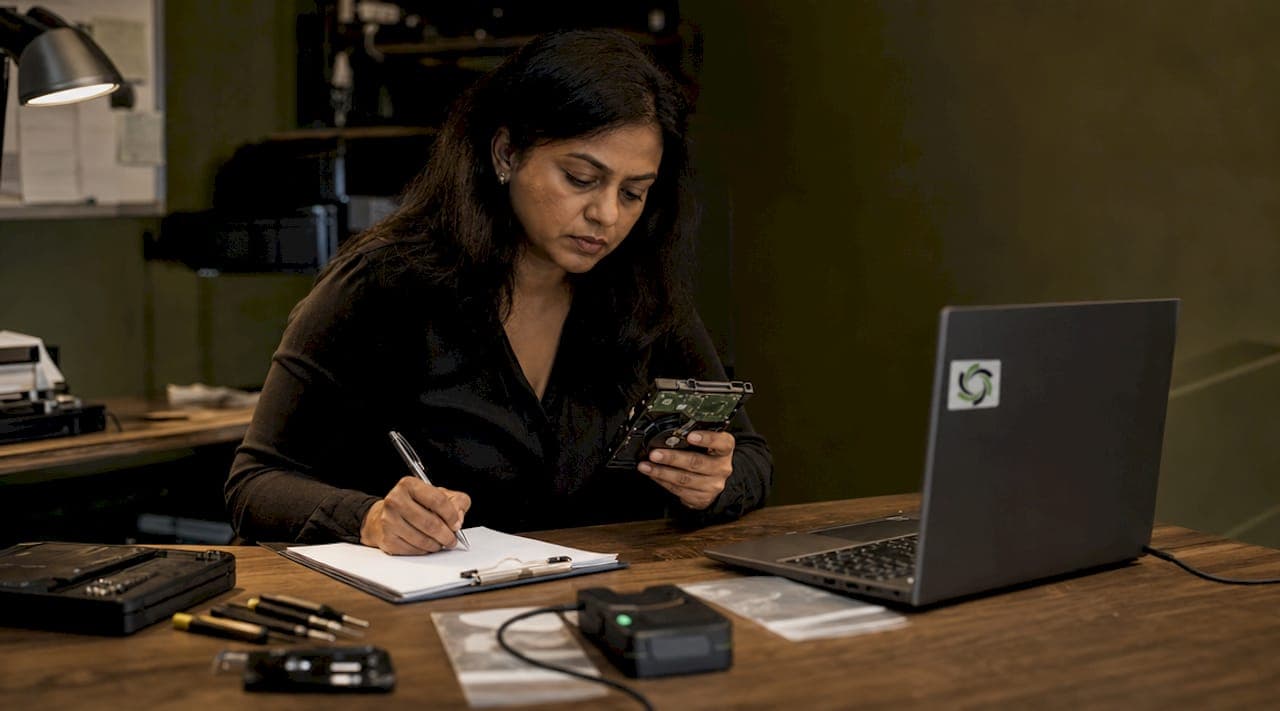
Forensic investigation in cybersecurity is defined as the methodical process of identifying, collecting, analyzing, and preserving digital evidence to reconstruct cyber incidents and produce legally defensible findings. Known formally as digital forensics, this discipline sits at the intersection of technical investigation and legal accountability. Tools like EnCase, FTK (Forensic Toolkit), and hash calculators using SHA-256 are standard instruments in any serious investigation. Whether you are a business owner trying to understand what happens after a breach or a security professional building investigation workflows, understanding digital forensics gives you the foundation to respond to incidents with precision and confidence.
What is forensic investigation in cybersecurity?
Forensic investigation in cybersecurity follows a structured sequence of phases. Each phase builds on the last, and skipping or rushing any one of them can compromise the entire investigation. Here is how a proper investigation proceeds:
-
Identification. The investigator scopes the environment, maps potential evidence sources, and prioritizes volatile data. RAM contents, active network connections, and running processes disappear the moment a system is powered down, so these are captured first. This phase also involves confirming legal authority to access the systems in question.
-
Collection and preservation. Forensic copies are made using write blockers, which prevent any modification to the original media. Cryptographic hashes like SHA-256 are computed immediately after acquisition and verified at every subsequent stage. Chain of custody documentation tracks who handled the evidence, when, and under what conditions.
-
Examination and analysis. Investigators use specialized tools to parse file systems, recover deleted data, correlate logs, and build attack timelines. This is where the story of the incident takes shape. Malware samples may be detonated in sandbox environments like Cuckoo Sandbox or analyzed through reverse engineering to understand attacker capabilities.
-
Reporting. Forensic reports summarize evidence, methods, findings, and recommendations in language that works for both technical teams and legal counsel. In litigation scenarios, these reports may support court testimony.
Remote and cloud-based investigations add real complexity to this process. Cloud providers control the infrastructure, which means investigators must submit preservation requests or litigation holds to prevent data from being overwritten. Timestamp discrepancies across cloud logs are common and must be explicitly documented to avoid drawing inaccurate conclusions.
Pro Tip: Before any collection begins, document your investigation aims in writing. SWGDE notes that investigation goals must drive forensic focus to prevent bias and avoid overlooking relevant evidence, especially in remote collection scenarios.
How does forensic investigation differ from incident response?
Many organizations treat incident response and forensic investigation as the same thing. They are not, and confusing the two leads to poor resource allocation and, in serious cases, inadmissible evidence.
Here is where the two disciplines diverge:
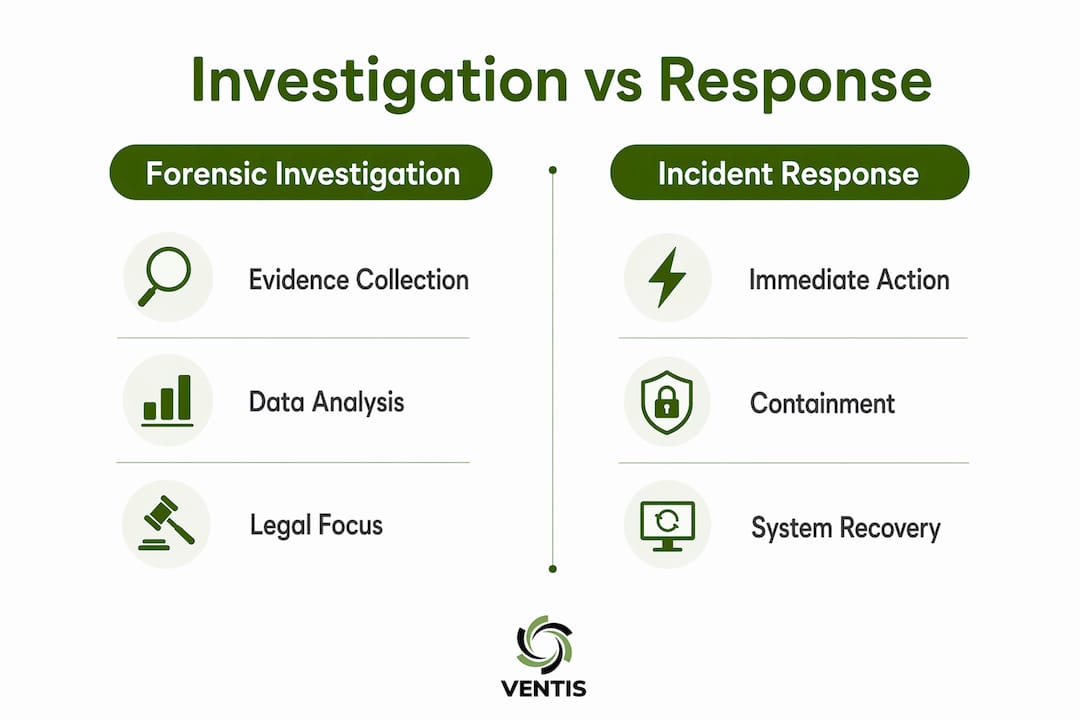
- Incident response focuses on immediate containment and recovery. The goal is to stop the bleeding: isolate affected systems, block attacker access, and restore operations as quickly as possible.
- Forensic investigation performs a deeper, methodical examination after containment. It answers the questions incident response does not have time for: What exactly happened? How did the attacker get in? What data was accessed or exfiltrated?
- Evidence integrity is the defining priority in forensics. Every action is documented, every copy is hashed, and legal admissibility is always in view. Incident response prioritizes operational continuity, which can sometimes conflict with strict evidence preservation.
- Forensics provides real-time intelligence during active incidents too, but its primary value is post-incident analysis for future prevention and potential prosecution.
- Collaboration between the two is standard practice. Incident responders flag evidence sources for forensic teams, and forensic findings inform containment decisions. The two functions work in parallel, not in sequence.
Understanding this distinction matters practically. If your team treats every breach as a pure incident response exercise, you may restore systems before forensic images are captured, permanently destroying evidence. Organizations that integrate both functions from the start protect their legal position and their security posture simultaneously. A solid cybersecurity assessment checklist helps you identify where these gaps exist before an incident forces the question.
What cybersecurity forensic techniques and tools are used?
The technical toolkit for digital forensics spans imaging, analysis, and verification. Here is a comparison of the core technique categories and the tools associated with each:

| Technique | Purpose | Example Tools |
|---|---|---|
| Write-blocked imaging | Creates exact forensic copies without altering source media | EnCase, FTK Imager, dd |
| Cryptographic hashing | Verifies evidence integrity at acquisition and throughout analysis | SHA-256 calculators, md5sum |
| Timeline analysis | Reconstructs attacker activity chronologically | Autopsy, Plaso, log2timeline |
| Malware sandboxing | Executes suspicious files in isolated environments to observe behavior | Cuckoo Sandbox, Any.run |
| Log correlation | Aggregates and cross-references logs from multiple sources | Splunk, Elastic SIEM |
| Cloud evidence acquisition | Preserves cloud data via provider requests or API-based collection | AWS CloudTrail exports, Azure Monitor |
Combining physical, network, and cloud forensic tools is the standard for any investigation that spans modern hybrid environments. An attacker who moves laterally from an on-premises endpoint to a cloud storage bucket leaves evidence in both places, and missing either source produces an incomplete picture.
Remote collection introduces a specific risk that many teams underestimate. Verifying the scope of acquired data is a common oversight. Investigators must review tool output carefully and document what was and was not captured to avoid wasted analysis effort on incomplete evidence sets.
Pro Tip: Always compute and record NIST-approved cryptographic hashes immediately after remote collection. Verification after the fact cannot fully compensate for gaps created during acquisition, and courts treat acquisition integrity as the foundation of admissibility.
Why does evidence integrity determine the outcome of forensic investigations?
Evidence integrity is not a procedural formality. It is the factor that determines whether your findings hold up in court, satisfy regulators, or get thrown out entirely. Poor acquisition practices compromise admissibility in ways that no amount of post-acquisition verification can repair.
The key standards and practices that protect evidence integrity include:
- Chain of custody documentation. Every person who accesses evidence must be logged, along with the time, location, and purpose of access. A break in this chain gives opposing counsel grounds to challenge the evidence.
- SHA-256 hashing at every stage. Hash values computed at acquisition must match those computed during analysis and again at reporting. Any mismatch signals potential tampering or corruption.
- Legal authority before collection. Investigators must confirm authorization before accessing any system, particularly for remote endpoints and cloud environments. Unauthorized access, even with good intentions, can render evidence inadmissible and expose the organization to liability.
- SWGDE guidelines as a baseline. The Scientific Working Group on Digital Evidence publishes standards that define acceptable forensic practice. Following these guidelines creates a documented, defensible methodology.
- Litigation holds for cloud data. Cloud providers routinely delete or overwrite data on standard retention schedules. A litigation hold freezes that data legally and technically, preserving it for investigation.
"Forensic admissibility begins at acquisition. Write protection and detailed documentation at this stage are critical, since later analysis phases cannot fully remedy acquisition weaknesses." — SWGDE Best Practices for Computer Forensic Examinations
For small and mid-sized businesses, the implications are direct. If you experience a breach and later pursue legal action or face regulatory scrutiny, your ability to produce defensible evidence depends entirely on how your team handled the first hours of the investigation. Reviewing your cybersecurity compliance practices before an incident is far less costly than discovering gaps during litigation.
Key takeaways
Forensic investigation in cybersecurity requires disciplined evidence handling from the first moment of acquisition through final reporting, because integrity failures at any stage can invalidate the entire investigation.
| Point | Details |
|---|---|
| Definition is precise | Digital forensics identifies, collects, analyzes, and preserves evidence to reconstruct incidents and support legal action. |
| Four phases structure every investigation | Identification, collection, examination, and reporting each serve a distinct purpose and must be completed in order. |
| Forensics and incident response are separate disciplines | Incident response contains the threat; forensics determines what happened and builds the evidentiary record. |
| Tools span physical, network, and cloud environments | EnCase, FTK, Splunk, and cloud-native logs must be combined for complete coverage in hybrid environments. |
| Evidence integrity starts at acquisition | SHA-256 hashing, write blockers, and chain of custody documentation cannot be retrofitted after poor initial handling. |
What I've learned from watching forensic investigations go wrong
I have seen organizations invest in solid incident response programs and still lose legal cases or fail regulatory audits because their forensic practices were an afterthought. The pattern is almost always the same. A breach happens, the IT team jumps into recovery mode, systems get wiped and rebuilt, and three weeks later someone asks for the forensic evidence. There is none.
The uncomfortable truth is that forensic readiness has to be built before an incident, not assembled during one. That means having forensic imaging tools deployed, knowing which systems hold volatile data, and having documented procedures that your team can execute under pressure. Complex, defensible investigations require expert training and high standards. Average IT staff can handle basic triage, but the moment legal admissibility enters the picture, you need someone who understands chain of custody as well as they understand file systems.
Cloud environments make this harder. I have watched investigators spend days reconciling timestamp discrepancies across AWS CloudTrail logs and endpoint telemetry, only to discover that the cloud timestamps reflected sync events rather than the actual attacker actions. SWGDE calls this "time semantics drift," and it is a real problem that requires explicit documentation throughout the investigation. The executive cybersecurity workflow frameworks I find most useful are the ones that treat forensic readiness as a standing operational requirement, not a post-breach scramble.
My advice for any organization: integrate forensic capability into your cybersecurity strategy now. Know your evidence sources, test your collection tools, and make sure someone on your team or your managed IT partner understands what legally defensible evidence actually looks like.
— Greg
How Ventisconsulting supports your cybersecurity investigation readiness
If this article made you realize your organization is not prepared for a forensic investigation, you are not alone. Most small and mid-sized businesses in Pittsburgh and surrounding areas have solid day-to-day IT support but no formal plan for evidence preservation or incident investigation.

Ventisconsulting works directly with businesses like yours to build cybersecurity programs that include forensic readiness, not just perimeter defense. From network monitoring and cloud security to incident documentation and regulatory compliance support, the team at Ventisconsulting provides the hands-on guidance that makes a real difference when something goes wrong. Explore the full range of managed IT and security solutions available, or visit Ventisconsulting to start a conversation about your specific needs.
FAQ
What is the main goal of forensic investigation in cybersecurity?
The main goal is to identify, collect, analyze, and preserve digital evidence to reconstruct a cyber incident accurately and produce findings that are legally defensible. This supports both internal security improvements and external legal or regulatory proceedings.
How does chain of custody work in digital forensics?
Chain of custody is a documented record of every person who accesses evidence, including when, where, and why. Any break in this record gives opposing parties grounds to challenge the admissibility of the evidence in legal proceedings.
What tools are commonly used in cybersecurity forensic investigations?
Investigators rely on tools like EnCase and FTK for forensic imaging, Autopsy and Plaso for timeline analysis, Cuckoo Sandbox for malware analysis, and Splunk or Elastic SIEM for log correlation. Cloud investigations also use provider-native tools like AWS CloudTrail.
Why is SHA-256 hashing used in forensic investigations?
SHA-256 generates a unique fingerprint for a dataset that changes if even a single bit is altered. Investigators compute this hash at acquisition and verify it at each subsequent stage to prove that evidence has not been modified or corrupted.
Can a small business conduct its own forensic investigation?
Basic triage is possible for trained IT staff, but legally defensible forensic investigations require specialized expertise and strict procedural adherence. For most small businesses, partnering with a managed IT provider that includes forensic readiness in its services is the practical path forward.