

If you're looking for fullservicenetwork.com alternatives, the strongest options for U.S. small and mid-sized businesses combine managed network infrastructure, local support, and predictable monthly pricing. The table below gives you a fast read on how the leading alternatives stack up before you dig into the details.
| Provider Type | Service Features | Support Availability | Pricing Model | Scalability | Technology Offerings |
|---|---|---|---|---|---|
| Managed NaaS provider | Internet, cloud, SaaS, private transport, office-to-office | 24/7 U.S.-based team, one support contact | Monthly subscription, one invoice | Multi-site, add services as you grow | Network as a Service, cloud interconnects, SD-WAN |
| Regional carrier | Local phone, internet, IT support | Live, local, on-site installation | All-inclusive monthly rate | Limited to service footprint | VoIP, business phone systems |
| National managed network | SD-WAN, LAN, secure gateway, WAN | Tiered enterprise support | Enterprise contract | Large-scale, multi-location | SD-WAN, managed LAN, AI-assisted management |
| Local MSP + telecom partner | Managed IT, cybersecurity, unified communications | On-site, consultative, personalized | Flexible, project or monthly | SMB-focused, grows with you | Managed IT, cloud, cybersecurity, NaaS |
Full Service Network has served the Pennsylvania, Ohio, and West Virginia tri-state area for over 33 years, offering phone, internet, and IT support under one all-inclusive monthly rate. That model works for many businesses. But if your needs have grown beyond that footprint, or you want deeper IT integration and cybersecurity alongside your connectivity, there are credible alternatives worth evaluating.
Table of Contents
- What do fullservicenetwork.com alternatives actually offer?
- How do these alternatives compare on the features that matter most?
- How do you choose the right business telecom provider?
- Ventis Consulting Group brings local expertise to your telecom decision
- Key Takeaways
What do fullservicenetwork.com alternatives actually offer?
The core difference between Full Service Network and the leading alternatives comes down to scope and integration. Full Service Network operates as a facility-based carrier focused on phone and internet within its tri-state region. The alternatives below serve a broader geographic footprint and often bundle managed IT, cloud connectivity, and cybersecurity into the same relationship.

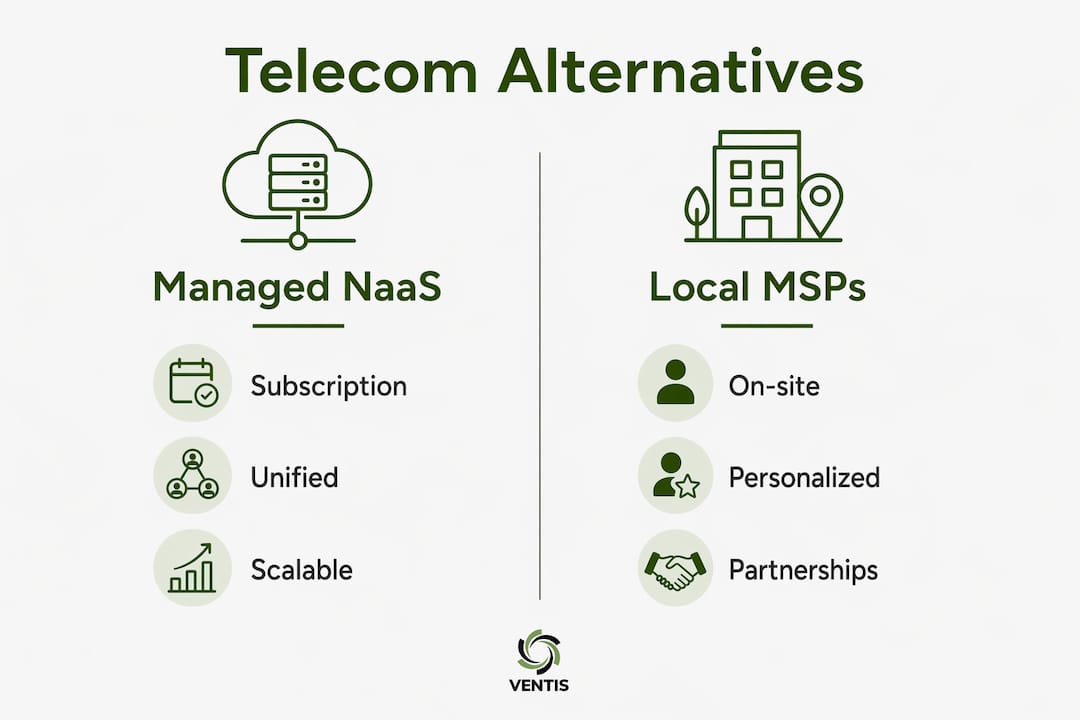
Managed NaaS providers deliver your entire network as a subscription. Network as a Service eliminates capital expenditure entirely: hardware, deployment, maintenance, and upgrades are all included in a single monthly cost. Growing businesses and multi-site operations benefit most because adding a new location doesn't require a capital approval cycle. The provider handles the infrastructure; you get the outcome.
Unified managed network solutions take this further by consolidating multiple carriers, contracts, support teams, and invoices into one managed solution. One provider, one invoice, one support team, and 24/7 monitoring. For a business currently juggling separate internet, phone, and cloud vendors, that consolidation alone can reduce both cost and operational friction.
National enterprise carriers offer managed SD-WAN, managed LAN, and secure gateway services at scale. These platforms suit larger organizations with complex, multi-location networks, though they typically come with enterprise-level contracts and less personalized support than a regional or local provider.
Local MSPs with telecom partnerships sit in a different category. As the research notes, MSPs manage IT environments using network connectivity but are distinct from traditional carriers who provide the connectivity pipe. A strong local MSP can complement your telecom provider or, in some cases, replace the need for a separate carrier relationship entirely through partner agreements.
How NaaS changes the cost equation
Traditional telecom contracts often hide costs in last-mile circuit procurement, hardware refresh cycles, and fragmented vendor billing. Offloading last-mile circuit ownership through a NaaS model removes those hidden operational costs and simplifies vendor management. You pay one predictable monthly fee; the provider absorbs the complexity.
How do these alternatives compare on the features that matter most?
| Evaluation Dimension | Regional carrier model | Managed NaaS model | Local MSP + telecom |
|---|---|---|---|
| Call quality | VoIP, business-grade | Carrier-grade, redundant | Depends on carrier partner |
| Cloud integration | Limited | Native (SaaS, cloud connect) | Strong via managed IT layer |
| Support model | Live, local, on-site | 24/7 U.S. team, remote-first | On-site, consultative |
| Pricing transparency | All-inclusive monthly | Single subscription | Project or monthly, flexible |
| Scalability | Regional footprint | Multi-site, national | SMB-focused, grows with you |
| Migration support | Professional installation | Provisioning through support | On-site training included |
Local providers distinguish themselves through live, on-site support and personalized service, which directly reduces downtime for SMEs. A national NaaS provider offers broader coverage and deeper technology integration but may route support through a remote team. Neither model is universally better. The right answer depends on where your offices are, how complex your cloud dependencies are, and how much internal IT capacity you have.
One point worth flagging: consolidating connectivity services into a single managed solution reduces points of failure and simplifies management. Businesses that currently manage separate internet, phone, and cloud contracts often find that the operational savings from consolidation outweigh any premium on the monthly rate.
How do you choose the right business telecom provider?
Start by mapping your current traffic. Before you evaluate any provider, document what your network actually carries: SaaS applications, cloud platforms, inter-office traffic, and video conferencing loads. Mapping current traffic patterns before switching providers is the single most effective way to avoid a mismatch between what you buy and what you actually need.
Key selection criteria:
- Support responsiveness: Can the provider reach your office in person, or is all support remote? For businesses with limited internal IT staff, on-site support is often the deciding factor.
- Technology alignment: Does the provider's stack match your current and planned cloud environment?
- Pricing transparency: All-inclusive monthly rates are easier to budget than itemized carrier contracts with variable fees.
- Contract flexibility: Month-to-month or short-term agreements reduce risk when you're transitioning from an existing provider.
- Migration support: Professional installation and on-site staff training reduce migration risk. Many businesses underestimate internal cabling and hardware configuration complexity.
- Scalability: If you plan to open additional locations, confirm the provider can serve those markets before you sign.
- Reputation: Client ratings and third-party assessments give you a baseline read on service quality before you commit.
Pro Tip: Before you contact any provider, write down your three biggest pain points with your current setup. Whether it's billing complexity, downtime, or lack of local support, those pain points should drive every question you ask during the evaluation.
Choosing between a managed IT provider and a traditional carrier is not always an either/or decision. Some businesses need both: a carrier for the connectivity pipe and an MSP to manage the IT environment on top of it. Understanding that distinction upfront saves you from buying the wrong type of service.
Ventis Consulting Group brings local expertise to your telecom decision
Pittsburgh-area businesses looking for a trusted alternative to Full Service Network have a strong local option in Ventis Consulting Group. Rather than selling you a one-size-fits-all connectivity package, Ventis takes a consultative approach: they assess your current IT environment, identify gaps, and recommend unified communications solutions that fit your actual workflow, not a generic template.

Ventis Consulting Group holds a 5-star client satisfaction rating, earned through managed IT services, cloud solutions, cybersecurity assessments, and competitive technology pricing. Their team handles professional installation, ongoing maintenance, and staff training, so your people are confident with the new setup from day one. For SMBs in Pittsburgh and surrounding areas, that combination of local presence and full IT integration is difficult to match from a national carrier alone. Ready to see what the right telecom setup looks like for your business? Contact Ventis Consulting Group to start the conversation.
Key Takeaways
Ventis Consulting Group is the strongest local alternative to Full Service Network for Pittsburgh-area SMBs, combining managed IT, cybersecurity, and unified communications under one consultative relationship.
| Point | Details |
|---|---|
| Map traffic before switching | Document SaaS, cloud, and inter-office loads before evaluating any provider to avoid a capability mismatch. |
| NaaS eliminates capital costs | A managed network subscription includes hardware, maintenance, and upgrades in one predictable monthly fee. |
| Consolidation reduces complexity | Combining carriers, invoices, and support into one managed solution lowers points of failure and management burden. |
| On-site support matters for SMBs | Local providers with on-site installation and staff training reduce migration risk and downtime. |
| Ventis Consulting Group | A 5-star rated local MSP offering managed IT, cybersecurity, and unified communications for Pittsburgh-area businesses. |