

Outsourced IT support, formally known as managed IT services, is defined as a third-party provider taking full or partial responsibility for a business's technology operations. The choice between IT support vs in-house staff is one of the most consequential decisions a small or mid-sized business owner makes. Get it wrong and you either overpay for talent you underuse or leave your business exposed to gaps in coverage and expertise. The right answer depends on your headcount, budget, risk tolerance, and how fast you plan to grow.
What are the real cost differences between IT support and in-house staff?
The numbers here are not close. A full-time in-house IT employee costs $100,000–$135,000 annually, while a managed IT service provider (MSP) typically costs $27,000–$36,000 per year for businesses under 30 employees. That gap represents a 3x to 4x cost difference before you account for hidden expenses.
Hidden costs push the in-house number even higher. Recruitment alone can take months, and onboarding, benefits, software licensing, and ongoing training add significantly beyond base salary. A senior IT hire is rarely just a salary line item. By the time you factor in health insurance, paid time off, and hardware, the real annual cost climbs well past the base figure.
MSP pricing structures give small businesses real flexibility. Managed IT pricing generally falls into three models:
- Per-user pricing: $75–$150 per user per month
- Per-device pricing: $25–$100 per device per month
- Fixed-fee contracts: $1,200–$3,500 per month
Each model lets you match spending to your actual usage. A 15-person office paying $100 per user per month spends $18,000 per year on IT support. That same business hiring one full-time IT employee would spend three to four times that amount.
| Cost Factor | In-House IT Staff | Outsourced IT (MSP) |
|---|---|---|
| Annual base cost | $100,000–$135,000 | $27,000–$36,000 |
| Benefits and overhead | $20,000–$35,000 | Included in contract |
| Recruitment and onboarding | $5,000–$15,000 | Minimal setup fee |
| Training and certifications | $2,000–$5,000/year | Included in contract |
| Coverage hours | Business hours only | 24/7 available |
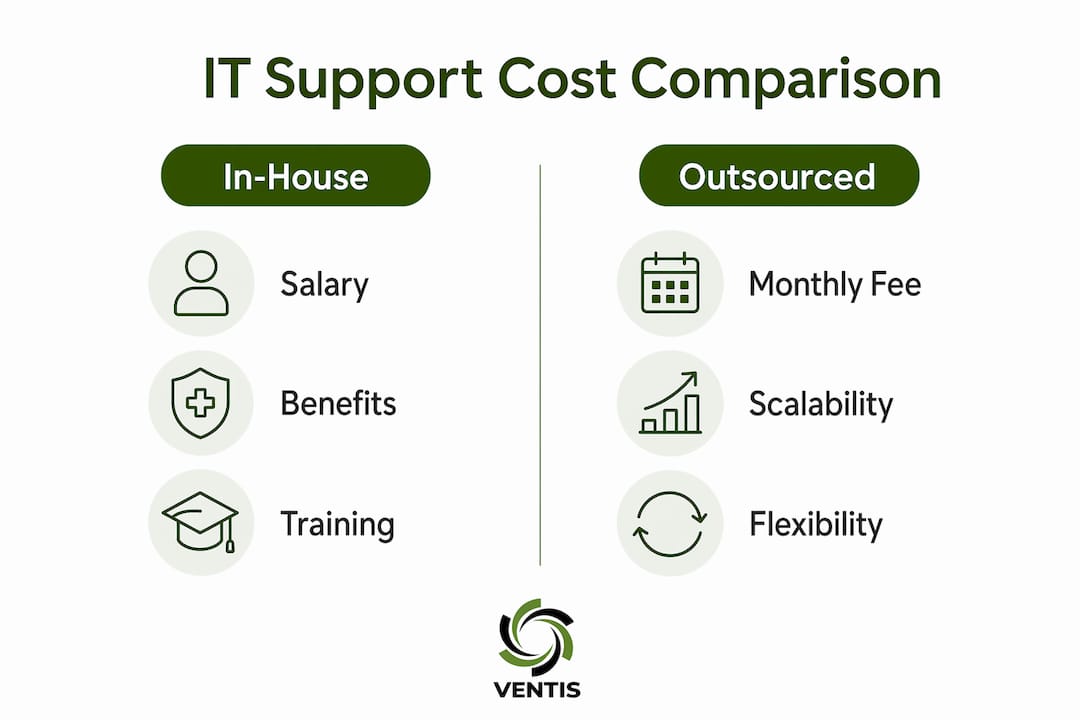
The table makes one thing clear. For businesses under 30 employees, outsourced IT support is the more cost-effective IT solution in almost every scenario.
How do expertise and coverage differ between in-house and outsourced IT?
One person cannot realistically cover every specialized IT discipline. In-house IT staff brings deeper organizational context and cultural integration, but faces real coverage limitations. A single employee cannot be an expert in networking, cybersecurity, cloud infrastructure, and end-user support simultaneously.

MSP teams solve this by distributing work across specialists. When your business needs a firewall audit, a cloud migration, and a help desk ticket resolved on the same day, an MSP routes each task to the right person. One in-house hire handles all three tasks sequentially, if they have the skills at all.
Coverage hours are another concrete difference. Most in-house IT staff work standard business hours. MSPs offer 24/7 monitoring and support, which matters when a server goes down at 11 p.m. on a Friday. For businesses running any kind of e-commerce, remote workforce, or time-sensitive operations, after-hours coverage is not optional.
Remote support efficiency also favors the outsourced model. At least 90% of routine IT tasks are resolved remotely, faster than on-site interventions. Password resets, software installations, and configuration changes rarely require someone to be physically present.
That said, in-house staff does have a real advantage in specific situations:
- Physical hardware repairs and on-site equipment setup
- Immediate, face-to-face support for non-technical staff
- Deep familiarity with internal systems built over years
- Faster response to office-specific issues like printer failures or network drops
Pro Tip: If your team frequently needs hands-on support for hardware or specialized equipment, consider whether a hybrid model gives you the best of both worlds before committing to a fully outsourced arrangement.
What are the risk and continuity implications of each model?
Operating with one or two internal IT employees concentrates risk in a way most business owners underestimate. If that person resigns, gets sick, or takes vacation, your entire IT function is either paused or dependent on whoever is available. That is a single point of failure with real operational consequences.
MSPs distribute risk across a team with documented, repeatable processes. No single person's absence disrupts service delivery. Tickets get picked up, monitoring continues, and escalations follow a defined path regardless of who is on shift.
Knowledge retention is a related problem. When an in-house IT employee leaves, they take institutional knowledge with them. Passwords, network diagrams, vendor contacts, and undocumented workarounds often exist only in one person's head. A well-run MSP documents everything, so that knowledge stays with your business.
"True IT control in a business environment stems from comprehensive documentation, SLAs, and process visibility, not from having IT staff physically onsite." — Managed IT Services Company vs Internal IT
Many business owners resist outsourcing because they want IT support in the building. That instinct is understandable but often misplaced. Control over IT operations is more accurately maintained through documented processes and service level agreements (SLAs) than through physical proximity. A well-structured SLA defines response times, escalation paths, and accountability in writing.
Pro Tip: Before signing any MSP contract, request a sample SLA and verify it includes defined response times for critical, high, and low-priority issues. Vague language in an SLA is a red flag.
When should you hire in-house IT staff, outsource, or use a hybrid model?
Company size is the most reliable starting point for this decision. Small businesses benefit most from fully outsourced IT support when under 30 employees, and progressively consider hybrid models as they grow. The logic is straightforward. Under 30 employees, the volume of IT work rarely justifies a full-time salary.
The hiring timeline reinforces this. Hiring internal IT staff typically takes 14 to 32 weeks, while engaging an MSP takes only 1 to 3 weeks. If your business needs IT support now, waiting seven months for a hire to come onboard is not a realistic option.
Here is a practical framework based on company size and IT complexity:
| Company Size | Recommended Model | Reasoning |
|---|---|---|
| Under 25 employees | Fully outsourced IT (MSP) | Cost savings are significant; IT volume is low |
| 25–75 employees | Outsourced IT with optional co-management | Growing complexity; MSP covers gaps |
| 75–150 employees | Hybrid or co-managed IT | Internal staff handles strategy; MSP covers routine tasks |
| 150+ employees | In-house IT team with MSP support | Volume and complexity justify full-time staff |
Compliance requirements add another layer to this decision. Businesses in healthcare, finance, or legal services face regulatory frameworks like HIPAA or PCI-DSS. MSPs with compliance specializations often handle these requirements more reliably than a generalist in-house hire. You can review a practical IT support checklist to assess where your current setup stands.
The co-managed IT model combines in-house focus on strategic projects with outsourced support for routine tasks and 24/7 coverage. This approach reduces staff burnout and fills expertise gaps without requiring a full team of internal hires. For businesses in the 75–150 employee range, it is often the most practical path forward.
Key factors to weigh when making your decision:
- Growth trajectory: Are you adding 10+ employees per year? Your IT needs will outpace a single hire quickly.
- IT complexity: Do you run cloud infrastructure, custom software, or remote teams? Complexity favors MSP depth.
- Compliance obligations: Industry regulations often require specialized knowledge that one generalist cannot cover.
- Budget predictability: Fixed MSP fees make budgeting easier than variable in-house costs.
For a deeper look at what small businesses need from IT in 2026, the operational and security stakes have never been higher.
Key Takeaways
For most small to mid-sized businesses, outsourced managed IT services deliver more coverage, broader expertise, and lower total cost than a single in-house hire, especially below 75 employees.
| Point | Details |
|---|---|
| Cost gap is significant | In-house IT costs $100,000–$135,000 annually versus $27,000–$36,000 for an MSP. |
| Coverage favors MSPs | MSPs provide 24/7 monitoring; in-house staff typically covers business hours only. |
| Risk concentration is real | One internal IT employee creates a single point of failure that MSP teams eliminate. |
| Hiring takes too long | In-house IT recruitment takes 14–32 weeks; an MSP can be operational in 1–3 weeks. |
| Hybrid models fit mid-size businesses | Co-managed IT lets internal staff focus on strategy while MSPs handle routine support. |
What I've learned from watching businesses make this call
I've seen business owners make this decision both ways, and the pattern is consistent. The ones who hire in-house too early almost always do it for the wrong reason. They want someone they can see. They equate physical presence with control, and that instinct costs them real money.
The businesses that thrive are the ones that treat IT like any other operational function. You don't hire a full-time accountant when a CPA firm handles your books more efficiently at a fraction of the cost. The same logic applies here. Under 50 employees, a well-chosen MSP almost always outperforms a single in-house hire on coverage, depth, and cost.
Where I think the conventional wisdom gets it wrong is on the hybrid model. Most articles treat it as a compromise. I see it as the most deliberate choice available. When a business reaches 75 to 100 employees, having one internal IT person focused on strategic projects while an MSP handles the daily volume is not a half-measure. It is the right structure for that stage of growth.
The one thing I'd push back on is the idea that outsourcing means losing control. Control comes from your SLA, your documentation, and your escalation process. A good MSP gives you more visibility into your IT environment than most in-house hires ever will. Ask for monthly reporting, defined response times, and a named account manager. If a provider won't commit to those basics, keep looking.
— Greg
How Ventis Consulting Group supports your IT decisions
Ventis Consulting Group works with small to mid-sized businesses across Pittsburgh and surrounding areas to provide managed IT services built around predictable pricing, broad expertise, and continuous coverage. Whether you are evaluating your first outsourced IT arrangement or looking to move from a single in-house hire to a more resilient model, Ventis Consulting Group offers a consultative approach that starts with your actual business needs.
Ventis Consulting Group's team covers managed IT, cybersecurity assessments, cloud solutions, and network support under one relationship. You get the depth of a full IT department without the overhead of building one internally. With a 5-star service rating and a focus on practical guidance over generic solutions, Ventis Consulting Group is worth a conversation before you make your next IT hire. Reach out today to discuss what the right model looks like for your business.
FAQ
What is the average cost of in-house IT staff vs an MSP?
A full-time in-house IT employee costs $100,000–$135,000 per year, while a managed IT service provider typically costs $27,000–$36,000 annually for businesses under 30 employees. The total cost gap widens further when you include benefits, recruitment, and training.
How quickly can a business get IT support from an MSP?
An MSP can be operational in 1–3 weeks, compared to 14–32 weeks for a full in-house IT hire. That speed advantage matters significantly when your business has an immediate technology need.
What is a co-managed IT model?
A co-managed IT model combines an internal IT employee focused on strategic projects with an MSP handling routine support and 24/7 monitoring. It works best for businesses with 75–150 employees that need both depth and daily coverage.
Does outsourcing IT mean losing control over your systems?
No. Control over IT operations comes from documented processes, defined SLAs, and clear escalation paths, not physical proximity to staff. A well-structured MSP agreement provides more process visibility than most in-house arrangements.
When should a small business hire in-house IT staff?
Businesses with more than 100 employees, high IT complexity, or significant compliance obligations are the strongest candidates for in-house IT staff. Below that threshold, outsourced or hybrid IT support options typically deliver better value.