

A secure startup cloud environment is defined as a cloud infrastructure where identity, configuration, and data protection controls are enforced from the first day of deployment. Most founders assume their cloud provider handles security automatically. That assumption is wrong. Cloud providers secure the underlying infrastructure, but you are responsible for everything built on top of it. Misconfigurations, weak access controls, and unencrypted data are startup problems, not provider problems. Ventis Consulting Group works with small and growing businesses every day to close exactly these gaps. The good news: the foundational controls that prevent most breaches cost very little to implement and pay off exponentially over time.
What foundational security practices should startups implement first?
Mastering identity, configuration, and data protection prevents the majority of cloud incidents startups face. These three pillars are not advanced concepts. They are table stakes, and skipping them creates compounding risk that becomes expensive to fix later.
Start with encryption. Every database, storage bucket, and data transfer should use encryption at rest and in transit. This is a one-time configuration that most cloud providers make trivially easy to enable. Next, block public access on all cloud storage by default. A public S3 bucket is not a misconfiguration you discover later. It is a breach waiting to happen.

Enable audit logging across every region from day one. Cloud audit logging like AWS CloudTrail is mandatory for detecting incidents and meeting compliance requirements. Without it, you cannot reconstruct what happened during a breach, and regulators will not accept that excuse.
Secrets management is another non-negotiable. Never store API keys, database passwords, or tokens in source code or environment files committed to version control. Use a dedicated secrets manager and inject credentials at runtime.
| Security Control | What It Does | Why It Matters |
|---|---|---|
| Encryption at rest and in transit | Protects stored and moving data | Prevents data exposure if storage is accessed |
| Public access block on storage | Stops accidental public exposure | Eliminates one of the most common breach vectors |
| Audit logging (all regions) | Records all API and user activity | Required for incident detection and compliance |
| Secrets manager | Stores credentials outside code | Prevents credential theft from repositories |
| Default-deny IAM policies | Blocks all access unless explicitly granted | Stops privilege escalation before it starts |
- Enable MFA on every human account before any other access is granted.
- Block public access at the account level, not just per bucket.
- Rotate any credentials that were ever stored in plaintext immediately.
- Set billing alerts to catch unexpected usage spikes from cryptomining attacks.
Pro Tip: Set a cloud budget alert at 110% of your expected monthly spend. Cryptomining attacks show up as sudden compute cost spikes, and an alert catches them within hours instead of weeks.
How do startups effectively manage identity and access?
Identity is the front door to your entire cloud environment. Over-privileged IAM roles appear in 89% of audited startup environments. That statistic means nearly every startup gives users and services more access than they need. An attacker who compromises one over-privileged account can move laterally across your entire infrastructure.
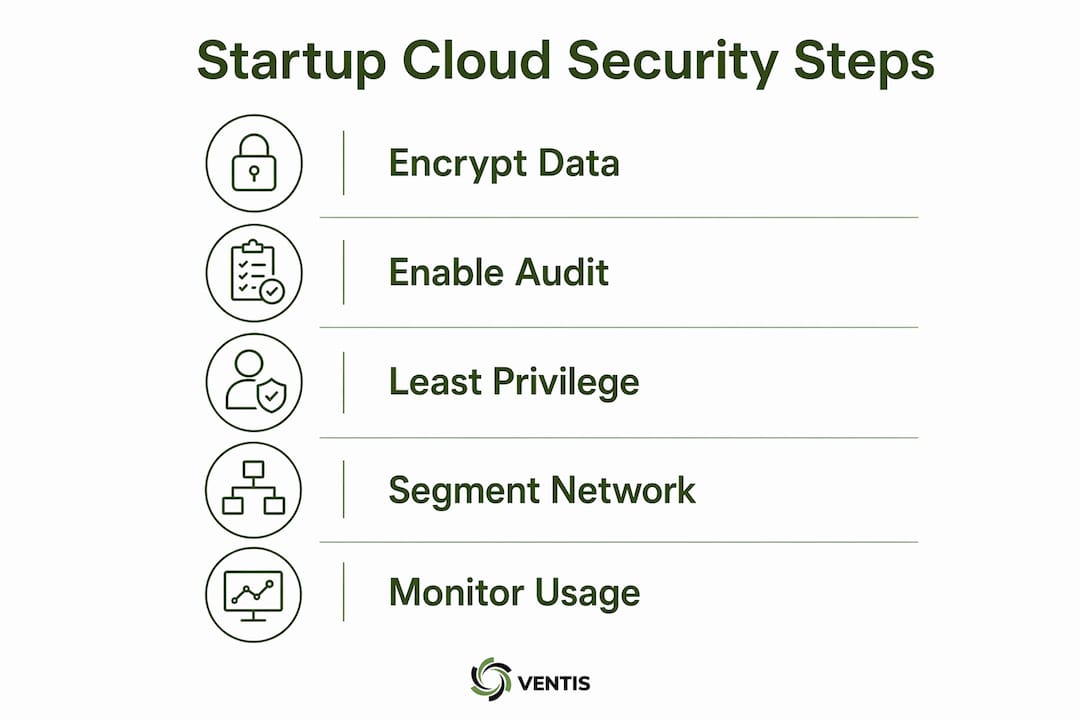
The fix starts with least-privilege access. Every user, service, and application should have only the permissions required for its specific function. Nothing more. Enforce this at account creation using deny-by-default IAM policies and Service Control Policies (SCPs). Fixing permissive permissions after deployment costs far more time and money than setting them correctly from the start.
Centralize identity with Single Sign-On (SSO) and enforce phishing-resistant MFA on all human accounts. FIDO2 security keys and passkeys are the current standard. SMS-based MFA is now considered bypassable and should not be used for any account with cloud access.
For machine-to-machine access, eliminate long-lived credentials entirely. Workload identity federation and short-lived tokens injected at runtime remove the risk of static keys being stolen from code repositories or CI/CD pipelines. This is one of the highest-impact changes a startup can make with minimal operational overhead.
- Use SSO to centralize all human identity management.
- Enforce FIDO2 or passkey MFA on every account with cloud console access.
- Replace IAM access keys in CI/CD pipelines with workload identity federation.
- Conduct quarterly access reviews and remove unused roles immediately.
- Never share credentials between team members, even temporarily.
Pro Tip: Implement conditional access policies that require re-authentication when a user's location or device changes. This stops session hijacking attacks that bypass MFA entirely.
What cloud configuration steps reduce your attack surface?
Configuration errors are the leading cause of cloud breaches, and they are entirely preventable. 43% of audited startups had security groups with unrestricted inbound access, meaning attackers could reach internal services directly from the internet. That is not a sophisticated attack. It is an open door.
Use Cloud Security Posture Management (CSPM) tools to scan your environment continuously against benchmarks like the CIS Controls. These tools flag misconfigurations automatically and prioritize them by risk level. Running a posture scan once at launch is not enough. Your configuration drifts every time a developer deploys a new resource.
Network segmentation is equally critical. Place databases and internal services in private subnets with no direct internet access. Use jump hosts or bastion servers for administrative access. Open only the ports your application actually requires, and close everything else by default. Never use the default VPC for production workloads, and never use the root account for daily operations.
| Misconfiguration | Risk Level | Remediation |
|---|---|---|
| Public S3 bucket | Critical | Enable account-level public access block |
| Open security group (0.0.0.0/0) | High | Restrict to required ports and source IPs |
| Unencrypted production database | High | Enable encryption and rotate exposed data |
| Root account used for daily work | High | Create IAM users; disable root access keys |
| No audit logging enabled | Medium | Enable CloudTrail or equivalent in all regions |
Pro Tip: Set a billing alert at account creation. Cryptomining attacks often start within hours of a credential leak, and a cost spike is frequently the first detectable signal.
How can startups plan and scale their security programs?
Security investments should match your team size and risk profile, not the security budget of an enterprise. Early-stage startups with fewer than 100 employees should focus on cloud and infrastructure security rather than buying enterprise tools they cannot operate or interpret.
A tiered approach works well in practice. Early-stage teams should complete foundational hygiene: SSO, encryption, secrets management, and audit logging. These controls cost almost nothing to implement on major cloud platforms and eliminate the most common attack vectors. Growth-stage companies at Series A should add recurring penetration tests and vulnerability management, which reduce coordination overhead compared to ad-hoc tests and provide consistent coverage as your codebase grows.
Compliance planning should start earlier than most founders expect. Frameworks like SOC 2, ISO 27001, HIPAA, and PCI DSS each require evidence of controls over time, not just at audit time. Building a central evidence repository from day one, tracking access reviews, vendor assessments, and configuration changes, makes your first audit dramatically less painful.
- Foundational hygiene (pre-seed to seed): Enable MFA, SSO, encryption, audit logging, and secrets management.
- Offensive security (Series A): Add recurring penetration testing and a formal vulnerability management program.
- Full monitoring (Series B and beyond): Deploy SIEM, 24/7 alerting, and a dedicated security engineer with cloud and code skills.
- Compliance readiness (ongoing): Map controls to SOC 2 or relevant frameworks and maintain a live evidence repository.
- DevSecOps integration: Embed security checks into CI/CD pipelines so every deployment is scanned before it reaches production.
Pro Tip: Hire your first security engineer for their cloud and code skills, not their compliance knowledge. You can buy compliance consulting. You cannot easily buy someone who can read your Terraform and spot a privilege escalation path.
What common cloud security mistakes should founders avoid?
The most damaging startup cloud security mistakes are not exotic. They are predictable, well-documented, and still widespread. 71% of audited startups had at least one publicly accessible storage bucket, and 56% ran unencrypted production databases. These are not edge cases. They are the norm.
Long-lived credentials stored in code are the second most common problem. A developer commits an AWS access key to a public GitHub repository, and automated scanners find it within minutes. The resulting breach can expose customer data, generate thousands of dollars in compute charges, and trigger regulatory investigations. Eliminating static credentials with workload identity federation closes this vector permanently.
Inadequate logging is the third critical mistake. Without logs, you cannot detect a breach, reconstruct an attack timeline, or satisfy a regulator's incident reporting requirement. Logging is not optional. It is the foundation of every incident response plan.
- Audit all storage buckets for public access settings monthly.
- Scan your code repositories for hardcoded secrets using automated tools before every merge.
- Review IAM roles quarterly and remove any that have not been used in 30 days.
- Enable cloud security best practices checklists as part of your onboarding process for every new developer.
- Test your incident response plan at least once per quarter with a tabletop exercise.
Key Takeaways
A secure startup cloud environment requires enforcing least-privilege identity controls, eliminating misconfigurations from day one, and scaling your security program in step with your company's growth.
| Point | Details |
|---|---|
| Identity is the highest-risk layer | Enforce least-privilege IAM, SSO, and FIDO2 MFA on every human account from day one. |
| Misconfigurations cause most breaches | Public buckets, open security groups, and unencrypted databases are the leading breach vectors in startup environments. |
| Audit logging is non-negotiable | Enable cloud audit logging in all regions before you deploy any production workload. |
| Scale security with your stage | Match your security investments to team size: hygiene first, then pentesting, then full monitoring. |
| Evidence repositories save audit time | Centralizing access reviews and configuration records from the start makes compliance audits far less costly. |
What I've learned from watching startups get this wrong
The pattern I see most often is not ignorance. It is prioritization. Founders know they should set up MFA and restrict IAM roles. They just keep pushing it to next sprint. Then a developer commits a credential to a public repo, or a misconfigured bucket gets indexed, and the scramble begins.
The uncomfortable truth is that security is a business enabler, not a tax on product velocity. The startups that build foundational hygiene into their first infrastructure deployment close enterprise deals faster because they can answer security questionnaires honestly. The ones that skip it spend weeks remediating before a Series A due diligence review.
My practical advice: treat your first cloud account setup like a legal document. Get it right before you build anything on top of it. Deny-by-default IAM, encrypted storage, audit logging, and a secrets manager take one engineer one day to configure correctly. Fixing them after 18 months of product development takes weeks and creates real business risk.
The other thing I would tell every founder: do not wait until you have a security team to act like you care about security. The startup cloud infrastructure security decisions you make in month one follow you through every funding round, every enterprise sales cycle, and every compliance audit. Start right.
— Greg
How Ventis Consulting Group helps startups secure their cloud
Building a secure cloud foundation is straightforward when you know what to configure. Getting there without a dedicated security team is where most startups struggle.
Ventis Consulting Group provides managed IT and cloud security services designed specifically for small and growing businesses. The team handles cloud security assessments, IAM configuration reviews, compliance preparation, and ongoing monitoring so your engineers can focus on building your product. Whether you are setting up your first cloud account or preparing for a SOC 2 audit, Ventis Consulting Group brings the expertise to get it done correctly. Reach out to discuss what your cloud environment needs right now.
FAQ
What is a secure startup cloud environment?
A secure startup cloud environment is a cloud infrastructure where identity access controls, encryption, audit logging, and configuration policies are enforced from initial deployment. It is the founder's responsibility, not the cloud provider's.
What are the most common cloud security mistakes startups make?
The most common mistakes are publicly accessible storage buckets, over-privileged IAM roles, unencrypted production databases, and long-lived credentials stored in code. Audits show these appear in the majority of startup cloud environments.
How does MFA protect startup cloud accounts?
MFA requires a second verification factor beyond a password, blocking most account takeover attempts. FIDO2 security keys and passkeys are the current best practice, as SMS-based MFA is now considered bypassable.
When should a startup start planning for SOC 2 compliance?
Start building your evidence repository from day one. SOC 2 auditors require proof of controls over time, and retroactively gathering that evidence is far more costly than maintaining it continuously from the start.
How do startups eliminate the risk of stolen cloud credentials?
Replace long-lived IAM access keys with workload identity federation and short-lived tokens injected at runtime. This removes static credentials from code and CI/CD pipelines entirely, closing one of the most exploited attack vectors.