
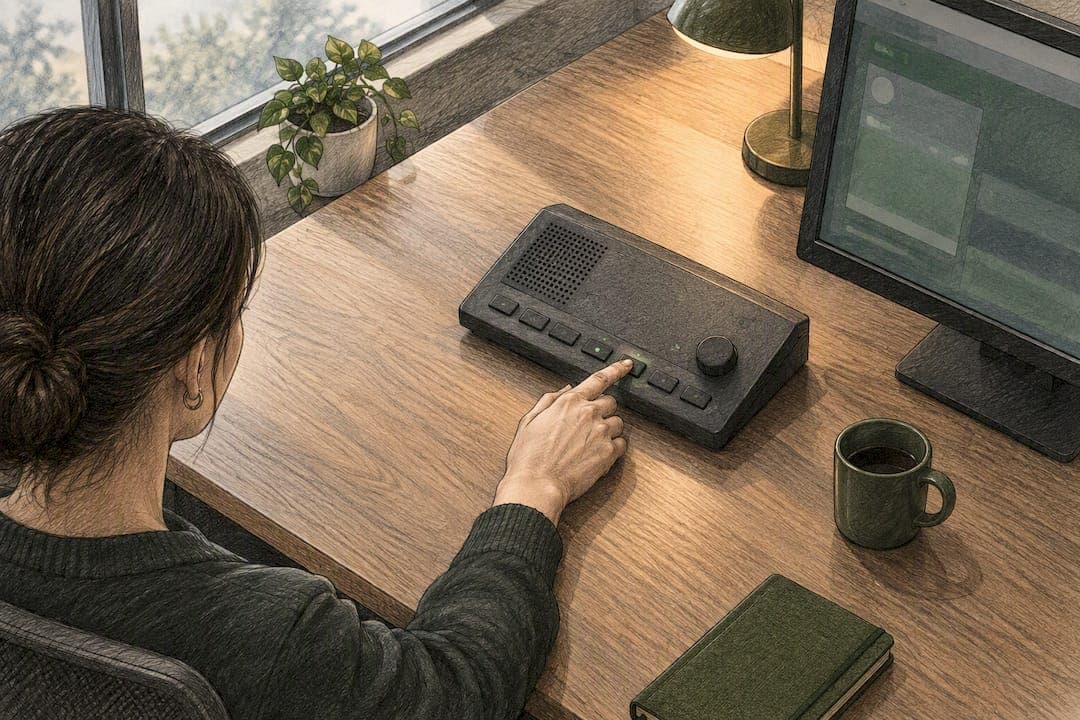
Call recording compliance rests on one federal baseline: under ECPA, only one participant needs to consent to a recorded call. Most companies get in trouble because they don't stop there. State laws are often stricter, and regulated industries pile on extra rules. The safest move, starting today, is automating a clear spoken disclosure before every recording begins, and tightening retention and access controls behind it.
TL;DR:
- Recording calls without proper disclosure can lead to civil or criminal liability in all-party consent states, even if federal law only requires one-party consent.
- Automating a clear disclosure and documenting consent before each recording effectively manages interstate compliance risks at minimal cost.
- Most compliance failures stem from gaps in system enforcement, such as missing disclosures, manual retention processes, or unapproved off-channel communications.
- Regulated industries like healthcare and financial services have additional requirements including secure storage, audit trails, and strict retention policies beyond basic consent.
- Regular audits, technical controls, and vendor assessments are essential to maintaining a defensible and compliant call recording program.
Table of Contents
- What Call Recording Compliance Actually Requires
- Federal Law Sets the Floor, Not the Ceiling
- Beyond the Baseline: What Regulated Industries Owe
- The Technical Stack That Makes a Recording Defensible
- Policy, Training, and the Off-Channel Problem
- Your Compliance Rollout: What to Fix First
- How Ventis Consulting Group Approaches Call Recording Compliance
- Where Most Compliance Programs Actually Fail
- Get Your Call Recording Systems Actually Compliant
- Primary Sources for Call Recording Law
- Sources
- FAQ
What Call Recording Compliance Actually Requires
Compliance in call recording boils down to answering three questions before you record a single call: who's on the line, what industry are you in, and where does that data go once it's captured? Get those three right, and most of your legal exposure disappears.
Start with jurisdiction. The location of your call center agents matters, but so does the location of the person on the other end of the line, and so does whichever state's law governs the contract if there's a dispute. A Pittsburgh-based support team calling a customer in California is subject to California's all-party consent rule, not just Pennsylvania's one-party standard. This is the single most common blind spot in voice recording compliance: companies assume their home state's rules travel with them. They don't.
From there, think in three tiers:
- Consent and disclosure. Do you have legal grounds to record, and does the other party know it's happening?
- Retention and security. How long do you keep the recording, where does it live, and who can access it?
- Supervision and archiving. Can you produce that recording on demand, with proof it hasn't been altered, if a regulator or court asks?
Each tier carries its own penalty profile. Get consent wrong and you're looking at civil suits, sometimes with statutory damages that don't require proof of actual harm. Get retention wrong in a regulated industry and you're looking at fines from the SEC or FTC, plus the cost of remediation and monitoring that regulators often demand afterward. Get supervision wrong, meaning you can't produce a record when asked, and you've turned a minor gap into an obstruction problem.
The heuristic that keeps compliance officers out of trouble: when in doubt, apply the strictest rule that could plausibly govern the call. If your business operates in multiple states or serves customers nationally, that usually means treating every call as if it falls under an all-party consent regime, even when it doesn't have to. It costs you nothing to disclose more than the law strictly requires. It costs you a lawsuit to disclose less.
Federal Law Sets the Floor, Not the Ceiling
The Electronic Communications Privacy Act, specifically 18 U.S.C. § 2511, sets the federal baseline for call recording regulations: a call can be recorded if at least one party to the conversation consents. If you're recording your own company's calls with a customer, your side of the line counts as that one party. No customer notification is federally required.
That's the floor. It is not remotely the whole picture.
One-party consent under ECPA does not preempt state law. A recording that's perfectly legal under federal statute can still expose a company to civil and criminal liability the moment a stricter state's rule applies to the call.
Roughly a dozen states, including California, Florida, Illinois, Pennsylvania, and Washington, require all parties to consent before a call can be recorded. The specifics vary. Some states require only that consent be obtained, spoken or otherwise; others require it be given before the recording starts. A handful treat violations as a criminal offense, not just a civil one. If your company operates a national call center, or if remote agents are calling into other states, you are very likely brushing up against an all-party jurisdiction on a regular basis, whether you've mapped that risk or not.
This is where state breach notification requirements and general state privacy trends matter beyond just call recording, too. States have been steadily tightening consumer data protections generally, and call recordings, once captured, become discoverable data assets. If a recording contains personal information and gets exposed in a breach, US breach notification laws at the state level typically require notifying affected individuals within a specific window, and that obligation exists independent of whether the recording itself was legally made in the first place.
The practical fix compliance teams actually use: treat every call as if it requires all-party consent, regardless of where the parties happen to be. Play an automated, unambiguous disclosure ("this call may be recorded for quality and training purposes") before recording starts, on every line, every time. Document that disclosure happened. This single habit neutralizes the interstate consent puzzle almost entirely, because a call recorded with disclosed consent in a one-party state remains fully compliant, while the same disclosure protects you in every all-party state you might unknowingly be dealing with.

There's a second risk hiding in ECPA that gets less attention: it's not just illegal to intercept a communication without authorization, it's also illegal to use or disclose a communication you know was intercepted unlawfully. If a recording was captured without proper consent and someone later uses that recording in a dispute, in a performance review, in litigation, the act of using it can itself trigger liability, separate from the original recording violation. Legal call recording practices have to account for the entire lifecycle of a recording, not just the moment it's captured.

GDPR and call recording is a related but distinct question that comes up often for US companies with international customers or EU-based staff. GDPR imposes its own consent and data-minimization requirements on any call involving an EU resident's personal data, independent of what US federal or state law says. If your call center handles any EU-based calls, GDPR obligations run in parallel with ECPA, not instead of it.
Beyond the Baseline: What Regulated Industries Owe
Financial services, healthcare, payments, and telemarketing operations all layer additional call monitoring compliance rules on top of the consent baseline. None of these obligations replace state consent law. They stack on top of it.
- Broker-dealers and investment firms fall under SEC Rule 17a-4, which requires electronic records, including call recordings tied to covered communications, to be preserved in WORM format (write once, read many) or through an audit-trail alternative that can recreate the original record on demand. FINRA-member firms have a parallel supervisory obligation to archive communications on approved channels and monitor for anything happening outside them.
- Off-channel communications are the SEC's current enforcement priority, and it isn't subtle about it. The agency has levied penalties and imposed remediation orders against firms whose staff conducted business over text messages, personal phones, or other unarchived channels specifically because those conversations escaped the recordkeeping net entirely.
- Healthcare organizations run into HIPAA the moment a recorded call touches protected health information, whether that's an insurance verification call, a patient scheduling line, or a billing dispute. Any vendor storing or processing those recordings on your behalf needs a signed Business Associate Agreement, and the recordings themselves need the same administrative, physical, and technical safeguards HIPAA requires for any other PHI.
- Payment card data creates a narrower but sharper problem: if a customer reads a card number aloud during a recorded call, that number is now sitting in your call recording archive, subject to PCI DSS scope. The fix isn't avoiding recording, it's pausing the recording during card entry or using redaction and transcription tools that strip that data out automatically.
- Telemarketing operations answer to the FTC's Telemarketing Sales Rule, which the agency has been explicit that vague customer acknowledgment isn't good enough. The FTC's own guidance stresses that oral authorization has to be clear and specific, and that recordkeeping has to actually demonstrate the required disclosures were made, not merely that a call took place.
The Technical Stack That Makes a Recording Defensible
A recording is only as good as your ability to prove it's authentic, unaltered, and properly consented to. Here's what that requires in practice.
- Automated pre-recording disclosure with proof of notice. The disclosure message needs a timestamp and a log entry showing it played before recording started, on every call, not a policy document claiming it happens.
- Tamper-resistant storage. WORM storage or a documented audit-trail alternative that can recreate the original file is the standard for regulated industries, and it's good practice everywhere else too. Immutable timestamps matter as much as the recording itself.
- Encryption at rest and in transit. Recordings sitting unencrypted on a shared drive are a liability whether or not anyone ever accesses them improperly.
- Role-based access controls with full logging. Not everyone in the building needs to hear every recorded call. Access should be scoped by role, and every access event should generate a log entry showing who listened, when, and why.
- Retention automation and secure deletion. Recordings kept past their required retention window are pure risk with no upside; recordings deleted before that window closes destroy evidence you may need later. Both directions need to be automated, not left to someone remembering to clean up a folder.
- Redaction and transcription tools. These let you strip payment data, and they make recordings searchable for supervision and quality review without a human listening to every call.
- The ability to pause or segment recording by call type. A support line handling payment information needs different recording behavior than a sales queue, and your system should let you configure that without rebuilding your entire call flow.
Pro Tip: Ask any VoIP or contact center vendor to show you the audit log for a single recorded call, not just describe it. If they can't produce a real example showing timestamp, consent event, and access history in under five minutes, that's a sign the audit trail isn't as solid as the sales deck claims.
Employee consent for recordings deserves a specific mention here too. Many states that require all-party consent for external calls apply the same standard to internal calls, meaning recording an employee's phone conversations, not just meetings, without their knowledge can carry the same liability as recording a customer without disclosure. Internal call monitoring needs its own documented consent process, separate from customer-facing scripts.

Policy, Training, and the Off-Channel Problem
A written call-recording policy is the document regulators and plaintiffs' attorneys ask for first, and it needs to actually describe what your systems do, not what you wish they did. At minimum, it should define which calls get recorded, what disclosure language is used, how long recordings are retained, who can access them, and what the deletion process looks like.
Training your team matters, but training alone doesn't hold up under audit. Humans forget, get busy, or make judgment calls under pressure that don't match the written policy. This is why call recording policies increasingly lean on automation, an automated disclosure and a system-enforced retention schedule doesn't have a bad day.
- Written policy should map directly to what the technology actually enforces, not describe an aspirational process.
- Off-channel communications, texts, personal calls, unapproved apps, are the fastest way to undo an otherwise solid recording program, since the SEC has made clear that business conducted off approved channels is itself an enforcement target.
- Enforcing approved communication channels requires both a policy and technical controls that make the unapproved path harder than the approved one.
- Audit readiness means having a documented chain of custody and a production playbook ready before a regulator asks, not built in a panic after the request lands.
Pro Tip: Run a tabletop exercise where you pretend a regulator has requested a specific recording from six months ago. If your team can't produce it, with its audit trail, in under a day, you've found your real gap.
Your Compliance Rollout: What to Fix First
- Immediately: Automate the pre-recording disclosure on every line. Inventory every system that currently records calls, including shadow tools nobody officially approved. Flag high-risk call types, anything touching payment data, health information, or all-party states, for priority review.
- Near term: Configure retention schedules and audit-trail capabilities so recordings age out automatically and can be recreated on demand. Turn on encryption at rest and in transit if it isn't already. Sign Business Associate Agreements with any vendor touching health-related calls. Lock down access with role-based permissions.
- Medium term: Shut down off-channel workarounds by giving staff an approved channel that's actually easier to use than the unapproved one. Update vendor contracts to reflect your retention and audit requirements explicitly. Run a real production test, pull a recording from storage and confirm the whole chain works.
- Ongoing verification: Internal audits on a set schedule, tabletop drills that simulate a real regulator request, and vendor attestations confirming their systems still meet the standards you signed up for.
How Ventis Consulting Group Approaches Call Recording Compliance
Building a defensible call recording compliance program touches several systems at once, which is why it rarely gets fixed by a single policy memo. Ventis Consulting Group works with small and mid-sized businesses across Pittsburgh and Western Pennsylvania on the pieces that actually make this work: Managed IT Services for the infrastructure underneath, VoIP & Unified Communications configuration for the recording and disclosure layer itself, and Cybersecurity & Compliance assessments to confirm access controls and encryption are actually set up the way your policy claims.
The company publishes service-level commitments for unified communications, so clients can see uptime and support response performance rather than just sales claims. This piece was contributed with input from Greg, who works with SMB and regulated-industry clients on the operational side of these buildouts, where policy meets the systems that have to enforce it.
Where Most Compliance Programs Actually Fail
Most call recording compliance programs don't fail on the legal research. They fail on execution: a disclosure script that exists in a policy binder but doesn't actually play on every call, a retention schedule nobody automated, an off-channel gap where staff quietly moved to texting customers because it was faster.
My honest read after looking at how enforcement actions actually unfold: regulators punish the gap between what your policy says and what your systems do, not the policy itself. Fix automation first. Enforce approved channels second. Build your production playbook before you need it, not after.
— Greg
Get Your Call Recording Systems Actually Compliant
This consulting group offers services to help ensure your call recording setup can survive a real audit. They build disclosure, retention, and access controls into existing phone and IT systems and maintain them with accessible local support.
An engagement typically starts with a free assessment of your current recording setup and retention gaps, moves into a configuration plan for your VoIP or unified communications platform, and continues with implementation and ongoing managed support so the controls don't quietly drift out of date. That covers everything from encryption and access management to the retention automation a defensible audit trail depends on.
If your business handles regulated calls, healthcare, financial, or telemarketing, and you're not confident your current setup would hold up under a records request, reach out to Ventis Consulting Group to schedule that assessment. It's the fastest way to find your actual gap instead of guessing at it.
Primary Sources for Call Recording Law
Review the statute directly at 18 U.S.C. § 2511, SEC recordkeeping guidance, and FTC telemarketing rules. Consult legal counsel for interpretation specific to your state and industry.
Sources
- 18 U.S.C. § 2511 (ECPA) — Cornell Legal Information Institute
- SEC rule amendments and FAQs — U.S. Securities and Exchange Commission
- FTC: Complying with the Telemarketing Sales Rule
- HHS: HIPAA security rule and related guidance
FAQ
Am I legally allowed to record my phone calls?
Yes, under federal law, as long as one participant in the call, which can be you, consents to the recording. Many states require consent from every participant instead, so the legal answer depends heavily on which state's law applies to the specific call.
Is it legal to record a phone call without asking permission?
It depends entirely on the state governing the call. In one-party consent states it's legal without notifying the other person, but in all-party states, roughly a dozen of them, recording without everyone's knowledge can trigger civil or even criminal liability.
What can I do if someone recorded me without my consent?
Start by identifying which state's law applies to the call, since that determines whether the recording was actually illegal in the first place. If it violated an all-party consent statute, you generally have grounds for a civil claim, and in some states the conduct is a criminal offense you can report.
Do you legally have to tell someone the call is being recorded?
Federal law doesn't require it, but a growing number of states do, and the safest practice regardless of location is disclosing it every time. An automated disclosure message before every recorded call removes the guesswork about which state's rule applies.
What should a call-recording compliance policy include?
It needs the disclosure language actually used, retention timelines, who can access recordings and how that's logged, and the deletion process, all matching what your systems actually do. Ventis Consulting Group works with SMBs to build these policies around real technical configurations rather than aspirational paperwork.