

Your business phone system carries more sensitive data than most people realize. Client records, financial discussions, employee credentials, and vendor agreements all flow through calls and mobile devices every day. Understanding why business phone security matters is not optional for small and mid-sized businesses. A single compromised call, a convincing scammer, or an unpatched VoIP server can cost you far more than you expect. This article breaks down the real threats, the tools that protect you, the regulations that require it, and the practical steps you can take starting now.
Table of Contents
- Key Takeaways
- Why business phone security matters more than you think
- How modern VoIP and mobile security protect your calls
- Compliance requirements your phone system must meet
- Practical steps to secure your business phone system
- The real cost of ignoring phone security
- My take on phone security as a business priority
- Protect your business communications with Ventisconsulting
- FAQ
Key Takeaways
| Point | Details |
|---|---|
| Phone threats are financial | Automated toll fraud and phone scams cause losses that appear suddenly and are hard to reverse. |
| Modern VoIP protects better | Encrypted, regularly updated VoIP systems reduce security incidents compared to legacy PBX setups. |
| Compliance is not optional | Healthcare, finance, and legal SMBs face fines up to $50,000 per incident for phone security failures. |
| Human error drives most breaches | Simple user mistakes, not sophisticated hacking, cause the majority of phone-related security incidents. |
| Prevention beats recovery | Rebuilding a compromised phone system is complex and costly. Proactive security is always the smarter investment. |
Why business phone security matters more than you think
Most small business owners lock their front doors, password-protect their laptops, and pay for antivirus software. Then they leave their phone system wide open. Business phone protection is one of the most neglected areas in SMB cybersecurity, and attackers know it.
The threats are real and varied. Here is what you are actually up against:
- Toll fraud. Attackers gain access to your VoIP system and route calls to premium-rate international numbers. Automated toll fraud attacks can generate massive financial losses within hours before you notice anything unusual on your bill. By the time your next billing cycle arrives, the damage is done.
- Vishing (voice phishing). A caller pretends to be your bank, a vendor, or even an IT support rep. Phone scammers impersonating banks generate nearly $980 million in annual global losses. Your employees are the target.
- Call interception. Unsecured calls, especially over unencrypted VoIP or public Wi-Fi, can be intercepted. Sensitive conversations about clients, contracts, or finances become exposed.
- Denial of service attacks. Flooding your phone system with traffic knocks it offline, cutting off your ability to communicate with customers and vendors during critical hours.
- Credential theft. Attackers steal login credentials for your phone admin portal and use them to access voicemail, call records, or reconfigure your system entirely.
- Legacy PBX vulnerabilities. Older phone systems were not designed with modern threats in mind. Legacy PBX systems experience 60% more security incidents compared to modern VoIP systems, yet many SMBs stick with them out of habit.
Pro Tip: Set up real-time call monitoring alerts through your VoIP provider so you get notified immediately if call volume or international dialing spikes unexpectedly. Catching toll fraud within the first hour makes a significant difference in total losses.
How modern VoIP and mobile security protect your calls
Switching to a modern business phone system is not just about features. It is about building security into the way you communicate. Here is how today's platforms reduce your risk.
Encryption protocols that protect call data
Modern VoIP systems use Transport Layer Security (TLS) to secure the signaling between phones and servers, and Secure Real-Time Protocol (SRTP) to encrypt the actual audio of your calls. Together, these protocols make intercepting a call significantly harder. Legacy systems offer neither by default.
Multifactor authentication and access controls
Your phone admin portal is a high-value target. Multifactor authentication (MFA) adds a second verification step so that even if a password is stolen, an attacker cannot get in. VoIP security is a shared responsibility. Providers manage infrastructure encryption, but your business controls who has access and how strong those access controls are.
Automatic updates and patch management
One of the biggest advantages of cloud-based VoIP is automatic security patching. Vulnerabilities get fixed without your team needing to schedule maintenance windows or remember to update firmware.
Platform-level scam detection
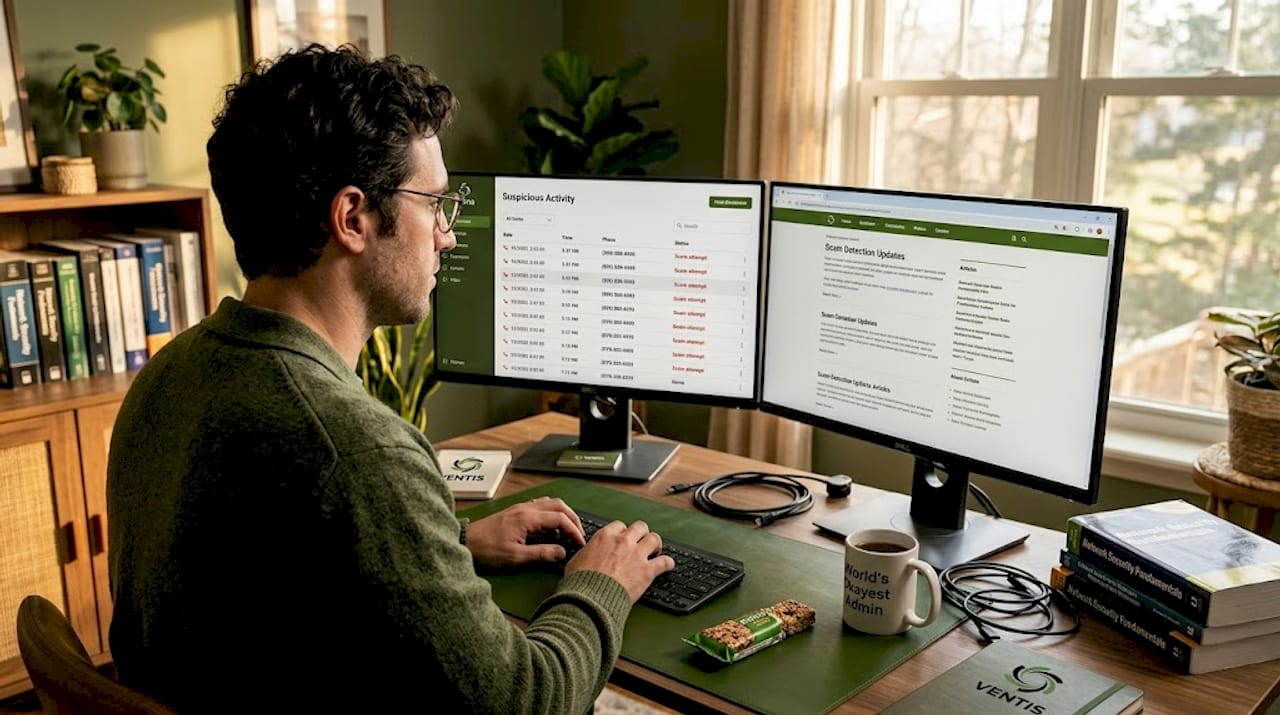
Google's Android platform has added new security features in 2026 specifically targeting scam calls, theft, and spyware. These tools flag suspicious behavior at the operating system level, giving your employees an extra layer of defense even before a call is answered.
The comparison below shows why the shift from legacy to modern systems matters:
| Feature | Legacy PBX | Modern VoIP |
|---|---|---|
| Call encryption | Rarely included | TLS and SRTP standard |
| Automatic security updates | No | Yes |
| MFA support | No | Yes |
| Scam call detection | No | Available on major platforms |
| Remote monitoring | Limited | Built-in with most providers |
| Security incident rate | Higher by 60% | Significantly lower |
Pro Tip: When evaluating VoIP providers, ask specifically about their patch release schedule and whether security updates are applied automatically or require action from your team. Auto-patching should be a non-negotiable.
Compliance requirements your phone system must meet
If your business operates in healthcare, finance, or legal services, your phone system is subject to real regulatory requirements. Ignoring them creates legal exposure, not just operational risk.
HIPAA requires that any electronic communication involving patient health information be encrypted and access-controlled. That includes phone calls handled over VoIP. FCC regulations govern call recording, data storage, and privacy. Many state-level laws add further requirements on top of those.
The financial stakes are significant. SMBs in healthcare, finance, and law face penalties ranging from $100 to $50,000 per incident when required security controls like encryption and access logging are not in place. In serious cases, criminal liability is also possible.
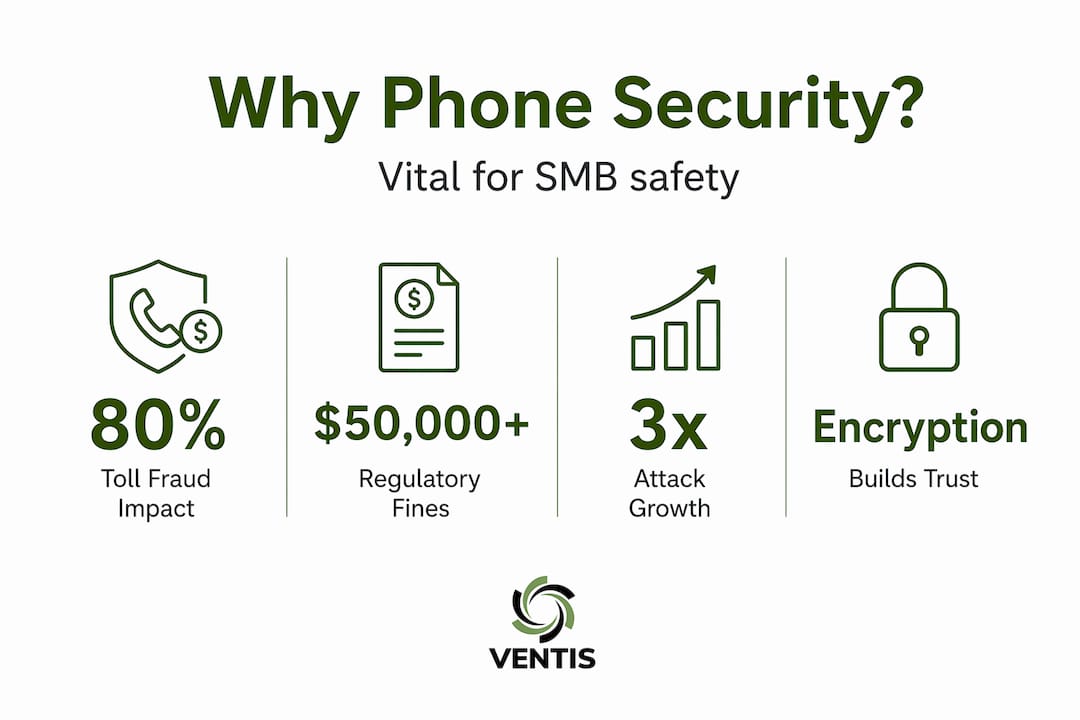
Beyond avoiding penalties, compliance builds trust. Clients in regulated industries want to know their conversations are protected. A business that can demonstrate documented phone security practices has a real competitive advantage over one that cannot.
| Regulation | Who It Affects | Key Phone Security Requirements |
|---|---|---|
| HIPAA | Healthcare businesses | Encrypted calls, access logs, business associate agreements |
| FCC Rules | All businesses | Call recording consent, data privacy, fraud prevention |
| PCI DSS | Businesses taking card payments | No storing of card data in call recordings |
| State Privacy Laws | Varies by state | Call recording disclosure, data retention limits |
Review your cybersecurity compliance practices regularly. The rules change, and a gap that seems minor today can become a costly violation when an audit or breach occurs.
Practical steps to secure your business phone system
You do not need an enterprise IT team to put strong phone security in place. These steps are realistic for any SMB and make a measurable difference.
- Move away from legacy systems. If you are still running an on-premise PBX, plan your migration to a cloud-based VoIP platform. The security gap between old and new systems is significant, and the cost of staying put is higher than most owners realize.
- Enable MFA on every admin account. Your VoIP admin portal controls your entire phone environment. Protect it the way you would protect your bank account. MFA is the single most effective access control you can implement.
- Set strong, unique passwords. Default credentials on VoIP equipment and phone admin portals are a known attack vector. Change them immediately and use a password manager to maintain strong, unique passwords across all accounts.
- Train employees to recognize vishing. Your staff need to know what a social engineering call sounds like. Run brief, regular training sessions that cover real examples. Most phone security breaches occur because of simple, avoidable user habits, not because of sophisticated hacking.
- Keep all devices and software updated. This applies to desk phones, softphone apps, and mobile devices used for business calls. Unpatched software is an open door.
- Use a VPN on mobile devices. When employees take business calls on mobile phones over public Wi-Fi, a VPN encrypts that connection and prevents interception.
- Consider managed security services. Cyber threats affect all business sizes equally, but SMBs often lack the internal resources to manage complex security tools. A managed IT provider monitors your environment continuously and responds to threats before they escalate.
Pro Tip: Create a simple one-page vishing response guide for your team. It should include who to call internally if they suspect a scam, what information to never share over the phone, and how to report suspicious calls. Keep it posted near every desk phone.
The real cost of ignoring phone security
Skipping phone security feels low-risk until the bill arrives. Here is what actually happens when businesses find out too late.
- Toll fraud losses often appear as a single large charge on a monthly invoice. By then, the fraudulent calls have already been made and the money is gone.
- Recovering from a compromised phone system is far more difficult than preventing the breach in the first place, because phones are tied to identity verification, banking, and password recovery.
- Remediation of a compromised VoIP server often requires rebuilding from a clean baseline due to multiple invisible malware persistence mechanisms, meaning days or weeks of disruption.
- Clients who learn their conversations were intercepted or their data was exposed rarely return. The reputational damage can outlast the financial one.
"Prevention of breaches is more effective and less costly than repairing post-compromise damage. For SMBs, a single breach can set operations back by months."
The math is straightforward. A managed security service, better software, and employee training cost a fraction of what a single serious breach costs to remediate. Understanding the importance of phone security starts with recognizing that the risk is real, constant, and growing.
My take on phone security as a business priority
I have seen a lot of SMBs invest seriously in endpoint protection, firewalls, and email security, then treat their phone system as an afterthought. It is one of the most consistent blind spots I encounter.
Here is what I have learned from working with small and mid-sized businesses: the phone is not just a communication tool anymore. It is tied to your identity, your banking, your two-factor authentication, and your client relationships. When it gets compromised, everything connected to it becomes vulnerable. That is not a minor IT problem. It is a business continuity problem.
The other thing I keep coming back to is how preventable most of these incidents are. Simple avoidable user habits drive the majority of phone breaches. Clicking the wrong thing, trusting the wrong caller, ignoring an update prompt. These are not failures of technology. They are failures of awareness. And awareness is fixable.
My recommendation to any SMB owner is this: treat your phone system with the same seriousness as your network security. Audit who has access to your VoIP admin portal. Make sure your employees know what a vishing attempt sounds like. If you do not have the in-house expertise to manage it, find a partner who does. The cost of getting this right is manageable. The cost of getting it wrong is not.
— Greg
Protect your business communications with Ventisconsulting
Ventisconsulting works with small and mid-sized businesses across Pittsburgh and the surrounding region to build phone systems that are secure, compliant, and built for growth. Whether you need to migrate from a legacy PBX, set up encrypted VoIP, or get ongoing monitoring for your communications infrastructure, the team at Ventisconsulting delivers practical solutions without unnecessary complexity.
From managed IT services that keep your systems patched and monitored around the clock, to unified communications solutions that integrate security from day one, Ventisconsulting tailors every recommendation to your actual business needs. You get a local team that knows your environment and stays ahead of threats so you do not have to. Ready to see where your phone security stands? Reach out to Ventisconsulting for a free consultation.
FAQ
What is the biggest risk to business phone security?
Toll fraud and vishing attacks are among the most damaging threats. Automated toll fraud can generate massive losses within hours, while vishing exploits employee trust to steal credentials or sensitive data.
How does VoIP improve business phone protection?
Modern VoIP systems use encryption protocols like TLS and SRTP to secure calls, support multifactor authentication, and receive automatic security updates. These features reduce security incidents significantly compared to legacy PBX systems.
Are SMBs required to secure their phone systems by law?
Yes, in many industries. Businesses in healthcare, finance, and legal services must meet regulations such as HIPAA and FCC rules or face penalties ranging from $100 to $50,000 per incident, plus potential criminal liability.
What phone security best practices should every SMB follow?
Enable MFA on all admin accounts, train employees to recognize vishing calls, keep all devices updated, use VPNs on mobile devices, and consider a managed IT provider for continuous monitoring.
Who is responsible for VoIP security in a business?
VoIP security is a shared responsibility. Providers manage encryption and infrastructure, but your business is responsible for managing user access, password policies, and employee behavior on the platform.