

E911 for VoIP is mandatory, not optional. If your business runs interconnected VoIP, federal rules require you to register a dispatchable location for every device before it goes live, keep that location current, and support direct-dial 911 under Kari's Law and RAY BAUM's Act. Skipping any of this isn't just a compliance gap. It's a real risk that a 911 call from your office never reaches the right dispatcher.
TL;DR:
- Businesses must assign and regularly update precise dispatchable locations, including floor and room details, to comply with RAY BAUM's Act and ensure accurate 911 routing.
- Validating addresses against the Master Street Address Guide and maintaining an audit trail are critical for PSAP match accuracy and rapid emergency response.
- Configuring ELINs or DIDs for each physical zone and using dynamic location tools is essential for nomadic or hybrid staff to prevent stale or missing location data.
- Routine testing via special numbers or provider portals, conducted quarterly, is necessary to verify that 911 calls route correctly and notifications trigger properly.
- Outsourcing compliance management to specialists like Ventis reduces administrative burdens, maintains ongoing updates, and helps prevent costly fines for violations.
Table of Contents
- How E911 Works With VoIP: Call Path, ELINs, and Dispatchable Location
- Regulatory Requirements: FCC Rules, Kari's Law, and RAY BAUM's Act Explained
- Business Responsibilities and Governance: Who Does What
- How to Configure E911 on Your PBX and SIP Trunks
- Testing and Maintenance: How to Verify E911 Safely
- Common E911 Failure Points and How to Fix Them
- A Pragmatic Take on E911 Compliance for Growing Businesses
- Get Managed E911 and VoIP Compliance Support From Ventis
- Where to Verify These Rules Yourself
- Sources
- FAQ
How E911 Works With VoIP: Call Path, ELINs, and Dispatchable Location
Traditional landline 911 works because the phone company ties a fixed address to a copper wire. VoIP breaks that link, since a phone number can move between offices, homes, and laptops in seconds.
Here's the actual path a VoIP 911 call takes: a handset or softphone dials 911, the call hits your PBX or hosted platform, the system routes it through a SIP trunk tied to an Emergency Location Identification Number (ELIN) or a dedicated DID, and your provider's E911 database looks up the associated address before handing the call to the correct Public Safety Answering Point (PSAP).
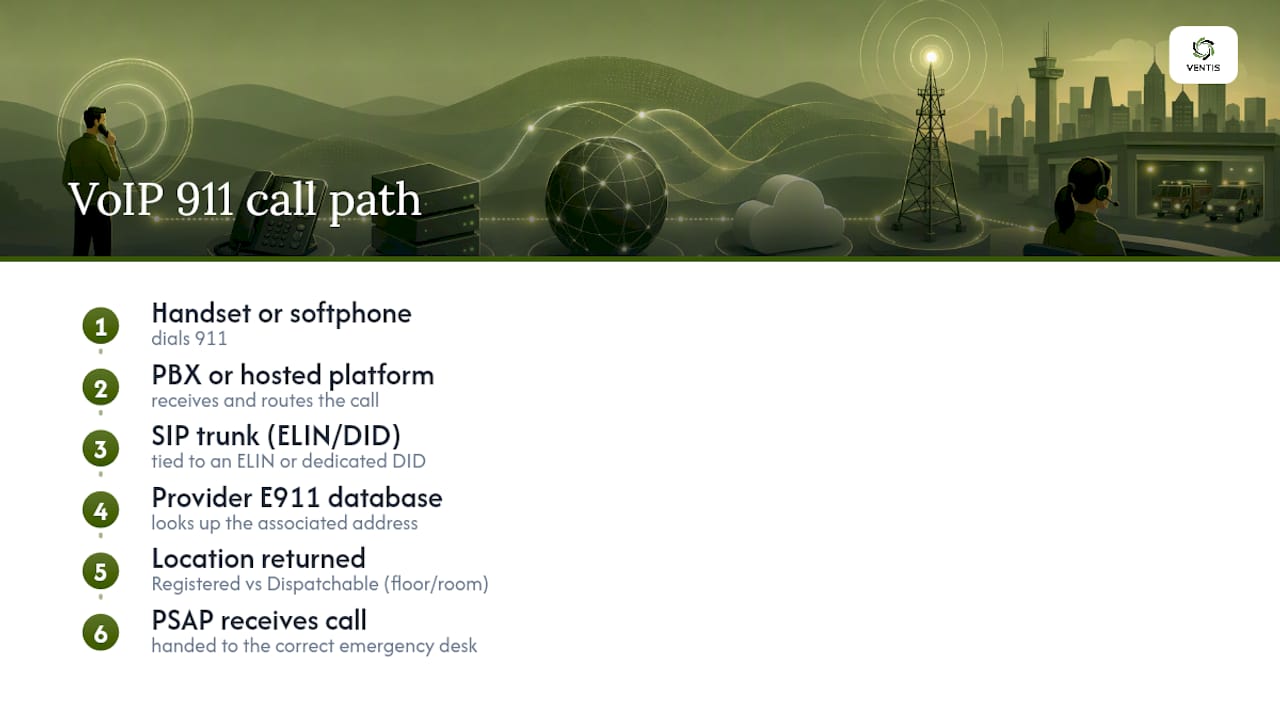
Two terms matter here. Registered Location is the address a subscriber has on file with the provider, updated manually or automatically. Dispatchable location is a stricter standard under RAY BAUM's Act that includes floor or room detail, not just a street address.
Interconnected VoIP itself splits into three flavors: fixed (a desk phone at a known address), non-fixed or nomadic (a softphone that travels with an employee), and portable business systems. Each carries different obligations, and nomadic setups carry the highest risk of a stale or missing location.
Regulatory Requirements: FCC Rules, Kari's Law, and RAY BAUM's Act Explained
Three overlapping federal rules govern E911 for VoIP, and IT leaders need to know all three thoroughly.
The FCC requires interconnected VoIP providers to treat E911 as a built-in feature, not an add-on. Providers must obtain a Registered Location before activating service, offer an easy way to update it, and distribute clear warnings about VoIP's 911 limitations. Non-compliance can trigger fines up to $10,000 per violation per day.
Kari's Law targets multi-line telephone systems (MLTS), the kind found in most offices. It requires direct-dial 911, no prefix, no "9 then 911," plus an automatic notification to a front desk, security office, or off-site monitoring point whenever someone dials emergency services.
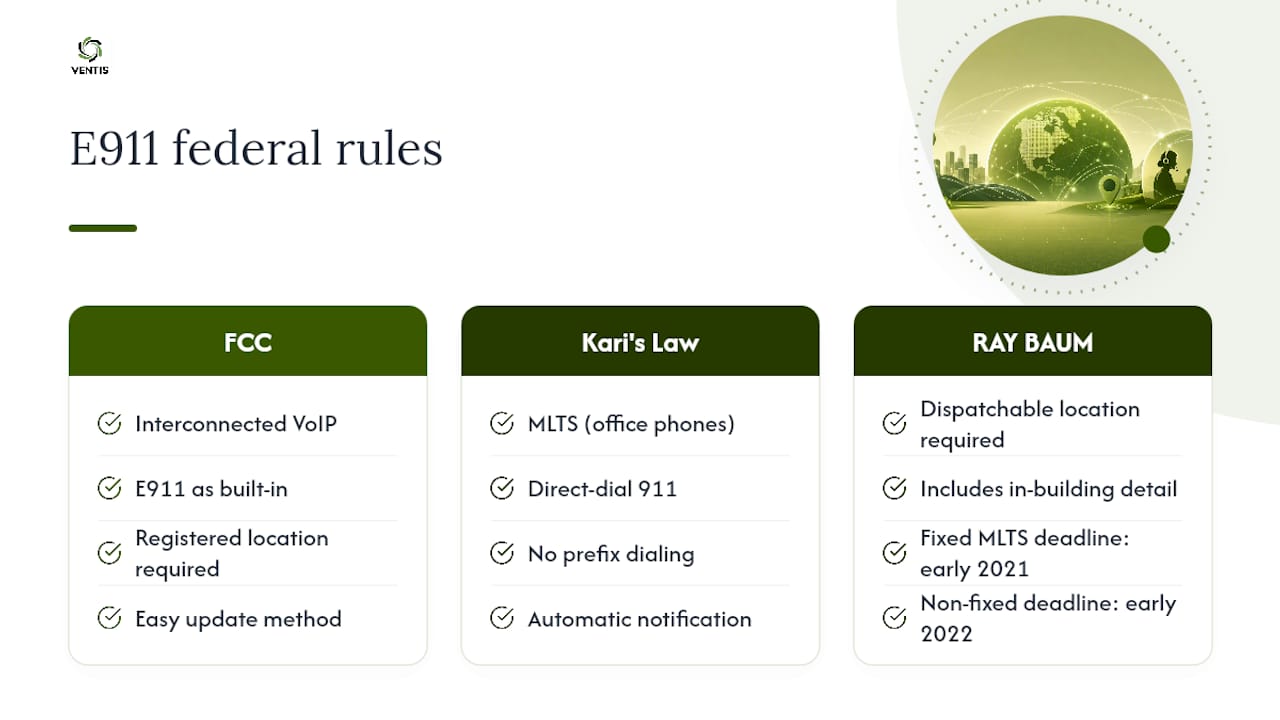
RAY BAUM's Act goes further, mandating dispatchable location data, including in-building detail, accompany every 911 call. Compliance deadlines already passed: fixed on-premises MLTS devices needed automated dispatchable location by early 2021, and non-fixed devices by early 2022, with narrow technical-feasibility exceptions. If your system predates these deadlines and hasn't been audited since, treat that as an open compliance gap today.
Business Responsibilities and Governance: Who Does What
Regulators put real obligations directly on the provider, but plenty of the operational burden lands on you as the business. Getting governance right means assigning clear ownership before an emergency exposes a gap.
Start with these core practices:
- Designate a specific location owner (usually IT or facilities) responsible for registering and updating addresses whenever a desk, floor, or office changes.
- Require affirmative acknowledgement from every user or department confirming they understand VoIP 911 limitations, and post warning labels or notices near VoIP handsets as FCC rules require.
- Validate every address against the Master Street Address Guide (MSAG) so PSAPs can actually match it to a jurisdiction.
- Keep an audit trail of every location change, including date, device, and who approved it.
This isn't paperwork for its own sake. A dispatcher who gets a bad address has no fast way to correct it mid-emergency.
How to Configure E911 on Your PBX and SIP Trunks
Setting up compliant E911 is a defined project, not a checkbox in your phone system's settings menu.
- Inventory every device and extension, noting fixed desk phones, conference room lines, and any nomadic softphone users.
- Register an ELIN or DID for each physical location or zone, then validate the associated address against the MSAG before activating it.
- Configure your dialplan so 911 dials without any prefix and routes through the trunk mapped to the correct location, satisfying Kari's Law directly.
- Map extension ranges to floor or zone level ELINs on multi-floor sites, since assigning ELINs by zone gives PSAPs room or floor granularity instead of just a building address.
- Deploy dynamic location tools for remote and hybrid staff, prompting a location confirmation at login rather than relying on a stale default.
- Document the full configuration and set a recurring calendar reminder to re-validate it.
Pro Tip: Treat every office move, desk reshuffle, or new remote hire as a trigger event for a location update, not an annual cleanup task. Stale data usually creeps in one small change at a time.
Testing and Maintenance: How to Verify E911 Safely
Never test by dialing 911 directly except in a genuine emergency. There are lawful ways to confirm your setup works without tying up a real dispatcher.
- Dial the 933 test number to confirm your registered address reads back correctly.
- Use your provider's test portal, if one is offered, to simulate call routing without placing a live call.
- Coordinate directly with your local PSAP's non-emergency line for a full end-to-end test on major installs or moves.
- Confirm the on-site notification (Kari's Law requirement) and the callback number both fire correctly during the test.
Run this cycle quarterly at minimum, and log every result. An untested system is a system you're only assuming works.
Common E911 Failure Points and How to Fix Them
Most VoIP 911 failures trace back to a handful of predictable causes, according to the FCC: stale address data, power or broadband outages, non-native phone numbers, or a PSAP unable to process the data it receives.
- Stale Registered Location: automate update reminders tied to HR onboarding and office moves, not manual annual reviews.
- Power or broadband outages: document battery backup limits clearly and consider cellular failover for critical lines.
- PSAP routing mismatches: validate MSAG formatting regularly and keep a direct contact at your provider for routing disputes.
Pro Tip: Ask your VoIP provider exactly how long a location update takes to propagate to the PSAP database. Some systems update instantly; others take hours, which matters enormously during a same-day office move.
A Pragmatic Take on E911 Compliance for Growing Businesses
Most small and mid-sized businesses treat E911 as a one-time setup task, then forget about it until an audit or a near-miss forces the issue. That's backwards. Compliance here is operational, not a project with an end date, and the businesses that stay clean are the ones who build it into routine IT governance the same way they handle patch management or backup verification.
The pattern that actually holds up: one named location owner, automated reminders tied to any physical or staffing change, and a quarterly test cycle that gets logged, not skipped. Some managed IT providers build this kind of lightweight governance into their engagements to help businesses avoid scrambling to fix a stale address after something goes wrong.
— Greg
Get Managed E911 and VoIP Compliance Support From Ventis
Ventis Consulting Group is the alternative to piecing together E911 compliance yourself across scattered vendor portals and spreadsheets. Instead of chasing ELIN registrations and MSAG validations on top of your regular workload, you get one team handling Registered Location management, ELIN mapping, dialplan configuration, and quarterly testing as part of ongoing VoIP & Unified Communications support.
That means fewer moving pieces to track and one point of contact when a PSAP flags a routing issue or an office move needs a location update fast. Ventis also covers the broader picture, from Managed IT Services to network reliability, so your emergency calling doesn't depend on a shaky broadband connection or an unmanaged failover plan.
If your current setup hasn't been tested this quarter, or you're not sure who owns your Registered Location updates, request a compliance assessment from Ventis Consulting Group and get a clear picture of where you stand.
Where to Verify These Rules Yourself
For the primary legal text, start with the FCC's VoIP and 911 Service guidance, the Kari's Law and RAY BAUM's Act summary, and 47 CFR §9.12. Bookmark your local PSAP's non-emergency contact alongside your provider's support portal.
Sources
- VoIP and 911 Service | Federal Communications Commission
- Federal Communications Commission § 9.12 (CFR)
- 911
FAQ
Can You Call 911 on a VoIP Phone?
Yes. Interconnected VoIP providers are required by the FCC to support 911 calling, and Kari's Law requires direct dialing without a prefix on business phone systems. The call still depends on an accurate Registered Location being on file.
What Is a Major Challenge of Using VoIP for 911 Calls?
The biggest challenge is that VoIP numbers aren't tied to a fixed physical location the way landlines are, so an outdated or missing address can send a 911 call to the wrong PSAP. Outages in power or broadband service can also interrupt VoIP 911 calls entirely, unlike a traditional landline.
Is E911 Mandatory for Business VoIP?
Yes, E911 is a mandatory feature for interconnected VoIP providers under FCC rules, not an optional add-on businesses can decline. Providers must obtain a Registered Location before activating service, and non-compliance can carry fines up to $10,000 per violation per day.
Why Do Some Guides Say Not to Rely Solely on VoIP for Emergency Calls?
VoIP 911 can fail during power or internet outages, since the call depends on active broadband service rather than dedicated phone lines. Businesses in outage prone areas often pair VoIP with cellular failover or battery backup to keep emergency calling available.
What's the Difference Between Registered Location and Dispatchable Location?
Registered Location is the address on file with your provider, while dispatchable location under RAY BAUM's Act adds specific detail like floor or room number. Multi-floor offices typically need ELINs assigned by zone to meet the dispatchable location standard.