

Containment in cyber incident response is defined as the phase immediately following detection and triage, where security teams act to stop an active threat from spreading further across systems, networks, or data stores. The industry standard term is "incident containment," and it sits between detection and eradication in frameworks like NIST 800-61 and OWASP NHI. Containment does not remove the threat. It stabilizes the environment so your team can investigate, preserve evidence, and plan a full remediation. Without effective cyber incident containment, attackers retain the freedom to move laterally, escalate privileges, and exfiltrate data while your team is still assessing the scope.
What is containment in cyber incident response?
Containment stops damage spread and preserves forensic evidence while buying time for deeper remediation. That dual purpose is what makes it the most consequential phase in the entire incident response lifecycle. Get it wrong in either direction and you either lose critical evidence or allow the attacker to deepen their foothold.
Containment is distinct from eradication and recovery. Eradication removes the threat entirely, such as deleting malware or closing a vulnerability. Recovery restores systems to normal operations. Containment does neither of those things. Its sole job is to draw a boundary around the incident and hold that line.
The urgency is real. Attackers can move laterally within 9 to 17 minutes of compromising exposed cloud credentials. That window is shorter than most incident response teams take to convene a call. Speed matters, but so does precision. A rushed containment action that tips off an adversary or destroys volatile memory evidence can make the incident significantly worse.

Containment strategies in cybersecurity apply across every environment: on-premises servers, cloud workloads, SaaS platforms, and hybrid networks. The tactics differ by environment, but the goal is identical. Stop the bleeding, hold the perimeter, and keep your options open for the investigation that follows.
What are the common containment strategies and tactics?
Containment actions exist on a continuum. The range runs from passive monitoring at one end to full system shutdown at the other, with many options in between. Choosing the right point on that continuum requires judgment about business risk, evidence needs, and attacker behavior.
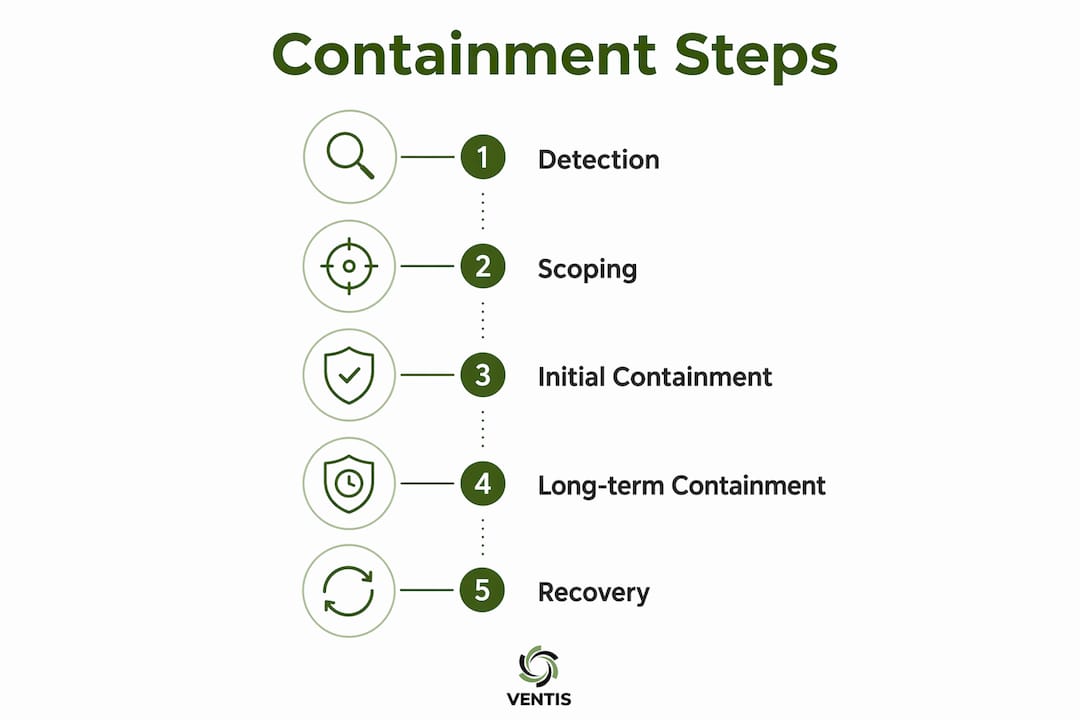
Short-term containment actions
Short-term steps focus on immediate damage limitation with minimal disruption:
- Host isolation: Disconnect a compromised endpoint from the network while keeping it powered on to preserve volatile memory.
- Account disablement: Suspend compromised user accounts or service accounts immediately to block further authentication.
- Token revocation: Invalidate OAuth tokens, API keys, and session tokens tied to the affected identity.
- Network path restriction: Block specific IP addresses, ports, or firewall rules to cut off attacker communication channels.
- DNS sinkholing: Redirect malicious domain lookups to a controlled server to interrupt command-and-control traffic.
Long-term containment actions
Long-term containment holds the environment stable while eradication is prepared:
- Network segmentation: Isolate affected network segments from the broader environment using VLANs or firewall policies.
- Service shutdown: Disable specific services or applications that the attacker is actively exploiting.
- Parallel system deployment: Stand up clean replacement systems to restore critical business functions while the compromised environment remains isolated.
- Credential rotation: Force a full password and key rotation across affected systems and accounts.
Pro Tip: Before isolating a host, capture a memory image and preserve system logs. Shutting down a machine first destroys volatile evidence that may be the only record of how the attacker gained access.
The modern emphasis in containment strategies in cybersecurity has shifted toward identity-first actions. Revoking credentials and tokens often stops lateral movement faster than isolating a single host, especially in cloud environments where workloads spin up and down dynamically.
How do cybersecurity frameworks guide containment decisions?
Three frameworks define how organizations should approach the incident response containment process: NIST 800-61, Zero Trust, and OWASP NHI. Each brings a different emphasis, but they reinforce each other in practice.
NIST 800-61 advises teams to spend 30 minutes scoping an incident before taking disruptive containment actions. That guidance exists for a specific reason. Premature action can alert adversaries, cause them to accelerate their activity, or destroy the forensic trail your team needs for root cause analysis. Scoping first means you contain the right thing, not just the first thing you notice.
| Framework | Primary containment focus | Key guidance |
|---|---|---|
| NIST 800-61 | Scoping before action | Spend time analyzing before disrupting; document all decisions |
| Zero Trust | Identity verification | Revoke access at the identity layer before touching infrastructure |
| OWASP NHI | Non-human identity risk | Prioritize token and service account revocation for cloud workloads |
Zero Trust architecture treats every identity as untrusted by default, which means containment under Zero Trust starts at the identity layer. Revoke the token, disable the account, and verify every subsequent access request. This approach limits blast radius without requiring a full network shutdown.
OWASP NHI guidance addresses non-human identities, including service accounts, API keys, and automated pipeline credentials. These are frequently the attack vector in cloud breaches. Containing a non-human identity compromise means revoking all associated credentials and auditing every system that identity had access to.
What are the strategic trade-offs in containment decision-making?
The biggest mistake in cyber incident containment is treating it as a reflexive shutdown. Overly aggressive containment destroys volatile evidence. Overly passive containment allows the attacker to move deeper into your environment. Neither extreme serves the organization well.
The core tension is between intelligence gathering and damage prevention. Monitoring an attacker's activity can reveal their objectives, tools, and the full scope of the compromise. Acting immediately stops the damage but may leave questions unanswered. This trade-off requires nuanced judgment and should be made deliberately, not under panic.
A second risk is tipping off the adversary. Poorly chosen containment actions can alert attackers, causing them to accelerate exfiltration, delete logs, or deploy additional payloads before you can respond. This is why NIST 800-61 recommends scoping before acting. Knowing what the attacker can see helps you contain without triggering a reaction.
Pro Tip: If you suspect an attacker is still active, consult legal counsel before deciding whether to monitor versus contain. In some jurisdictions, monitoring an active intrusion without proper authorization creates liability.
Coordination with legal, HR, and compliance teams is not optional during containment. Business disruption decisions, such as taking down a production system, carry operational and contractual consequences. Those decisions need sign-off from the right stakeholders, not just the security team.
How has containment evolved for cloud and AI environments?
Traditional network isolation does not translate cleanly to cloud-native environments. In a dynamic cloud, workloads are ephemeral, credentials rotate automatically, and services communicate through APIs rather than fixed network paths. Cloud and agentic AI environments require identity-layer containment over traditional host or network isolation.
The steps for cyber containment in cloud environments follow a specific order:
- Revoke compromised tokens and API keys immediately across all services that accepted those credentials.
- Disable the affected service account or IAM role to prevent any further authenticated requests.
- Preserve cloud logs from AWS CloudTrail, Azure Monitor, or Google Cloud Audit Logs before any system changes are made.
- Isolate the affected workload by modifying security group rules or network policies to block inbound and outbound traffic.
- Audit downstream trust relationships to identify any other services or accounts that the compromised identity could have accessed.
- Notify your cloud provider's abuse team if attacker infrastructure is hosted on the same platform.
The LLMjacking threat pattern illustrates why speed matters in cloud containment. Attackers exploit exposed cloud credentials in as little as 9 minutes, using them to spin up large language model inference at the victim's expense. By the time a billing alert fires, significant damage may already be done. Identity-first containment, specifically token revocation before host isolation, is the only response fast enough to matter.
For cloud security in 2026, agentic AI systems introduce a new containment challenge. Automated agents can propagate compromised credentials across dozens of downstream services within minutes. Containing an agentic AI incident requires revoking the agent's identity, auditing every tool call it made, and reviewing all outputs it produced for signs of data exfiltration.
Statistic callout: Attackers compromise exposed cloud credentials and move laterally within 9 to 17 minutes. That timeline is shorter than most incident response teams take to escalate an alert internally.
Why is documentation and coordination critical during containment?
Documentation of containment actions is critical for forensic investigation and operational continuity. Every decision made during containment needs a timestamp, a rationale, and the name of the person who authorized it. Without that record, root cause analysis becomes guesswork and legal defense becomes difficult.
Effective containment documentation includes:
- A timestamped log of every action taken, including commands run and systems touched.
- The name and role of each person who authorized or executed a containment step.
- Screenshots or exports of system state before and after containment actions.
- A record of what evidence was preserved and where it is stored.
- Notes on what was deliberately left unchanged and why.
Cross-functional coordination during containment involves technical teams, legal counsel, HR, compliance officers, and sometimes law enforcement. When personal data is involved, privacy regulations may require breach notification within specific timeframes. Legal counsel needs to be looped in early to protect attorney-client privilege over the investigation. HR involvement is necessary when an insider threat is suspected.
Building a cybersecurity incident response plan before an incident occurs is the single most effective way to reduce coordination friction during containment. Pre-defined communication trees, escalation paths, and decision authorities mean your team spends time containing the threat, not figuring out who to call. Good forensic investigation practices depend entirely on the quality of documentation your team creates during containment.
Key Takeaways
Effective cyber incident containment requires speed, precision, and deliberate decision-making across technical, legal, and operational teams.
| Point | Details |
|---|---|
| Containment stops spread, not the threat | Containment limits damage and preserves evidence; eradication removes the threat afterward. |
| Identity-first is the modern standard | Revoke tokens and disable accounts before isolating hosts, especially in cloud environments. |
| Scope before you act | NIST 800-61 recommends 30 minutes of scoping to avoid alerting attackers or destroying evidence. |
| Document every decision | Timestamped logs of containment actions support forensic analysis and legal defense. |
| Coordinate across functions | Legal, HR, and compliance teams must be involved when personal data or insider threats are present. |
Containment is a governance test, not just a technical drill
After years of working through incident response scenarios, the pattern I see most often is teams treating containment as a purely technical problem. They reach for the "pull the plug" option because it feels decisive. It rarely is.
The most damaging containment failures I have seen came from speed without strategy. A team shuts down a compromised server before capturing memory, destroying the only evidence of how the attacker got in. Another team isolates a host without revoking the service account, and the attacker simply pivots to a different cloud workload using the same credentials. The technical action was correct in isolation. The sequence was wrong.
What I have found actually works is treating containment as a stabilization exercise, not a shutdown exercise. Your goal is to draw a defensible perimeter and hold it while your investigation catches up. That means identity-first actions in cloud environments, careful sequencing of host isolation, and a deliberate choice about whether to monitor or act based on what the evidence shows.
The organizations that handle containment well are the ones that practiced it. Tabletop exercises that force teams to make containment trade-off decisions under simulated pressure build the judgment that matters when a real incident hits. Containment readiness is a governance indicator. If your team cannot answer "what do we revoke first?" in under two minutes, that is a gap worth closing before an attacker finds it.
— Greg
Ventis Consulting Group and your incident containment readiness
Knowing the theory of containment is one thing. Having the tools, processes, and expertise to execute it under pressure is another. Ventis Consulting Group works with small and mid-sized businesses in Pittsburgh and surrounding areas to build the incident response capabilities that make containment fast and effective when it counts.

From managed IT and security services to cybersecurity assessments and incident response planning, Ventis Consulting Group provides the practical support your team needs to contain threats before they become full-scale breaches. Whether you need help building containment playbooks, reviewing your identity controls, or assessing your cloud security posture, the team at Ventis Consulting Group is ready to help. Reach out to discuss where your containment readiness stands today.
FAQ
What is the difference between containment and eradication?
Containment stops an active threat from spreading further. Eradication removes the threat entirely, such as deleting malware or patching the exploited vulnerability, and happens after containment is complete.
How long should containment take during an incident?
Containment timing depends on incident scope and severity. NIST 800-61 recommends at least 30 minutes of scoping before taking disruptive actions to avoid destroying evidence or alerting the attacker.
What does identity-first containment mean?
Identity-first containment means revoking tokens, API keys, and disabling compromised accounts before isolating hosts or shutting down systems. This approach stops lateral movement faster in cloud and hybrid environments.
Why is documentation required during containment?
Containment documentation creates a timestamped record of every action taken, which supports forensic investigation, root cause analysis, and legal defense. Failing to document decisions complicates remediation and impairs chain of custody.
What frameworks guide the incident response containment process?
NIST 800-61, Zero Trust architecture, and OWASP NHI each provide guidance on containment sequencing, identity controls, and balancing speed with evidence preservation during active incidents.