

Attacker dwell time is defined as the total duration a threat actor operates inside a network from initial infiltration to detection and removal. This metric sits at the center of every serious breach analysis because it measures the actual window of exposure, not just the moment an alert fires. Industry data shows median dwell times for ransomware incidents hover around 16 days, with global median detection across intrusion types closer to 10 days. Tools like Network Detection and Response (NDR), SIEM platforms, and AI-driven detection engines all target this window. Understanding why dwell time matters in cybersecurity is the foundation of any mature threat response program.
Why dwell time matters in cybersecurity risk assessment
Dwell time is an adversary-centric metric. It captures what the attacker accomplished during their stay, not just how fast your tools generated an alert. That distinction changes how you interpret breach severity and prioritize investment.
During extended dwell periods, attackers do not sit idle. Longer dwell times allow reconnaissance, lateral movement, privilege escalation, data staging, and full exfiltration before any defender intervenes. A 16-day dwell period in a ransomware incident is not just 16 days of risk. It is 16 days of an attacker mapping your environment, identifying your most valuable data, and positioning for maximum impact before detonating a payload.
The dwell time impact on security outcomes is direct and measurable. The longer an attacker remains undetected, the more systems they compromise, the more credentials they harvest, and the harder recovery becomes. A breach contained in under 24 hours rarely produces the catastrophic data loss that a two-week intrusion generates.
"Dwell time is the critical window attackers exploit to maximize damage. Every day of undetected access is another day of attacker advantage."
Here is what attackers typically accomplish across a prolonged dwell period:
- Reconnaissance: Mapping internal network topology, identifying domain controllers, and locating sensitive data repositories.
- Lateral movement: Pivoting from the initial foothold to higher-value systems using harvested credentials or exploitation of trust relationships.
- Privilege escalation: Acquiring domain administrator or root-level access to remove barriers to full environment control.
- Data staging and exfiltration: Compressing and transferring sensitive files to attacker-controlled infrastructure before triggering ransomware or extortion.
The cybersecurity threats facing mid-sized businesses in 2026 make this window even more dangerous. Attackers now use automated tooling to accelerate lateral movement, compressing what once took weeks into days once they gain a foothold.
How dwell time differs from MTTD and MTTR
Mean Time to Detect (MTTD) measures how long it takes your security operations center to become aware of a threat. Mean Time to Respond (MTTR) measures how quickly the team acts after awareness. Dwell time measures something broader: the total adversary presence from first compromise to full containment.

Dwell time and MTTD measure different aspects of the same incident. MTTD reflects detection awareness. Dwell time captures total adversary presence, including all post-alert delays. An organization can have a strong MTTD of four hours and still carry a dwell time of five days if investigation, escalation, and containment workflows are slow.
Dwell time is extended not only by detection delay but also by investigation friction, escalation queues, manual analyst confirmation steps, and containment execution. This is the part most security programs underestimate. The alert fired quickly. The attacker was still active for 72 more hours while the team worked through triage.
| Metric | What it measures | Perspective |
|---|---|---|
| Dwell time | Total attacker presence: compromise to containment | Adversary-centric outcome |
| MTTD | Average time from intrusion to detection awareness | Defender detection speed |
| MTTR | Average time from detection to response action | Defender response speed |
| Containment time | Time from response initiation to attacker removal | Operational execution |
Dwell time is the outcome metric that reflects your security program's overall maturity. MTTD and MTTR are inputs. Boards and compliance frameworks increasingly ask for dwell time data because it translates technical performance into business risk language. A 10-day dwell time tells a risk committee far more than an alert volume report.
Pro Tip: When reporting to leadership, present dwell time alongside MTTD and MTTR together. This shows not just how fast you detect, but how effectively you contain. The gap between MTTD and dwell time is where your response workflow improvements live.
What factors extend dwell time and how to measure it accurately
Several operational realities combine to keep dwell times higher than security teams expect. Recognizing these factors is the first step toward reducing them.
-
Low-and-slow attacker tactics. Attackers space operations to stay below alert thresholds, distributing malicious activity across days or weeks to avoid triggering volume-based detection rules. A single login anomaly at 2 a.m. on a Tuesday does not fire an alert. Thirty such anomalies spread across three weeks, each below threshold, go unnoticed until correlation reveals the pattern.
-
Incomplete telemetry coverage. Telemetry coverage and SOC detection quality directly impact dwell time by affecting when earliest adversary actions are observed. Gaps in endpoint visibility, unmonitored cloud workloads, or missing network flow data mean the earliest malicious activity never reaches the detection layer.
-
Alert fatigue and single-signal optimism. Analysts working through hundreds of daily alerts deprioritize low-confidence signals. A single suspicious event gets reviewed and closed as a false positive. The same event, correlated with three others from different sources, would have triggered escalation.
-
Investigation and confirmation delays. Manual analyst workflows add hours to every confirmed incident. Escalation queues, shift handoffs, and the requirement for senior analyst sign-off before containment actions all extend the window between detection and removal.
-
Inaccurate initial compromise timestamps. Accurate dwell time measurement requires validating the initial compromise time based on observable adversary actions, not solely alert timestamps. Teams that anchor dwell time to the first alert rather than the first malicious event systematically underreport their true exposure.
Pro Tip: During post-incident reviews, always work backward from the earliest confirmed malicious artifact, not the first alert. This gives you an honest dwell time figure and reveals detection gaps that alert-based timestamps hide.
How organizations can reduce dwell time effectively
Reducing dwell time requires parallel improvements across detection quality, response speed, and attacker access prevention. No single tool solves it.
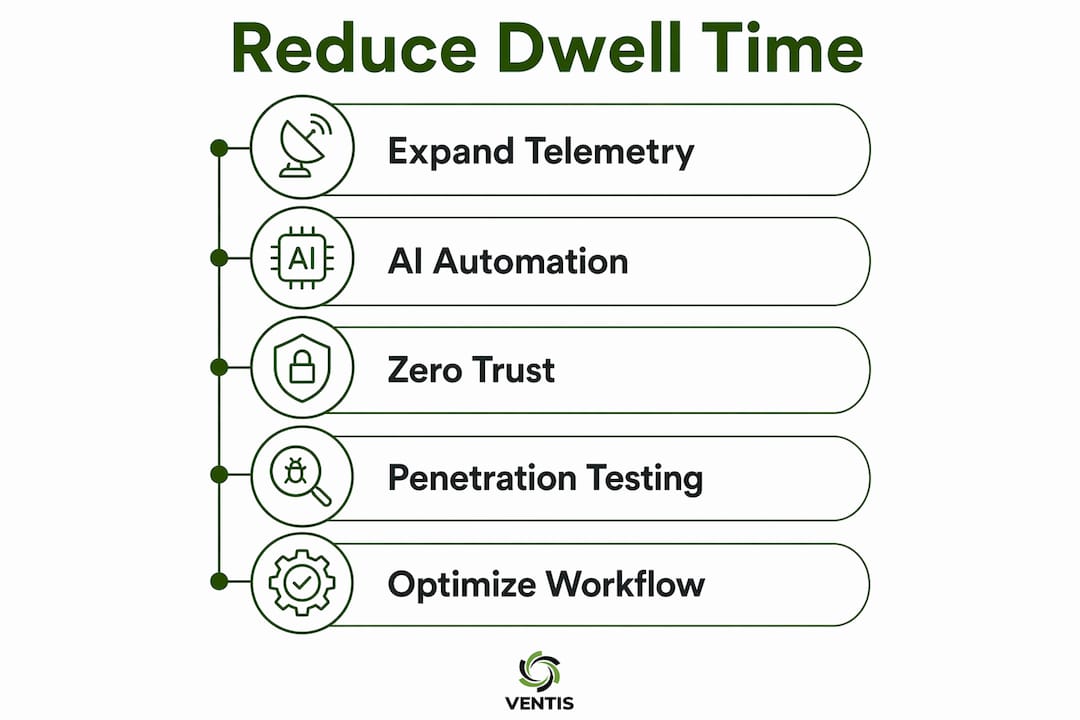
Expand and deepen telemetry coverage. You cannot detect what you cannot see. Full coverage means network traffic analysis via NDR platforms, endpoint detection and response (EDR) on every managed device, cloud workload monitoring across AWS, Azure, or Google Cloud environments, and identity log ingestion into your SIEM platform. Each coverage gap is a potential blind spot where an attacker operates undetected.
Deploy AI-driven correlation and automated response. Agentic AI can reduce MTTR by up to 90%, which directly compresses total dwell time. AI-powered detection platforms correlate weak signals across multiple data sources simultaneously, catching the distributed low-volume activity patterns that rule-based systems miss. Automated playbooks can isolate a compromised endpoint or revoke a suspicious credential within seconds of confirmation, eliminating the manual delay that extends attacker presence.
Implement zero trust architecture. Zero trust limits how far an attacker can move after gaining initial access. Continuous authentication, microsegmentation, and least-privilege access controls mean that even a successful initial compromise does not automatically grant access to the entire environment. This does not reduce detection time, but it dramatically reduces the damage an attacker can cause during their dwell period.
Run continuous penetration testing. Continuous penetration testing cuts the window of exposure by identifying and closing the vulnerabilities attackers use for initial access. Point-in-time annual assessments leave months of unaddressed exposure between tests. Continuous external perimeter testing, combined with internal network penetration testing, keeps your attack surface current and reduces the likelihood of a successful initial compromise.
Optimize response workflows. Detection quality improvements mean nothing if response workflows add days to containment. Pre-approved playbooks for common incident types, clear escalation paths, and defined containment authorities reduce the confirmation friction that extends dwell time beyond the alert. Teams that can contain a confirmed incident without waiting for multi-level approval consistently achieve lower dwell times.
The table below summarizes the primary reduction levers and their primary impact area:
| Reduction strategy | Primary impact |
|---|---|
| Full telemetry coverage (NDR, EDR, SIEM) | Reduces detection blind spots |
| AI correlation and automated playbooks | Cuts MTTD and MTTR simultaneously |
| Zero trust and microsegmentation | Limits lateral movement during dwell |
| Continuous penetration testing | Reduces initial access opportunities |
| Pre-approved response playbooks | Eliminates confirmation friction |
Pro Tip: Measure your dwell time quarterly and track it as a KPI alongside MTTD and MTTR. If dwell time is falling while MTTD stays flat, your response workflows are improving. If MTTD improves but dwell time does not move, the bottleneck is in your containment process.
Key takeaways
Dwell time is the single most complete measure of breach exposure, and reducing it requires simultaneous improvements in detection coverage, response speed, and attacker access prevention.
| Point | Details |
|---|---|
| Dwell time defined | Total attacker presence from initial compromise to full containment, not just detection speed. |
| Damage scales with duration | Reconnaissance, lateral movement, and exfiltration all accelerate the longer an attacker stays undetected. |
| MTTD is not dwell time | Fast alerting does not end dwell time if investigation and containment workflows are slow. |
| Telemetry gaps inflate exposure | Incomplete coverage of endpoints, network, and cloud hides earliest adversary activity. |
| AI and automation compress the window | Automated correlation and response playbooks directly reduce both MTTD and post-alert containment delays. |
What I have learned from watching dwell time play out in real environments
I have reviewed enough post-incident timelines to say this with confidence: the organizations that suffer the worst breach outcomes are almost never the ones with the weakest perimeter defenses. They are the ones with the longest gap between when the attacker arrived and when anyone noticed.
The most common blind spot I see is teams treating alert volume as a proxy for security effectiveness. A SOC generating 500 alerts per day and closing 490 as false positives is not a high-performing SOC. It is a team that has trained itself to discount signals. Organizations often misunderstand SOC quality by focusing on alert volume rather than dwell time reduction, and this leads to misplaced resource allocation.
The shift I recommend to every IT manager I work with is simple: stop optimizing for alert speed and start optimizing for containment time. Your MTTD can be four hours and your dwell time can still be two weeks. That gap is where attackers live. Closing it requires honest post-incident measurement, pre-approved response authorities, and detection engineering that catches distributed low-volume activity, not just high-confidence single-event triggers.
Dwell time is not a vendor metric. It is a direct reflection of how your people, processes, and tools perform together under real adversary pressure. Track it honestly, and it will tell you exactly where to invest next.
— Greg
How Ventisconsulting can help you reduce attacker dwell time
If your organization is working to reduce dwell time but lacks the internal resources to build out full telemetry coverage, automated response workflows, or continuous monitoring, Ventisconsulting provides exactly that support for small and mid-sized businesses in Pittsburgh and the surrounding region.

Ventisconsulting's managed IT and security services include network detection and response, continuous monitoring, and SIEM-backed alerting designed to close the detection gaps that extend attacker dwell periods. Their security responsibility consulting practice helps organizations define clear ownership, pre-approved response playbooks, and containment workflows that cut the post-alert delays most teams struggle with. If you want to know where your dwell time stands today, reach out to Ventisconsulting for a direct assessment.
FAQ
What is dwell time in cybersecurity?
Dwell time is the total duration a threat actor remains inside a network from initial compromise to full detection and removal. It measures the complete exposure window, not just the moment an alert is generated.
How does dwell time differ from Mean Time to Detect?
MTTD measures how long it takes to become aware of a threat, while dwell time captures the entire adversary presence including post-alert investigation, escalation, and containment delays. An organization can have a fast MTTD and still carry a high dwell time if response workflows are slow.
What is a typical dwell time for ransomware attacks?
Industry data shows median dwell times for ransomware incidents run around 16 days, with global median detection across all intrusion types closer to 10 days. Extended dwell periods directly correlate with higher operational and financial damage.
Why is minimizing dwell time risks so difficult?
Attackers use low-and-slow tactics that space malicious activity below alert thresholds, making correlation difficult. Incomplete telemetry, alert fatigue, and manual confirmation workflows all compound the problem.
How can IT teams accurately measure dwell time?
Accurate measurement requires anchoring the start time to the earliest confirmed malicious artifact in your environment, not the first alert timestamp. Post-incident forensic review of logs, endpoint telemetry, and network flow data is required to establish a reliable initial compromise time.