

A cybersecurity incident response plan (IRP) is a documented operational program that guides your organization through detecting, containing, eradicating, and recovering from cyber incidents. This is not a binder that sits on a shelf. It is a living set of procedures your team executes under pressure, often while regulators are watching. For small to mid-sized businesses, the stakes are real: SEC rules require disclosure within four days of a material breach, and HIPAA mandates breach notifications within 60 days. If you need to create a cybersecurity incident response plan and do not know where to start, this guide walks you through every step.
What does a cybersecurity incident response plan include?

An effective IRP is built from several distinct components, each serving a specific function during a crisis. Skipping any one of them creates a gap that attackers or regulators will find first.
The core components every plan must address:
- Scope and purpose statement. Define which systems, data types, and business units the plan covers. A plan without clear scope leaves teams arguing about jurisdiction during an active breach.
- Incident response team (IRT) roles. Assign specific responsibilities to IT, management, legal, HR, and communications. Each role needs a primary contact and a backup. Cross-functional alignment among Legal, HR, and IT with pre-agreed workflows is critical for successful execution in small businesses.
- Severity classification matrix. Use a tiered system such as P1 through P4 to categorize incidents by business impact. This matrix drives every decision about escalation, resource deployment, and notification timing.
- Communication plan. Specify internal reporting paths, external notifications, and regulatory reporting triggers with timelines. Effective communication reduces confusion during incidents and keeps your organization compliant.
- Business continuity integration. Your IRP must connect directly to your business continuity and disaster recovery plans. An incident that takes down your payment systems or customer data requires both a security response and an operational recovery track running at the same time.
Framing these components as a business risk management program, not an IT project, is what secures leadership support and funding. Translate every technical risk into financial and regulatory language before presenting it to your leadership team.
How do you respond to a cyber incident step by step?
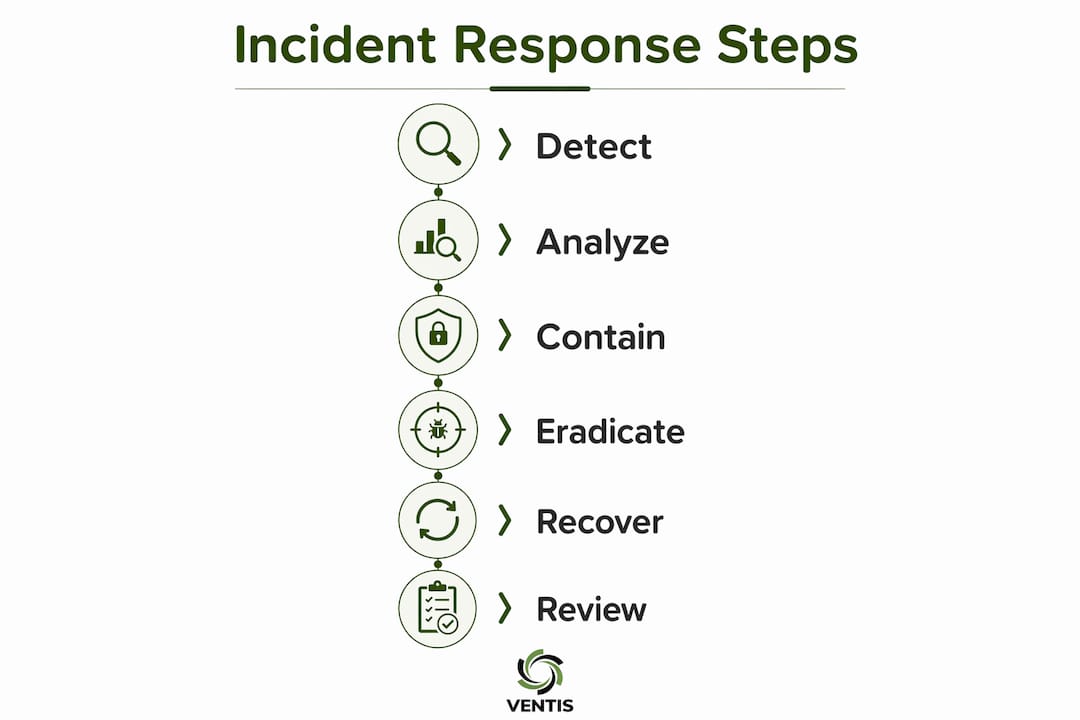
A well-built cyber incident response strategy follows six phases. Each phase has defined inputs, outputs, and time constraints.
-
Preparation. Develop policies, assign IRT roles, build scenario-specific playbooks, and configure monitoring tools. Most IRPs include 8 to 15 playbooks customized for scenarios like ransomware or stolen credentials. Update each playbook after every incident or exercise.
-
Detection and analysis. Monitor alerts, triage signals, and declare an incident when thresholds are crossed. Alert triage is where most small businesses lose time. Assign a dedicated analyst role for this phase, even if that person wears multiple hats.
-
Containment. Isolate affected assets using your severity classification. A P1 incident (full network compromise) triggers immediate asset shutdown. A P3 incident (single workstation malware) may allow monitored isolation instead. Do not rush this step.
-
Eradication. Remove the threat after containment is confirmed and evidence is preserved. Jumping straight to eradication destroys volatile forensic evidence and alerts adversaries, giving them time to deepen network access. Always document before you delete.
-
Recovery. Restore systems from clean backups, verify integrity, and return to normal operations. SEC four-day disclosure rules and HIPAA 60-day notification deadlines mean your recovery and communications must run simultaneously with remediation, not after it.
-
Post-incident review. Conduct a structured post-mortem within two weeks of incident closure. Document root cause, timeline, and control failures in a formal report. This review is the engine for continuous improvement in your security program.
Pro Tip: Run a tabletop exercise at least once a year where your IRT walks through a simulated breach scenario. Schedule a full-scope red or purple team exercise every 18 months to stress-test your detection and response capabilities under realistic conditions.
Testing is not optional. Plans tested annually through tabletop exercises stay executable. Plans that are never tested become fiction.
What are the most common IRP mistakes SMBs make?
Most small business IRPs fail not because they are poorly written, but because they are poorly maintained and never practiced. These are the patterns that show up most often:
"The plan that is not exercised is fiction." Cybersecurity professionals use this phrase because it is true. SMBs that invest in documentation but skip training experience significantly longer downtime than those with tested, executable playbooks.
- Treating the IRP as a static document. An IRP is an operational program, not a one-time deliverable. It must be updated after every incident, every exercise, and every major change to your technology environment.
- Skipping regular testing. A plan that has never been run under pressure will fail under pressure. Annual tabletop exercises are the minimum standard. Without them, your team will freeze at the worst possible moment.
- Rushing to eradication. This is one of the most damaging technical mistakes. Removing malware before preserving memory dumps, log files, and network captures eliminates the evidence you need for forensic investigation and legal proceedings. Review your forensic investigation protocols before an incident happens.
- Siloed tools and misaligned permissions. When your SIEM, endpoint detection, and ticketing systems do not share synchronized logs and permissions, your team develops blind spots. Siloed tools with asynchronous permissions cause detection gaps that attackers exploit.
- Failing to translate risk for leadership. If your IRP is written entirely in technical language, your CEO will not fund it. Present security risks as financial exposure and regulatory liability. That framing gets budgets approved.
Overly complex IRPs also fail. Simple, flexible plans that are tested regularly outperform elaborate documents that no one reads. Keep your core plan concise and put the complexity in the playbooks.
What tools and templates do you need for your IRP?
Building a cyber response plan template library is the practical side of IRP development. Your documentation set should include more than a single master document.
Pro Tip: Start with a one-page severity classification matrix and a single ransomware playbook. Get those two documents tested and working before building out the full library. Complexity added before practice creates confusion.
The table below outlines the core document types every SMB IRP needs:
| Document type | Purpose | Update frequency |
|---|---|---|
| Master IRP policy | Defines scope, roles, and governance | Annually or after major changes |
| Scenario playbooks | Step-by-step response for specific threats | After each incident or exercise |
| Severity classification matrix | Guides escalation and resource decisions | Annually |
| Communication flowchart | Maps internal and external notification paths | Annually or after org changes |
| Evidence preservation form | Captures forensic data before eradication | Review after each incident |
| Post-incident review template | Structures root cause and lessons learned | After every declared incident |
| Tabletop exercise checklist | Prepares team for annual simulation | 60 days before scheduled exercise |
A cybersecurity assessment checklist helps you identify which playbooks your environment needs most before you start writing them. Pair that with a review of your compliance obligations to confirm your communication flowchart covers every required notification trigger.
Decision logs are often overlooked. During an active incident, document every decision made, who made it, and why. These logs protect your organization in regulatory reviews and litigation.
Key Takeaways
A tested, regularly updated incident response plan is the single most effective tool an SMB has for limiting the financial and regulatory damage of a cyber breach.
| Point | Details |
|---|---|
| IRP is an operational program | Treat your plan as a living set of procedures, not a static document filed away after creation. |
| Roles and communication are foundational | Assign IRT roles across IT, legal, HR, and management before an incident occurs. |
| Never skip containment before eradication | Preserve forensic evidence during containment or you lose the ability to investigate and defend legally. |
| Test at minimum once a year | Annual tabletop exercises keep your team ready; untested plans fail when pressure is highest. |
| Translate risk into business language | Leadership funds what they understand; frame every security risk as financial exposure or regulatory liability. |
Why most SMB incident response plans fail before the first breach
I have worked with enough small and mid-sized businesses to see the same pattern repeat. The IRP gets written, often by the IT lead or an outside consultant, and then it gets filed. Leadership signs off, the checkbox gets checked, and the plan does not get touched again until something goes wrong.
That is exactly backwards. The value of an incident response plan is not in the document. It is in the muscle memory your team builds by practicing it. A business that runs two tabletop exercises a year will respond to a real breach in hours. A business that has never practiced will spend the first 48 hours figuring out who is supposed to call whom.
The other failure I see consistently is the leadership disconnect. When the IRP is framed as an IT expense, it competes with every other line item on the budget. When it is framed as the difference between a four-day SEC disclosure and a regulatory fine, it becomes a board-level priority. Cybersecurity's role in business continuity is not a technical conversation. It is a business survival conversation.
The SMBs that recover fastest from breaches are not the ones with the most sophisticated tools. They are the ones where the CEO, the IT lead, and the legal counsel have all sat in the same room and walked through a scenario together. That cross-department coordination before an incident is what separates resilient businesses from the ones that make the news.
— Greg
Cybersecurity incident response support for your business
Building and maintaining a full incident response program takes time, expertise, and ongoing attention that most small business owners do not have to spare.

Ventis Consulting Group works directly with small to mid-sized businesses in Pittsburgh and surrounding areas to develop custom IRPs, build scenario-specific playbooks, and provide the managed IT support that keeps your defenses current. The team at Ventis Consulting Group also helps you meet SEC, HIPAA, and other regulatory notification requirements so you are not scrambling when a breach happens. Whether you need a full IRP build or a review of your existing plan, explore managed IT services from Ventis Consulting Group to get started with a team that knows your environment.
FAQ
What is a cybersecurity incident response plan?
A cybersecurity incident response plan is a documented operational program that defines how your organization detects, contains, eradicates, and recovers from cyber incidents. It includes team roles, severity classifications, communication procedures, and scenario-specific playbooks.
How often should an IRP be tested and updated?
Test your IRP at least annually through tabletop exercises and conduct a full red or purple team exercise every 18 months. Update the plan after every incident, exercise, or major change to your technology environment.
What regulations require an incident response plan?
HIPAA requires breach notifications within 60 days, and SEC rules require material breach disclosure within four days. Many cloud compliance frameworks also mandate documented incident response procedures as a condition of compliance.
How many playbooks does an IRP need?
Most effective IRPs include 8 to 15 scenario-specific playbooks covering threats like ransomware, stolen credentials, and insider threats. Start with the scenarios most relevant to your industry and expand the library as your program matures.
What is the biggest mistake SMBs make with their IRP?
The most common mistake is treating the IRP as a one-time document rather than an active program. Plans that are never practiced fail under real incident conditions, leading to longer downtime and greater financial and regulatory exposure.