

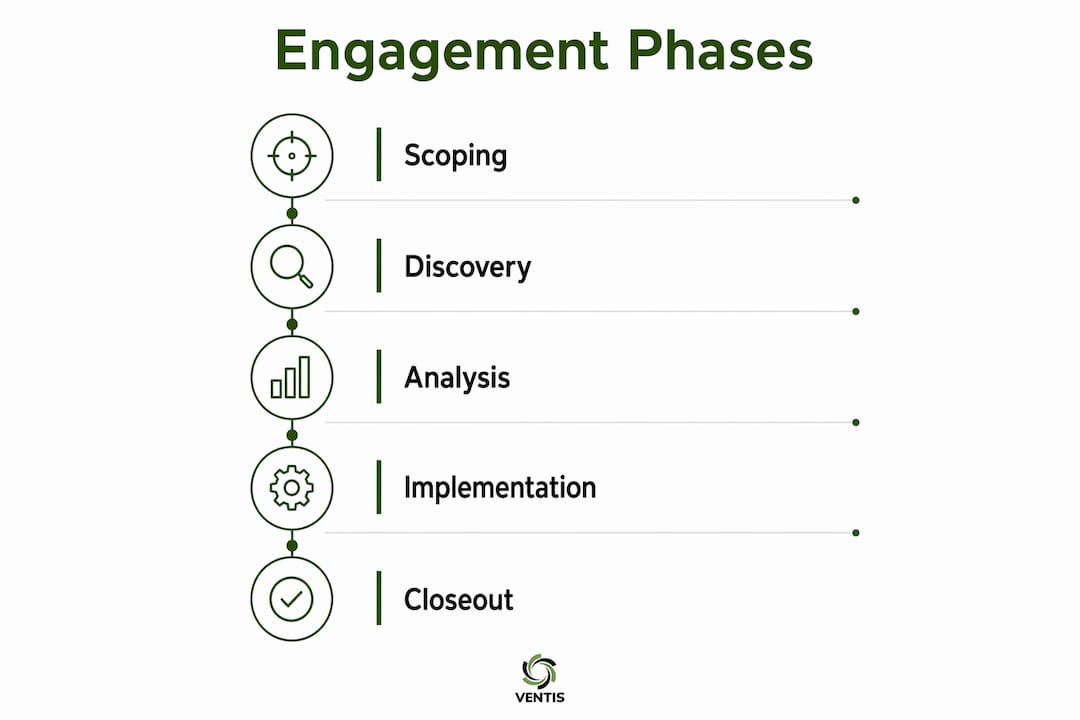
A technology consulting engagement is a structured, phased process where a consultant and client collaborate to define needs, analyze options, implement solutions, and measure results against agreed success criteria. Understanding how technology consulting engagement works helps you avoid scope creep, budget overruns, and misaligned expectations before you sign a single contract. The process follows five defined phases: scoping, discovery, analysis and recommendation, implementation support, and measurement and closeout. Each phase has specific deliverables, decision points, and accountability structures that govern the relationship from start to finish.
How does a technology consulting engagement work phase by phase?
The technology consulting process is sequential by design. Each phase builds on the outputs of the previous one, so skipping or rushing any step creates compounding problems downstream.
-
Scoping. This is the most critical phase. You and the consultant co-define success metrics along with the problem statement, deliverables, and timeline. Scoping is not administrative paperwork. It establishes the objective measurement framework that determines whether the engagement succeeded or failed at closeout.
-
Discovery and Assessment. The discovery phase typically spans several weeks and covers stakeholder interviews, system reviews, workflow and data mapping, gap analysis, and benchmarking. The output is a decision-ready roadmap or architecture document. For AI-focused engagements, GeekyAnts describes a 3–4 week fixed-scope sprint that prioritizes use cases and defines pilot scope before any build begins.
-
Analysis and Recommendation. The consultant synthesizes discovery findings into prioritized recommendations with business impact estimates. A good deliverable here ranks options by effort, cost, and risk. It does not hand you a wish list. Prioritization and sequencing with clear ownership and dependencies are what make a roadmap executable rather than aspirational.
-
Implementation Support. The level of involvement here varies by contract. Advisory-only engagements deliver recommendations without execution responsibility. Implementation-included engagements assign the consultant accountability for outcomes. You need to know which model you are buying before the engagement starts.
-
Measurement and Closeout. The consultant evaluates outcomes against the success metrics defined during scoping. This phase closes the loop and determines whether the stated business problem was solved. Without clear scoping, this phase becomes subjective and disputed.
Pro Tip: Ask your consultant to show you the measurement framework before discovery begins. If they cannot describe how success will be evaluated at closeout, the scoping phase is incomplete.
What do MSA and SOW contracts cover in tech consulting?

Two documents govern almost every technology consulting engagement: the Master Services Agreement (MSA) and the Statement of Work (SOW). Confusing them is one of the most common mistakes business owners make.
The MSA holds the legal backstop for all engagements with a given firm. It covers confidentiality, liability limits, intellectual property ownership, payment terms, and dispute resolution. You negotiate the MSA once. It applies to every SOW you sign with that firm afterward.
The SOW is the operational document for a specific engagement. It contains scope, deliverables, timeline, team composition, and pricing. Separating legal terms from commercial terms in this way enables faster contracting for follow-on work. You can review the MSA structure Ventis Consulting Group uses to see how this separation works in practice.
| Document | What It Covers | When It Is Signed |
|---|---|---|
| MSA | Legal terms, liability, confidentiality, IP, payment rules | Once, at the start of the relationship |
| SOW | Scope, deliverables, timeline, team, fees, acceptance criteria | Once per engagement |
Effective SOWs do three things that prevent disputes. First, they specify deliverables and acceptance criteria explicitly so both parties agree on what "done" means. Second, they include a formal change request process so any scope addition requires written approval and a fee adjustment. Third, they use milestone payment schedules, such as 30% upfront, 40% at midpoint, and 30% at final delivery, to align cash flow with progress.
Pro Tip: Treat the SOW as the operational constitution of the engagement. If a deliverable is not named in the SOW, it is out of scope. Review every line before signing.
What governance practices keep consulting projects on track?
Governance is the operating system of a consulting engagement. Strong governance beats contract clauses alone in controlling delivery risk. Active decision-making and scope discipline keep timelines and budgets intact in ways that legal language cannot.
Effective governance for technology consulting engagements includes the following practices:
- Steering committee with authority. Assign senior stakeholders who can approve scope changes and resolve escalations without delay. A committee without decision-making power creates bottlenecks.
- Biweekly progress reviews. Steering committees meeting every two weeks during active phases catch drift early. Monthly reviews are too infrequent to prevent compounding delays.
- Formal change control. Every request that falls outside the SOW scope triggers a written change request. The change request documents the new work, the cost impact, and the timeline adjustment before any work begins.
- Clear decision rights. Define who approves deliverables, who signs off on change requests, and who can escalate to executive leadership. Ambiguity here is a direct cause of schedule slippage.
- Client feedback windows. Timely client feedback within 3–5 business days is critical to keeping the engagement on schedule. Delayed reviews push consultant timelines and can trigger rework fees.
The last point is one most business owners underestimate. Your responsiveness as a client directly affects the cost and schedule of the engagement. Consultants cannot proceed through review gates without your sign-off. Delays on your side become delays on the invoice.
How do engagement scope and consultant roles affect outcomes?
The scope of a consulting engagement determines who is accountable for results. This is not a minor distinction. It shapes how you staff the project internally, how you measure success, and what happens after the consultant leaves.
-
Advisory-only engagements. The consultant delivers analysis and recommendations. Your internal team executes. This model works well when you have capable technical staff who need strategic direction. It costs less but places execution risk on you.
-
Implementation-included engagements. Contract terms assign accountability for execution outcomes to the consultant. This model suits organizations without deep internal technical capacity. The consultant builds, configures, and validates the solution. You pay more but transfer execution risk.
-
Pilot engagements. Pilots are not demos. A well-scoped pilot tests specific implementation risks such as data quality, workflow adoption, or architecture fit. If your pilot is designed to impress stakeholders rather than reduce uncertainty, it will not tell you what you need to know before a full rollout.
-
Knowledge transfer. When implementation is included, documentation and knowledge transfer are formal deliverables. Your internal team needs to understand what was built and how to maintain it. Without this, you become permanently dependent on the consultant for routine operations.
-
Post-engagement managed services. Many engagements transition into ongoing managed services after closeout. This is a natural continuation when the consultant has deep context on your environment. Ventis Consulting Group structures this transition explicitly so clients move from project mode to operational support without losing continuity. You can learn more about how consulting engagements are structured across different delivery models.
The right engagement model depends on your internal capabilities, your risk tolerance, and your budget. A good consultant will tell you which model fits your situation rather than defaulting to the higher-fee option.
Key takeaways
A technology consulting engagement succeeds when scoping, governance, and the right accountability model are aligned before work begins.
| Point | Details |
|---|---|
| Scoping defines success | Co-define success metrics during scoping so closeout measurement is objective, not disputed. |
| MSA and SOW serve different roles | The MSA covers legal terms once; the SOW governs each specific engagement's scope and fees. |
| Governance prevents drift | Biweekly steering committees with formal change control keep scope and budget on track. |
| Engagement model determines accountability | Advisory-only transfers execution risk to you; implementation-included transfers it to the consultant. |
| Client responsiveness affects cost | Delayed feedback within review windows causes schedule slippage and potential rework fees. |
What i've learned after years of technology consulting engagements
Most project failures I have seen trace back to one of two problems: vague success criteria at scoping, or a client who underestimated their own role in keeping the engagement moving.
The scoping conversation is where the real consulting work begins. When a client cannot articulate what a successful outcome looks like in measurable terms, the engagement is already at risk. I push hard on this in every initial conversation. If we cannot agree on what "done" looks like before discovery starts, we are setting up a subjective argument at closeout.
Governance is the other variable that separates successful engagements from expensive disappointments. I have watched organizations invest in detailed contracts and then skip biweekly reviews because "things are going fine." Scope drift does not announce itself. It accumulates quietly until the budget is gone and the timeline is broken.
The pilot question is one I feel strongly about. A pilot scoped to reduce a specific risk, whether that is data quality, user adoption, or system integration, is worth every dollar. A pilot scoped to produce a polished demo for a board presentation is a waste of time and money. Know which one you are buying.
Finally, choose your engagement model based on your actual internal capabilities, not your aspirational ones. If your team cannot execute on advisory recommendations, an advisory-only engagement will produce a document that sits on a shelf. Match the accountability model to the reality of your organization.
— Greg
How ventis consulting group structures your technology engagement
Ventis Consulting Group works with small and mid-sized businesses in Pittsburgh and the surrounding region to structure technology consulting engagements that deliver real outcomes, not just reports.
Every engagement starts with a clear scoping conversation to define your problem, your success criteria, and the right delivery model for your team. Ventis Consulting Group provides MSA and SOW documentation, governance support, and implementation services that include formal knowledge transfer so your team can operate independently after closeout. For ongoing support, explore the full range of managed IT services available to keep your technology environment running after the engagement ends. If you are ready to talk through your situation, start here.
FAQ
What are the five phases of a technology consulting engagement?
The five standard phases are scoping, discovery and assessment, analysis and recommendation, implementation support, and measurement and closeout. Each phase produces specific deliverables that feed into the next.
What is the difference between an MSA and an SOW?
The MSA covers legal and operational terms that apply to all engagements with a firm, while the SOW details scope, deliverables, timeline, and pricing for one specific engagement. You sign the MSA once and a new SOW for each project.
How long does the discovery phase typically take?
Discovery typically lasts several weeks. For AI-focused engagements, a structured sprint runs 3–4 weeks and produces a prioritized roadmap with a defined pilot scope.
What is the difference between advisory-only and implementation-included engagements?
Advisory-only engagements deliver recommendations without execution responsibility, while implementation-included engagements assign the consultant accountability for building and validating the solution. The right choice depends on your internal technical capacity and risk tolerance.
How can i prevent scope creep during a consulting engagement?
Use a formal change request process documented in the SOW, and hold biweekly steering committee reviews to catch out-of-scope requests early. Scope discipline and active governance are more effective than contract language alone.