

IT consulting is a professional advisory service that helps organizations plan, implement, and optimize technology to support specific business goals. Unlike break-fix support or general tech help, IT consulting connects your technology decisions directly to outcomes like revenue growth, operational efficiency, and risk reduction. Firms like Ventisconsulting, BridgeView IT, and Opsio Cloud each deliver this service differently, but the core purpose is the same: make your technology work harder for your business. Whether you're evaluating a cloud migration, tightening your cybersecurity posture, or untangling years of software sprawl, an IT consultant gives you a structured path forward.
What is IT consulting and how does it differ from regular IT support?
IT consulting, also called technology advisory services, is the practice of providing expert guidance on how a business should select, deploy, and manage technology. The distinction from standard IT support matters. Support is reactive. Consulting is strategic. A support technician fixes your server when it goes down. A consultant tells you whether you should still be running that server at all.
The scope of IT consulting spans several disciplines. A consultant might assess your entire technology stack against your three-year business plan, design a cloud architecture for a specific workload, or evaluate whether your current software licensing is costing you more than it should. Indirect IT costs like technical debt and inefficient licensing can reach up to 20% of total IT spend. That figure represents real money leaving your business every year without delivering value.

Consulting engagements also vary in depth. A small business might hire a consultant for a one-time security assessment. A mid-sized company might retain a firm for ongoing technology roadmap guidance. The common thread is that the work is advisory and outcome-focused, not just operational.
What services do IT consultants typically provide?
IT consultants cover a broad range of service areas, and the right engagement depends on where your business has the most exposure or opportunity. Here are the core categories you'll encounter:
- IT strategy and roadmap planning: Aligning technology investments with business priorities over a 12 to 36-month horizon.
- Cloud design and migration: Evaluating platforms like Microsoft Azure, Amazon Web Services, or Google Cloud and designing migration plans that minimize disruption.
- Cybersecurity assessments: Identifying vulnerabilities, reviewing access controls, and recommending remediation steps. For context on current threats, the cybersecurity risks for mid-sized businesses in 2026 have grown significantly more complex.
- Vendor selection and contract review: Evaluating software and hardware vendors against your actual requirements rather than a vendor's sales pitch.
- DevOps and software optimization: Reviewing development pipelines, deployment practices, and application performance.
- Compliance and governance: Helping businesses meet frameworks like NIST, SOC 2, or HIPAA through structured assessments and documentation.
Consultants bring certifications and frameworks that most internal IT teams at smaller companies simply don't have time to maintain. Credentials like Certified Information Systems Security Professional (CISSP), AWS Solutions Architect, or ITIL practitioner signal that a consultant has validated expertise in specific domains, not just general experience.
Pro Tip: Ask any prospective consultant to walk you through a recent engagement in your industry. How they describe the problem, their process, and the outcome tells you more than any credential list.
What are the main benefits of IT consulting for small businesses?
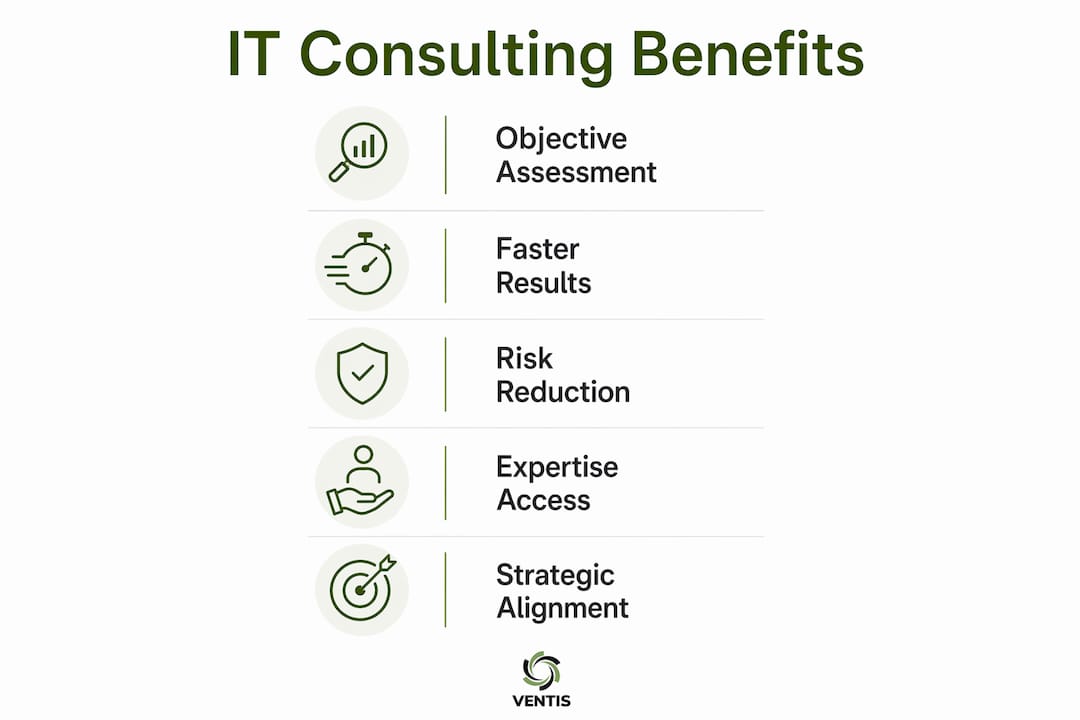
The benefits of IT consulting go well beyond getting a technology recommendation. For small to mid-sized businesses, the value shows up in four specific ways.
Objective decision-making. External consultants provide objective assessments free from internal politics and legacy biases. This matters more than it sounds. Internal teams often defend past decisions because reversing them feels like admitting failure. A consultant has no such attachment and will tell you what the data actually shows.
Faster results. Most mid-sized organizations see tangible outcomes within 60 to 90 days of starting a consulting engagement, including clarified priorities and removed blockers. That timeline is short enough to demonstrate ROI before a full transformation program is even underway.
Cost reduction. Experienced consultants conduct Total Cost of Ownership assessments that surface hidden costs most businesses overlook. Addressing indirect IT costs through consulting typically improves overall budget efficiency and reduces unnecessary spend on tools that duplicate function or carry unused licenses.
Access to specialized expertise on demand. Hiring a full-time cloud architect or cybersecurity specialist costs significantly more than engaging one for a defined project. Consulting gives you senior-level expertise for the duration you actually need it, without the overhead of a permanent hire.
"The primary value of external consultants is objective decision-making free from internal politics and legacy biases." — Abbacus Technologies
For businesses managing cybersecurity compliance, consulting also reduces the risk of regulatory exposure by identifying gaps before an audit or incident forces the issue.
How do IT consulting engagements work?
Understanding how IT consulting works in practice helps you set realistic expectations and get more from the engagement. Most engagements follow a defined structure, even if the scope varies.
Common engagement types:
- Project advisory: A time-limited engagement focused on a specific deliverable, such as a cloud migration plan or a security gap assessment.
- Transformation programs: Longer engagements spanning six to eighteen months, covering multiple technology domains and organizational change.
- Retainer models: Ongoing advisory relationships where a consultant provides regular guidance, reviews, and recommendations on a monthly or quarterly basis.
Typical phases in a consulting engagement:
- Assessment: The consultant audits your current environment, interviews stakeholders, and documents the gap between where you are and where you need to be.
- Recommendations: A structured report or roadmap is delivered with prioritized actions, cost estimates, and risk ratings.
- Implementation support: The consultant either guides your internal team through execution or works alongside them directly.
- Outcomes tracking: Progress is measured against the original goals, with adjustments made as the engagement evolves.
Here is how consulting compares to relying solely on an internal IT team:
| Factor | IT consultant | Internal IT team |
|---|---|---|
| Objectivity | High. No internal bias or legacy attachment. | Lower. Tied to past decisions and team dynamics. |
| Specialized expertise | Deep in specific domains for defined periods. | Broad but often generalist at smaller companies. |
| Cost structure | Project fees from $5,000 to $50,000; hourly rates from $75 to $250. | Fixed salary plus benefits, regardless of workload. |
| Availability | Engaged for defined scope and timeline. | Full-time, but bandwidth is finite. |
| Knowledge transfer | Built into well-structured engagements. | Retained internally but can leave with staff turnover. |
Consultants augment rather than replace your internal IT team. The goal is to bring in focused senior expertise for a defined challenge, then transfer that knowledge back to your team when the engagement closes.
Pro Tip: Before signing any consulting agreement, define three specific outcomes you expect by day 90. If a consultant can't commit to measurable early wins, that's a signal the engagement lacks focus.
How to select the right IT consulting partner
Choosing the right consulting partner is where many businesses make avoidable mistakes. Price is the wrong starting point. Fit, experience, and clarity of process matter far more.
Use this checklist when evaluating candidates:
- Relevant recent experience: Has the firm worked with businesses your size, in your industry, within the last two years? General IT experience does not substitute for domain-specific knowledge.
- Clear outcome definitions: Can they articulate what success looks like at 30, 60, and 90 days? Vague deliverables produce vague results.
- Transparent pricing: Upfront agreement on timeline and pricing is the single most effective way to maintain stakeholder buy-in throughout the engagement.
- References and case studies: Ask for two or three client references you can actually call. A firm confident in its work will provide them without hesitation.
- Communication style: Will you receive weekly updates, or will you be chasing status reports? Establish the cadence before the contract is signed.
- Cultural fit: A consultant who talks over your team or dismisses your existing infrastructure will create friction. Look for someone who listens before they prescribe.
Waiting too long to engage IT consultants is a documented mistake that leads to delayed initiatives and riskier technology investments. The businesses that benefit most from consulting are the ones that bring in outside expertise before a crisis forces the decision. Review your IT consulting best practices before you start the selection process so you know what questions to ask.
Key takeaways
IT consulting delivers the most value when it is treated as a strategic investment in technology alignment, not a one-time fix for an immediate problem.
| Point | Details |
|---|---|
| IT consulting defined | Advisory services that connect technology decisions directly to business goals and outcomes. |
| Core service areas | Strategy, cloud design, cybersecurity, vendor selection, compliance, and software optimization. |
| Tangible early outcomes | Most businesses see clarified priorities and removed blockers within 60 to 90 days. |
| Cost structure | Project fees range from $5,000 to $50,000 for mid-market clients; hourly rates run $75 to $250. |
| Selection criteria | Prioritize relevant experience, transparent pricing, and measurable outcome definitions over lowest cost. |
Why I think most small businesses engage consultants too late
I've seen the same pattern repeat itself more times than I can count. A business owner waits until a system failure, a compliance notice, or a failed software rollout forces the conversation. By that point, the options are narrower and the costs are higher.
The mindset shift that changes everything is this: IT consulting is not a luxury for companies with large IT budgets. It is risk management for businesses that cannot afford to get their technology decisions wrong. A mid-sized company in Pittsburgh running on outdated infrastructure or misconfigured cloud services is not saving money by avoiding a consultant. It is accumulating risk that will surface at the worst possible time.
The other thing I'd push back on is the fear that bringing in a consultant means your internal IT person is being replaced or criticized. The most successful engagements treat consulting as augmentation, not substitution. Your internal team knows your business. A consultant knows the technology domain deeply. Together, they produce better outcomes than either could alone.
If you're on the fence about whether your business needs consulting, ask yourself one question: Do you have a written technology roadmap that connects your IT investments to your business goals for the next 24 months? If the answer is no, that's your signal.
— Greg
See how Ventisconsulting supports your technology strategy
If this article clarified what IT consulting is and what it can do for your business, the next step is finding a partner who delivers on that promise. Ventisconsulting works with small to mid-sized businesses in Pittsburgh and the surrounding region, providing managed IT services that combine strategic guidance with hands-on support. The approach is consultative by design. You get a team that understands your goals, not just your hardware. From cloud solutions and cybersecurity assessments to ongoing IT support, Ventisconsulting builds technology plans that fit how your business actually operates. Explore the full range of IT solutions and see what a practical, local partner looks like.
FAQ
What is IT consulting in simple terms?
IT consulting is a professional advisory service where experts help businesses make better technology decisions. Consultants assess your current setup, identify gaps, and recommend specific steps to align your technology with your business goals.
How much does IT consulting cost for a small business?
Project-based fees for mid-market clients typically range from $5,000 to $50,000, with hourly rates between $75 and $250. The final cost depends on the scope, duration, and complexity of the engagement.
How long does an IT consulting engagement take?
Most initial engagements run 60 to 90 days and focus on assessment and recommendations. Larger transformation programs can span six to eighteen months, depending on the number of technology domains involved.
Will an IT consultant replace my internal IT staff?
No. IT consultants are designed to work alongside your existing team, not replace them. They bring specialized expertise for a defined project or roadmap, then transfer knowledge back to your internal staff when the engagement ends.
What is the difference between managed IT services and IT consulting?
IT consulting is advisory and project-focused, delivering strategy and recommendations. Managed IT services provide ongoing operational support, monitoring, and maintenance. Many businesses use both: consulting to set the direction and managed IT support to execute and maintain it day to day.