

Protecting customer data in a retail business is defined by your ability to control where that data lives, who can access it, and how it moves across every system you operate. Retailers today collect payment card numbers, email addresses, purchase histories, and loyalty program details across POS terminals, e-commerce platforms, CRM tools, and mobile apps. Frameworks like PCI DSS 4.0 and GDPR set the legal floor, but real protection requires layered technical controls built on top of compliance. This guide gives you a practical, step-by-step path to retail data security that holds up in the real world.
How to protect customer data in your retail business: start with visibility
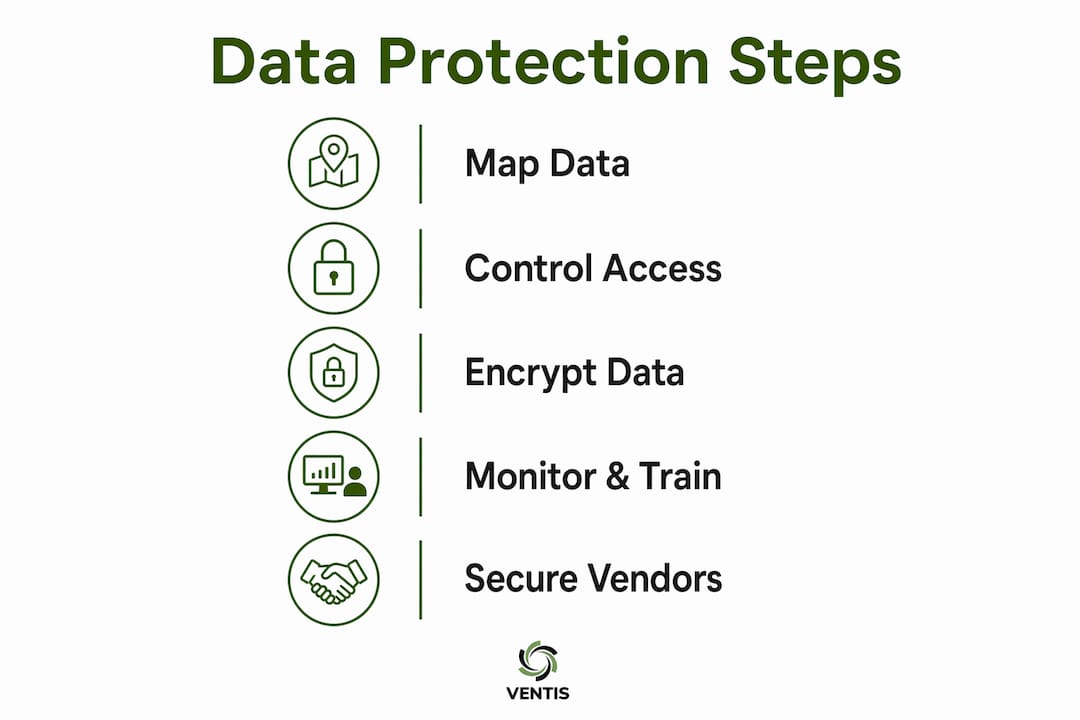
You cannot protect data you cannot see. Visibility into data location and movement is the foundational step before any technical control delivers real value. Retailers often discover they are storing sensitive customer information in places nobody planned for, including old CRM exports sitting in shared drives, loyalty data cached on mobile devices, and payment records buried in third-party analytics tools.
Start by building a complete data inventory across every system that touches customer information:
- POS terminals and payment processors: Card numbers, transaction histories, and cardholder names
- E-commerce platforms: Shipping addresses, saved payment methods, and browsing behavior
- CRM and email marketing tools: Contact lists, purchase preferences, and communication histories
- Mobile apps and loyalty programs: Device identifiers, location data, and reward balances
- Cloud storage and data warehouses: Aggregated analytics, segmentation data, and backup files
- Third-party vendors and integrations: Any partner with API access to your customer records
Once you have the inventory, map the data flow. Trace how information is collected at the point of sale, where it is stored, how it transfers between systems, and who it is shared with externally. Effective data protection is a dynamic system that must survive integration failures, channel switchovers, and vendor changes. Retailer loyalty and personalization stacks in particular tend to spread sensitive data widely, so using a Data Security Posture Management (DSPM) tool to run continuous data discovery can reduce exposure before an audit or incident forces the issue.
Pro Tip: Involve your store operations manager, IT lead, and marketing team in the data mapping exercise together. Each team knows about data flows the others do not, and a cross-functional session closes blind spots faster than any solo audit.

How does access control reduce your risk of a data breach?
Restricting who can reach customer data is one of the highest-return controls you can implement. The principle of least privilege means every employee, contractor, and vendor gets access only to the specific systems and data their role requires. Nothing more. A cashier does not need access to your full customer database. A marketing vendor does not need write access to your payment records.
Here is a practical sequence for tightening access in a retail environment:
- Audit all active accounts. Pull a list of every user account across your POS, CRM, e-commerce platform, and cloud tools. Remove inactive accounts immediately, including former employees and expired vendor credentials.
- Segment access by role. Assign permissions based on job function across all retail platforms including POS, inventory, finance, and customer service. Least-privilege segmentation across all functional platforms reduces the blast radius of any single compromised account.
- Enforce MFA on every access point. PCI DSS 4.0 mandates MFA for all access to the cardholder data environment, and that requirement now extends broadly across retail systems handling payment data.
- Centralize identity management. Use a single identity provider such as Microsoft Entra ID or Okta to manage logins across systems. This gives you one place to monitor login activity, enforce policies, and revoke access instantly.
- Review permissions quarterly. Role changes, promotions, and vendor contract renewals all create permission drift. A quarterly review catches access that should have been removed months ago.
Pro Tip: Choose phishing-resistant MFA methods like hardware security keys (YubiKey) or passkeys rather than SMS-based codes. SMS authentication can be intercepted through SIM-swapping attacks, which are increasingly common in retail-targeted fraud.
What are the best practices for encrypting customer data?
Encryption is the last line of defense when other controls fail. If a bad actor extracts your customer database and the data is properly encrypted, the records are unreadable. PCI DSS 4.0 requires strong cryptography and key rotation with documented audit trails for all cardholder data, and those same standards apply as a practical baseline for any sensitive customer information.
The core encryption requirements for retail businesses break down like this:
| Data State | Standard to Use | Key Requirement |
|---|---|---|
| Data at rest (databases, backups) | AES-256 | Documented key rotation schedule |
| Data in transit (web, API, POS) | TLS 1.2 or TLS 1.3 | Valid certificates, no self-signed certs in production |
| Mobile and POS endpoints | Device-level encryption | Remote wipe capability enabled |
| Backup files | AES-256 with separate key storage | Keys stored separately from backup data |
One critical gap many retailers miss: encryption at rest alone does not protect data that has already been downloaded into email threads, shared drives, or collaboration tools like Slack or Google Drive. Those copies need separate controls including data loss prevention (DLP) scanning and access restrictions. Retire any legacy TLS 1.0 or TLS 1.1 configurations immediately. They are no longer considered secure and will fail a PCI DSS 4.0 audit.
- Maintain a full certificate inventory with expiration dates and renewal owners assigned
- Rotate encryption keys on a documented schedule, not just when a breach occurs
- Store encryption keys separately from the data they protect
- Test your backup decryption process at least twice per year to confirm it actually works
How to secure third-party access and stop data leakage
Third-party vendors are one of the most underestimated risks in retail data security. The 2026 Zara breach exposed approximately 197,400 customer records through compromised tokens belonging to a retired vendor. The vendor was no longer active, but the tokens still had live access to cloud data. That single oversight cost the company a significant breach.
Token and credential lifecycle management is the fix:
- Revoke access immediately at offboarding. Build vendor offboarding into your contract termination process so tokens, API keys, and credentials are disabled on the same day the relationship ends.
- Limit token permissions to minimum scope. A vendor running marketing analytics does not need read access to full customer profiles. Scope tokens to the exact data fields the vendor's function requires.
- Monitor data warehouse and cloud query behavior. Set alerts for unusual query volumes, off-hours access, or bulk data exports. Abnormal query patterns are often the first signal of a compromised token or insider threat.
- Conduct quarterly vendor access reviews. Treat third-party access the same way you treat employee access. Review it, document it, and remove what is no longer needed.
For retailers using third-party integrations across payment processors, loyalty platforms, and marketing tools, the attack surface grows with every new vendor connection. Each integration is a potential entry point that needs the same scrutiny as your internal systems.
Building resilience: monitoring, training, and incident response
Controls and configurations degrade over time without active maintenance. Continuous monitoring, regular employee training, and a tested incident response plan are what separate retailers who contain breaches quickly from those who discover them months later.
Here is how to build that resilience layer:
- Deploy continuous monitoring across endpoints, networks, and cloud. Use tools like Microsoft Defender for Endpoint or a managed detection and response (MDR) service to catch threats in real time. Monitoring gaps are where breaches grow undetected.
- Run phishing simulations and security awareness training monthly. Employee email is a primary breach vector in retail, and AI-powered phishing attacks are harder to spot than ever. Monthly training keeps recognition skills sharp.
- Write a documented incident response plan. Assign clear roles: who declares an incident, who notifies customers, who contacts your payment processor, and who communicates with regulators. Ambiguity during a breach costs time and money.
- Run tabletop exercises twice per year. Walk your team through a simulated breach scenario. These exercises surface gaps in your plan before a real incident does.
- Review and update security policies annually. Threats evolve, and so do compliance requirements for retailers. An annual policy review keeps your controls aligned with current risks.
Pro Tip: After every tabletop exercise, assign a single owner to each gap identified. Unowned action items from exercises almost never get resolved. One owner, one deadline, one follow-up.
Both GDPR and FTC enforcement reinforce this approach. GDPR gives individuals rights to access, correct, and delete their personal data, which means your incident response plan must include a process for handling data subject requests under pressure. The FTC holds US retailers accountable for documented, reasonable security decisions scaled to the sensitivity of the data they hold. Documented controls are not just good practice. They are your legal defense.
Key takeaways
Protecting customer data in retail requires layered controls across data visibility, access management, encryption, vendor oversight, and continuous monitoring, all tied to documented compliance with PCI DSS 4.0 and applicable privacy regulations.
| Point | Details |
|---|---|
| Start with data visibility | Map every location and flow of customer data before applying any technical control. |
| Enforce least privilege and MFA | Restrict access by role and require phishing-resistant MFA for all systems touching cardholder data. |
| Encrypt at rest and in transit | Use AES-256 and TLS 1.2+ with documented key rotation and a complete certificate inventory. |
| Control third-party token access | Revoke vendor credentials immediately at offboarding and monitor cloud query behavior for anomalies. |
| Train and test continuously | Run monthly phishing simulations and twice-yearly tabletop exercises to keep your response plan current. |
What I've learned from watching retailers get this wrong
After working with retail businesses of all sizes on their cybersecurity posture, the pattern I see most often is not a lack of tools. It is a lack of ownership. Retailers invest in a firewall or a POS system with built-in encryption and then assume the data protection problem is solved. It is not. The firewall does not know about the marketing vendor who still has an active API token from a campaign that ended eight months ago. The encrypted POS does not protect the customer export your sales manager emailed to a personal Gmail account.
The second most common gap is treating compliance as the finish line. PCI DSS and GDPR are floors, not ceilings. I have seen businesses pass their annual PCI audit and then experience a breach three months later through a vector the audit never examined. Compliance tells you what the minimum standard is. Risk management tells you what your actual exposure is.
The retailers who handle this well share one trait: they treat data protection as an operational discipline, not a one-time project. They review vendor access quarterly. They run phishing tests. They update their incident response plan when their team changes. None of that is technically complex. All of it requires consistent follow-through. If you are a small or mid-sized retailer, the good news is that you do not need an enterprise security budget to get this right. You need clear processes, the right tools for your scale, and a partner who understands your environment. Start with visibility, lock down access, encrypt what matters, and build the habit of reviewing your controls regularly. That sequence works.
— Greg
How Ventisconsulting can help you secure your retail business
Retail cybersecurity is not a set-it-and-forget-it problem, and you should not have to manage it alone.
Ventisconsulting works with small and mid-sized retail businesses in Pittsburgh and the surrounding region to build layered data protection programs that actually fit how you operate. From PCI DSS-aligned managed IT and MFA implementation to encryption audits, vendor access reviews, and continuous monitoring, the team at Ventisconsulting delivers practical cybersecurity support without the enterprise price tag. If you want to know exactly where your customer data is exposed and what to do about it, reach out to Ventisconsulting for a no-pressure consultation. Your customers trust you with their data. Let's make sure that trust is well placed.
FAQ
What is the biggest data security risk for retail businesses?
Third-party vendor access and compromised credentials are among the top risks. The 2026 Zara breach exposed nearly 197,400 customer records through a retired vendor's active cloud tokens, showing that unrevoked access is a serious and often overlooked vulnerability.
Does PCI DSS 4.0 apply to small retail businesses?
Yes. PCI DSS 4.0 applies to any business that stores, processes, or transmits payment card data, regardless of size. Key requirements include MFA for all access to the cardholder data environment and TLS 1.2 or higher for data transmission.
How does GDPR affect US-based retailers?
GDPR applies to any retailer that collects or processes personal data from individuals in the European Union, even if the business is based in the US. It gives customers the right to access, correct, or delete their data, so retailers need processes in place to respond to those requests.
What encryption standard should retailers use for customer data?
AES-256 is the standard for data at rest, and TLS 1.2 or TLS 1.3 is required for data in transit. Both are mandated under PCI DSS 4.0, and both require documented key management and rotation schedules to remain compliant.
How often should retail businesses review their cybersecurity controls?
Access permissions should be reviewed quarterly, security policies annually, and incident response plans after every significant team change or tabletop exercise. Monthly phishing simulations keep employee awareness current between formal reviews.