

Responding to security alerts effectively is defined as the structured process of triaging, prioritizing, and acting on detection events before they escalate into confirmed breaches. Security Information and Event Management (SIEM) platforms and Endpoint Detection and Response (EDR) systems generate enormous alert volumes. Mid-market SOCs generate over 11,000 alerts daily, with nearly 70% going ignored due to sheer volume. That ignored 70% is where breaches hide. For IT professionals and security managers at small to mid-sized businesses, the challenge is not just detecting threats. It is building a repeatable process to act on them without burning out your team.
How to respond to security alerts effectively through triage
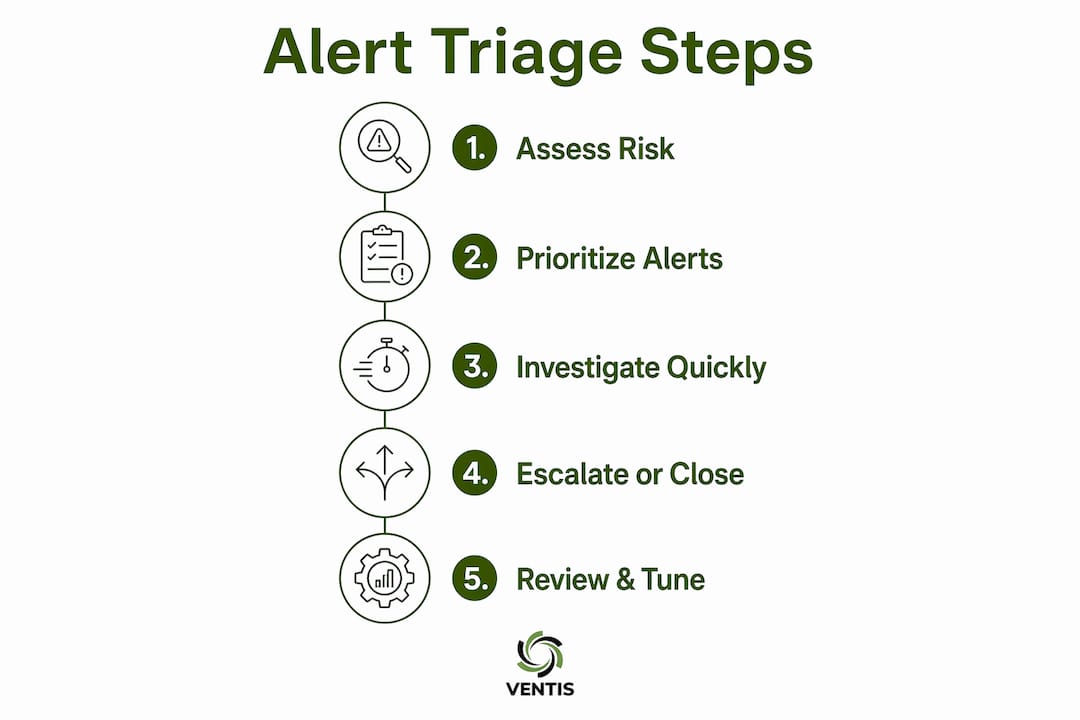
Triage is the first and most critical step in any alert response workflow. The goal is to separate genuine threats from noise before investing analyst time. Prioritizing by the intersection of asset criticality and detection confidence, rather than processing alerts in a first-in, first-out queue, is the recommended triage approach for 2026 SOC operations. An alert on a domain controller with high detection confidence ranks above a low-confidence alert on a guest workstation, regardless of which fired first.
Use these four triage questions for every alert category:
- What asset is affected? Identify whether the asset is critical to operations, stores sensitive data, or sits in a high-value network segment.
- How confident is the detection? Calibrate signal quality beyond the tool's default severity rating. Understand why the alert fired, not just what severity label it carries.
- Is the activity still active? A completed lateral movement event requires a different response than one in progress.
- What is the blast radius? Estimate how many systems or users could be affected if the threat is real and uncontained.
Tier 1 analysts should spend no more than 12–20 minutes per alert before escalating or closing. Spending 45 minutes investigating a single low-value alert while a critical one ages in the queue is one of the most common and costly mistakes in security operations.
Experienced SOCs also group related alerts by detection rule and time window. This reduces redundant investigations when the same rule fires repeatedly across similar events. Pair that with auto-close runbooks for known false positives, and your team focuses only on alerts that require human judgment.

Pro Tip: Build a short auto-close runbook for your top five recurring false positives. Review it quarterly to confirm those patterns have not changed. This single habit can recover hours of analyst time each week.
How do you tune alerts without creating blind spots?
Alert tuning is a risk management exercise, not a housekeeping task. The goal is to reduce regret, meaning you want to suppress noise without losing visibility across any stage of a real attack chain. Security teams should eliminate at least 90% of high-volume alert traffic through rule logic adjustments before considering disabling any alert entirely.
Here is what effective tuning looks like in practice:
- Whitelist by context, not by entity. Suppress alerts from a specific service account only when it performs a specific action on a specific host. Broad suppression by account name alone creates gaps.
- Track false positive rates per rule. If a rule fires 500 times a week and zero of those are true positives, that rule needs logic work, not a disable toggle.
- Make every tuning change reversible. Over-tuning creates blind spots that attackers can exploit. Every suppression change should be documented, dated, and reviewed on a set schedule.
- Measure tuning effectiveness. Compare alert volume, true positive rate, and analyst time per alert before and after each tuning change.
| Tuning Approach | Risk Level | Best Use Case |
|---|---|---|
| Whitelist by context | Low | Known benign processes on specific hosts |
| Raise detection threshold | Medium | Reducing noise on high-volume behavioral rules |
| Disable alert entirely | High | Only after 90%+ volume reduction via logic |
| Suppress by entity only | High | Avoid; creates exploitable gaps |
The feedback loop between investigation outcomes and detection engineering is what separates mature security programs from reactive ones. Closing the loop after each investigation refines both detection logic and analyst triage judgment over time. If your team investigates an alert and closes it as a false positive, that outcome should feed directly back into the rule that generated it.
Pro Tip: Assign one analyst each sprint to review the top 10 false positive rules. Have them propose one logic change per rule. This practice builds detection engineering skills across your team and reduces noise faster than any single tool purchase.
Can automation actually replace human judgment in alert response?
Automation does not replace human judgment. It handles the repeatable, deterministic steps so analysts can focus on the decisions that require experience. AI-driven triage engines execute full enrichment and correlation for every alert, applying the same investigation logic consistently at machine speed. A human analyst working a queue of 200 alerts will inevitably skip enrichment steps under pressure. An automated system does not.
The practical benefits of automation in alert triage include:
- Automated enrichment: Pulling threat intelligence, user context, and asset data the moment an alert fires, so analysts start with a complete picture instead of a raw event.
- Correlation across data sources: Linking a suspicious login to a prior phishing email and a recent privilege escalation, giving analysts a narrative instead of isolated signals.
- Playbook-driven escalation: Triggering escalation workflows automatically when specific conditions are met, such as confirmed lateral movement or data exfiltration indicators.
- Campaign-based signal analysis: Tools like SmishAlert aggregate related signals into campaign views rather than surfacing them as isolated alerts, which reduces investigation volume significantly.
The right balance is automation handling enrichment, correlation, and routine escalation, with analysts making the final call on containment and remediation. AI agents codifying expert workflows enable consistent execution at scale while preserving the human judgment layer for complex decisions. For SMBs without large security teams, this balance is not optional. It is the only way to maintain coverage without burning through headcount.
Pro Tip: Before buying a dedicated SOAR platform, check whether your existing EDR or SIEM supports native playbook automation. Many mid-market tools include this capability and it is underused.
Why documentation and timelines define your incident response
Documentation is not a post-incident formality. It is an active defense tool. Regulatory notification windows begin the moment an incident is classified as confirmed, not when it is fully investigated. GDPR requires notification within 72 hours. The SEC mandates disclosure within 96 hours for material incidents. State breach notification laws vary but are equally unforgiving. Missing these windows because your team could not reconstruct a timeline from memory is an avoidable compliance failure.
Build your documentation practice around these steps:
- Log every decision with a timestamp. Record what you knew, what you decided, and why. A hash-chained, append-only ledger of IR decisions satisfies compliance requirements and creates a defensible record.
- Classify the incident as early as possible. Use a structured decision tree to confirm malicious activity, identify affected data, determine whether the threat is still active, and estimate the blast radius. This four-question framework from IR-OS keeps classification fast and consistent.
- Separate containment from eradication. Rushing to wipe a system before imaging it destroys forensic evidence. Document the trade-off explicitly if you choose speed over preservation.
- Conduct an After Action Report (AAR) within 72 hours of closure. Cover what happened, what worked, what failed, and what changes to make to detection rules, playbooks, or escalation criteria.
Containment decisions made under pressure require deliberate trade-offs. Avoiding panic reactions and documenting your reasoning improves both IR outcomes and your legal defensibility.
For SMBs, cybersecurity compliance best practices around documentation are often underdeveloped. A single well-structured incident log can be the difference between a manageable regulatory conversation and a costly enforcement action.
What are the most common alert response mistakes?
Most alert response failures are process failures, not technology failures. The tools are often adequate. The workflows around them are not.
- Working alerts in FIFO order. Processing alerts by arrival time instead of risk level means a critical threat can sit in queue behind dozens of low-value notifications. Risk-based prioritization is the standard, not the exception.
- Spending too long on low-value alerts. Without a time-box, analysts can spend 40 minutes on an alert that should have been closed or escalated in 15. The 12–20 minute Tier 1 limit exists for this reason.
- Suppressing alerts without review. Disabling a noisy rule without understanding why it fires is how blind spots form. Every suppression needs a documented rationale and a review date.
- Skipping the feedback loop. Investigation outcomes that never reach detection engineering mean the same false positives keep firing indefinitely. Effective triage outcomes feed directly into analyst training and tuning decisions.
- Inconsistent escalation criteria. When different analysts apply different standards for escalation, critical alerts get closed and minor ones get escalated. Written escalation criteria, reviewed quarterly, fix this.
Pro Tip: Run a monthly 30-minute review of the previous month's closed alerts. Look for patterns in what got escalated versus closed. Inconsistencies in that data reveal training gaps faster than any formal assessment.
Understanding SIEM fundamentals for SMBs is a solid starting point if your team is still building out its detection baseline.
Key takeaways
Responding to security alerts effectively requires risk-based triage, disciplined tuning, automation support, and thorough documentation working together as a single repeatable system.
| Point | Details |
|---|---|
| Risk-based triage first | Prioritize alerts by asset criticality and detection confidence, not arrival order. |
| Time-box Tier 1 analysis | Spend no more than 12–20 minutes per alert before escalating or closing. |
| Tune with discipline | Reduce alert volume through rule logic before disabling; document every suppression change. |
| Automate enrichment, not judgment | Use automation for context gathering and escalation triggers; keep humans on containment decisions. |
| Document every decision | Timestamped, append-only records protect you legally and improve future response quality. |
Alert response in practice: what i've actually seen work
I have worked with enough SMB security teams to say this plainly: the biggest gap is almost never the tooling. It is the absence of a written process that everyone follows consistently.
Teams running Splunk, Microsoft Sentinel, or CrowdStrike Falcon often have more detection capability than they use. What they lack is a triage workflow that tells an analyst exactly what to do in the first five minutes of receiving an alert. Without that, every analyst improvises, and improvisation at scale produces inconsistent outcomes.
The teams that handle alerts well share one habit: they treat every closed alert as a data point. They ask whether the closure was correct, whether the rule that fired needs adjustment, and whether the playbook needs updating. That feedback loop is what separates a team that gets better every month from one that stays stuck in the same reactive cycle.
For SMBs specifically, I would push back on the idea that you need a large team to do this well. Two analysts with a clear process, a tuned detection stack, and a working escalation runbook will outperform a six-person team operating without structure. Invest in the process before you invest in headcount. And if you are evaluating where to start, proactive cyber risk management gives you a framework for prioritizing where your gaps are most likely to hurt you.
The other thing I will say: do not wait for a real incident to test your documentation practices. Run a tabletop exercise, trace a fictional alert from detection to closure, and see whether your team can reconstruct a defensible timeline. Most teams cannot. That gap is fixable before it becomes a compliance problem.
— Greg
Ready to strengthen your alert response process?
If your team is dealing with alert overload, inconsistent triage, or gaps in your incident documentation, Ventis Consulting Group can help you build a process that actually holds up under pressure.
Ventis Consulting Group works with small to mid-sized businesses in Pittsburgh and surrounding areas to implement structured security alert management, from SIEM configuration to incident response planning. Our managed IT and cybersecurity solutions are built for organizations that need enterprise-grade security practices without the enterprise-sized team. We do not hand you a generic framework. We work with your environment, your tools, and your team to build something that fits. Reach out to Ventis Consulting Group today and let us take a look at what you are working with.
FAQ
What does it mean to respond to security alerts effectively?
Responding to security alerts effectively means triaging each alert by risk level, investigating within a defined time window, and escalating or closing based on documented criteria. The goal is to address genuine threats quickly while avoiding analyst burnout from low-value noise.
How many alerts should a tier 1 analyst handle per alert?
Tier 1 analysts should spend no more than 12–20 minutes per alert before escalating or closing. Exceeding that window on a single alert without escalation is a workflow failure, not an investigation success.
What is alert fatigue and how do you fix it?
Alert fatigue occurs when high alert volumes cause analysts to ignore or rush through detections, increasing the risk of missing real threats. The fix combines risk-based prioritization, alert tuning to reduce false positives, and auto-close runbooks for known benign patterns.
How do you tune security alerts without missing real threats?
Tune alerts by adjusting rule logic to suppress at least 90% of high-volume false positives before considering disabling any rule. Every tuning change should be documented, reversible, and reviewed on a set schedule to prevent blind spots.
When do regulatory notification clocks start after a security incident?
Regulatory clocks start when an incident is classified as confirmed, not when the investigation is complete. GDPR requires notification within 72 hours and the SEC within 96 hours, making early classification and timestamped documentation critical.