
Plan on $125 to $400 per drop for a standard Cat6 installation, $175 to $500 for Cat6A, and more for fiber, depending on scope. A small office job with a modest number of drops typically lands in the lower thousands to mid tens of thousands, a mid-size buildout spans a wider range based on scale and complexity, and larger enterprise projects can surpass several tens of thousands. Labor and building access drive most of that swing, not the cable itself, so get a site survey before you lock in a number.
TL;DR:
- Cabling costs vary widely based on project size, with small offices averaging $125 to $400 per drop for Cat6 and up to $500 for Cat6A, including labor and fixed telecom-room expenses.
- Labor typically accounts for 55% to 65% of the total cost on copper installs, with fiber projects requiring more specialized skills that increase prices.
- Fixed costs like telecom-room equipment significantly impact small projects, while larger builds spread these costs over more drops, reducing per-unit expenses.
- Quotes should clearly specify cable specs, termination standards, testing methods, and build items to avoid hidden charges and ensure warranty coverage.
- Cost-saving measures include batching drops, prewiring during construction, standardizing cable types, and bundling low-voltage work, but cutting corners on testing or certification risks warranty invalidation.
Table of Contents
- What Actually Drives Structured Cabling Cost
- What Should You Budget Per Drop and Per Project?
- How Do You Compare Structured Cabling Quotes?
- Cost-Reduction Strategies That Don't Cut Corners
- How Ventis Consulting Scopes and Prices Cabling Projects
- In-House Cabling Crews vs. Subcontractors: What It Costs You
- When to Hire a Managed IT Provider vs. a One-Off Installer
- Ready to Get an Itemized Cabling Quote?
- Sources
- FAQ
What Actually Drives Structured Cabling Cost
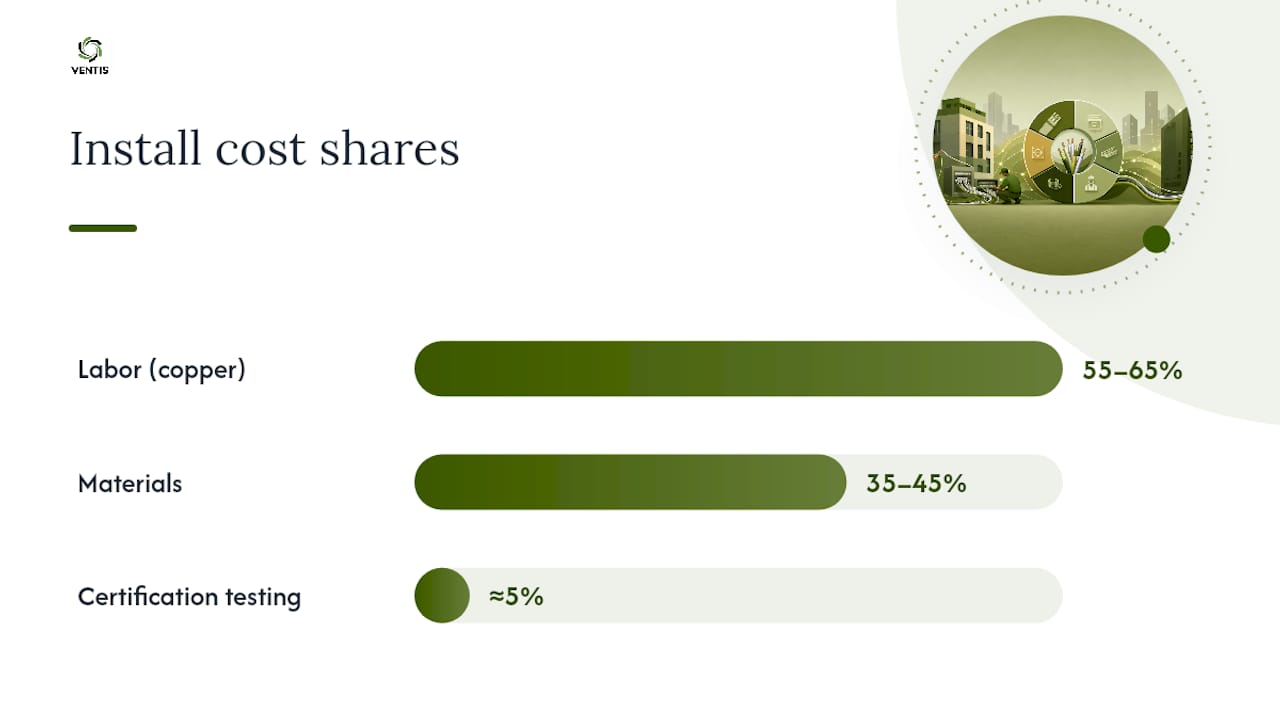
Every quote you get should break down into two buckets: labor and materials. On copper installs, labor typically runs 55% to 65% of the total install cost. Fiber shifts even more weight toward labor, since splicing and testing take specialized skill and time that plain cable-pulling doesn't.
A single "drop" isn't just a cable. It's the cable run, the jack, the faceplate, termination at both ends, a patch cord, and the test result that proves it works. When a bid lists a flat per-drop price with no mention of these pieces, ask what's actually included.
Beyond individual drops, every project carries fixed telecom-room costs: the rack, patch panels, cable management, and sometimes a small UPS. These costs don't scale with drop count, so they hit small projects harder on a per-drop basis than large ones.
Several factors move the price up or down:
- Cable category and jacket: Cat5e is cheapest, Cat6 is the common baseline, Cat6A costs $30 to $75 more per drop but supports 10-gigabit speeds at 100 meters. Plenum-rated jacket costs more than riser-rated cable but is required in certain ceiling spaces.
- Access and timing: New construction (prewire before drywall) is far cheaper than retrofit work through finished ceilings. After-hours work, lift rental, core drilling through concrete, and union labor requirements all add cost.
- Testing and documentation: Certification with a Fluke DSX tester or equivalent, labeling, and as-built documentation.
Pro Tip: Certification testing typically adds only about 5% to the total install cost but is what activates manufacturer warranties on the cable and connectors. Skipping it to save a few dollars per drop is a bad trade.
What Should You Budget Per Drop and Per Project?
Per-drop pricing works as a planning shortcut, but it hides fixed costs that don't scale evenly. A 12-drop office and a 120-drop office both need a telecom room, and that fixed cost gets absorbed very differently across the two projects.
Here's how typical ranges break down by cable type and project size:
| Project size | Drop count | Typical total cost | Cable type notes |
|---|---|---|---|
| Small office | 10 drops | $2,750–$14,000 | Cat6 baseline; Cat6A adds a premium |
| Mid-size office | 50 drops | $7,750–$64,000 | Wide range reflects access and telecom-room scope |
| Enterprise/large | 300 drops or more | Several tens of thousands or more | Often includes fiber backbone, larger telecom rooms |
Per-drop cost, on average, runs $125 to $400 for Cat6 and $175 to $500 for Cat6A, with fiber runs pricing out even higher depending on distance and connector type. Small residential or single-office Ethernet jobs can fall as low as $400 to $3,500 total when only a handful of ports are involved.
A few patterns worth noting:
- Per-drop cost tends to decline as drop count rises, since mobilization and telecom-room costs spread across more units.
- Retrofit work through occupied space, finished drywall, or drop ceilings adds a real premium over new-construction prewire.
- After-hours or weekend scheduling in occupied buildings can add a meaningful multiplier to labor rates.
The wide range in every bracket above isn't sloppy estimating. It reflects genuine variability: ceiling height, pathway availability, and how far the telecom room sits from the farthest drop all move the number.
How Do You Compare Structured Cabling Quotes?
A low bid that skips scope items isn't actually cheaper. It just moves the cost to a change order later. Use this checklist to compare quotes on equal footing:
- Cable spec — Brand and category (Cat6 vs. Cat6A) called out by name, not just "network cable."
- Termination standard — T568B wiring standard specified for consistency across the job.
- Test and certification method — Fluke DSX or equivalent permanent-link certification, not just a continuity check.
- Telecom-room build items — Rack, patch panels, cable management, and power itemized separately from drops.
- Labels and as-built documentation — Delivered at project close, not left as an afterthought.
- Warranty registration — Confirmation the installer will register the job for the manufacturer's extended warranty.
Watch for red flags: no site visit before the bid, a single flat per-drop number with no equipment or telecom-room line items, no mention of testing or certification, or an owner-supplied-materials clause that can void the manufacturer warranty entirely.
Pro Tip: Ask every bidder the same three questions: "What testing standard do you certify to?" "Is the telecom room priced separately from drops?" and "Does your quote include labels and as-built documents?" The answers expose more about quote quality than the total price does.
Cost-Reduction Strategies That Don't Cut Corners
Lowering your structured cabling budget doesn't mean cutting testing or buying undersized cable. It means removing waste from the process:
- Batch your drops. One mobilization for 40 drops costs far less per drop than two trips for 20 each, since crews avoid re-mobilization fees and setup time.
- Prewire during construction. Running cable before drywall goes up is dramatically cheaper than fishing cable through finished walls later.
- Standardize your cable spec. Committing to one certifiable-brand cable and category across the project avoids mixed-material headaches and lets installers buy in bulk.
- Bundle related low-voltage work. Combine data drops with access points, security cameras, and access-control cabling into one mobilization instead of three separate visits.
- Budget contingency line items. Set aside allowance for firestopping, pathway modifications, and occasional after-hours work so a surprise doesn't turn into a change order.
Choosing Cat6A only where it's justified, like near access points or high-power PoE devices, also keeps costs down without sacrificing capacity where it matters. A PoE standards guide is worth reviewing before finalizing which runs need the heavier cable.
How Ventis Consulting Scopes and Prices Cabling Projects
Some cabling providers start every engagement with a site survey, rather than a phone quote. Walking the space first can help ensure the itemized proposal that follows actually reflects reality: drop-by-drop deliverables, a telecom-room baseline, and a testing and certification plan spelled out before any cable gets pulled.
Clients get a proposal built around their structured cabling needs, not a generic per-drop guess. To get a tight quote fast, come prepared with a rough floor plan, an estimated drop count, and a list of devices (phones, access points, cameras) that need connections.
In-House Cabling Crews vs. Subcontractors: What It Costs You
Businesses managing their own facilities crew sometimes ask whether cabling should stay in-house and how to coordinate it with your commercial build out schedule. For most small and mid-sized businesses, the answer comes down to volume and frequency, not raw hourly rate.
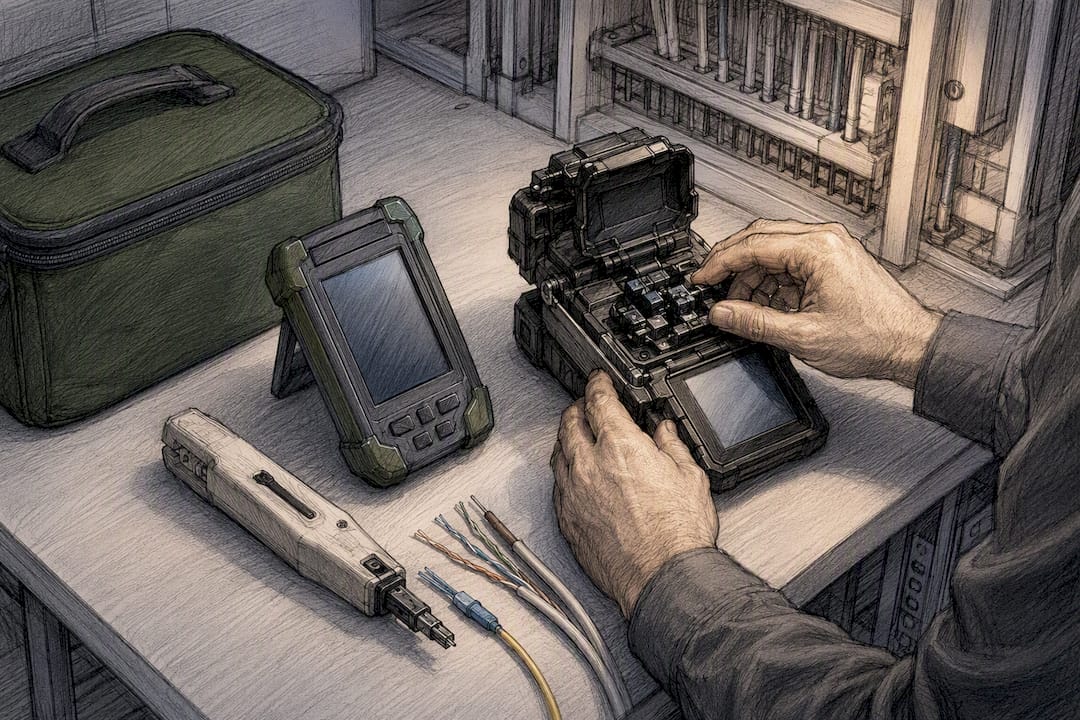
An in-house maintenance technician might handle a single-drop add or a simple patch panel change competently, and cheaply, since there's no markup for outside labor. But structured cabling installation at any real scale requires specialized tools: a Fluke DSX certification tester, proper punch-down equipment, and fiber splicing gear if fiber is involved. Buying that equipment for one project rarely pays off. Renting or hiring it project by project usually costs more per job than contracting a specialist who already owns the gear and runs it daily.
Subcontracted low-voltage crews also carry liability insurance and manufacturer certifications that unlock extended warranties on the cable and hardware. An in-house team without that credential can still do fine work, but the manufacturer warranty on the parts may not apply.
The math usually favors subcontractors for anything beyond occasional small jobs: 10 or more drops, any telecom-room build-out, or a job requiring certified test documentation. In-house labor makes more sense for a business with an ongoing facilities crew that handles occasional single-port moves and adds between larger projects.
When to Hire a Managed IT Provider vs. a One-Off Installer
Choose a managed IT provider when cabling connects to switching, Wi-Fi, and security that need ongoing support. Choose a standalone installer for a one-time retrofit with no future IT dependency.
— Greg
Ready to Get an Itemized Cabling Quote?
If you've been pricing cabling by asking three contractors for a flat per-drop number, you already know how hard those quotes are to compare. Some consulting groups start differently: a site survey first, then an itemized proposal that separates drop costs from telecom-room build-out and testing.

Such proposals often include a proposed telecom-room baseline, a test and certification plan, and a clear project timeline, so you know exactly what you're paying for before work starts. This provides a straightforward way to move from a rough budget range to a real number for your building. For businesses planning voice and data cabling together, our unified communications solutions page covers how structured cabling projects often pair with phone system upgrades. Reach out to schedule a site survey and get your itemized quote started.
Sources
- Structured Cabling Pricing in 2026: Cost Per Drop & What Drives It
- Structured Cabling Cost Per Drop in 2026 | SRS Networks
- Angi — Ethernet installation cost data
FAQ
What Are the Disadvantages of Structured Cabling?
Structured cabling costs more upfront than ad hoc point-to-point wiring and requires dedicated telecom-room space, but it pays off through easier troubleshooting, cleaner moves and changes, and certified performance you can document.
How Much Do Electricians Charge to Run an Ethernet Cable?
Simple per-port labor for small jobs often runs $50 to $100 per port, though commercial structured cabling installers typically price full drops, including termination and testing, at $125 to $400 each.
Is Cat6A Overkill for a Small Office?
Not necessarily. Cat6 handles most standard office needs, but Cat6A is worth the $30 to $75 per-drop premium for runs feeding access points or devices with heavy PoE demand.
How Much Does It Cost to Run 200 Feet of Cable?
Cost depends far more on access and labor than distance alone. A run in an accessible drop ceiling might fall within the standard $125 to $400 per-drop range, while the same run through finished walls or tight conduit can push toward the higher end.
What Should Be Included in a Structured Cabling Quote?
A complete quote itemizes cable and jack specs, termination standard, testing and certification method, telecom-room build items, labeling, and as-built documentation, not just a flat per-drop number.