
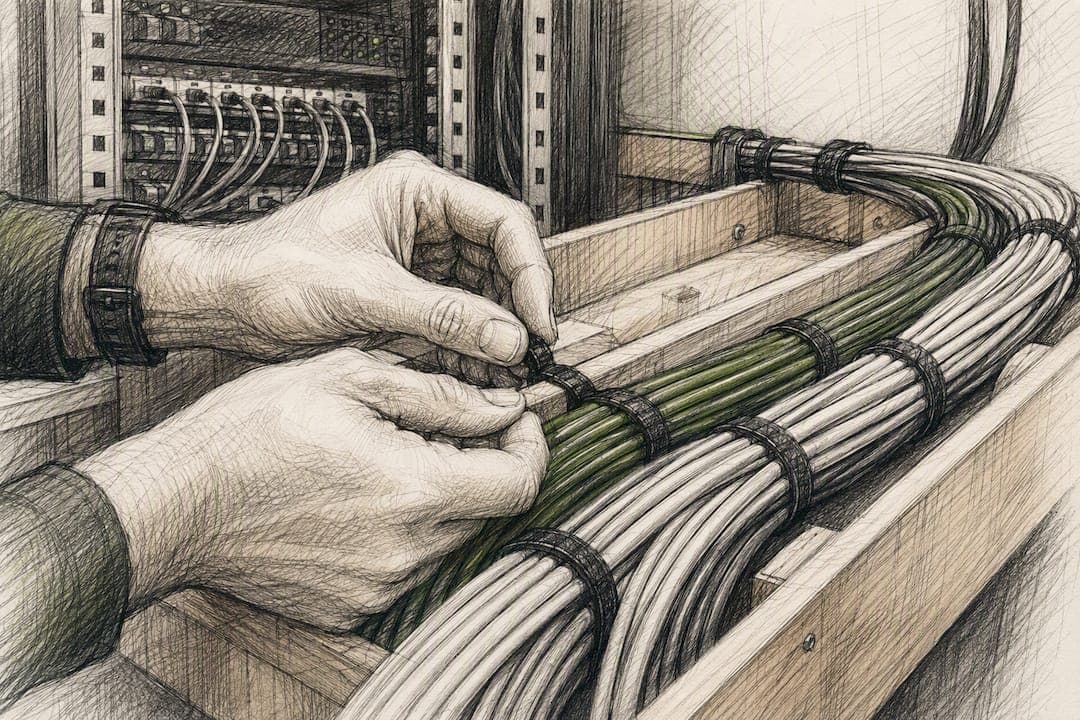
Follow IEC 61537 for cable trays and ladders, IEC 62275 for ties and fixing devices, TIA/ANSI 568 for cabling topology, and ANSI/TIA-606 for labeling, with BICSI and ISO/IEC 11801 rounding out installation guidance. The immediate move: adopt structured cabling over ad-hoc runs, budget real rack and pathway capacity, label every termination at both ends, keep power and data separated, and document the install before you walk away.
TL;DR:
- Proper labeling and thorough documentation are critical, as most failures happen after installation when updates are not recorded or maintained.
- Choosing the right cable ties and supports depends on environmental resistance, tensile strength, and providing service loops, not just cost.
- Planning for space management should follow the one-to-one rule for active equipment to ensure adequate airflow and future growth.
- Compliance with standards like IEC 61537 and IEC 62275 requires careful attention to load ratings and environmental specifications during procurement.
- Ensuring separation of power and data cables, correct bend radii, and airflow management prevents signal degradation and hotspots in active data centers.
Table of Contents
- Which cable management standards actually govern your install?
- How much space do you actually need for rack and pathway management?
- What ties and supports should you actually spec?
- How should you label and document a cabling installation?
- What separation, bend radius, and airflow rules matter most?
- What's the operational checklist for testing and ongoing compliance?
- How does Ventis Consulting Group apply these standards for SMB clients?
- Where to verify these standards directly
- The gap between "compliant" and "maintainable"
- Sources
Which cable management standards actually govern your install?
Four standards do most of the heavy lifting, and each one answers a different question you'll face during design or an audit.
IEC 61537 covers cable tray and ladder systems: load ratings, corrosion classification, and the safe working load (SWL) test methods manufacturers use to rate their products. The current 2023 edition replaced the 2006 version and tightened the classification and test procedures, so any tray spec sheet referencing the older edition is worth a second look before you buy.
IEC 62275 governs cable ties and fixing devices, meaning tensile strength, temperature range, and fire/UV resistance. The 2022 fourth edition clarified mechanical testing and classification, and a European alignment document, EN IEC 62275:2026, sharpened labeling requirements further.
TIA/ANSI 568 sets the topology and termination rules for structured cabling: pair counts, pinouts, and channel performance. ANSI/TIA-606 handles labeling and administration, telling you how to identify a cable, a port, or a rack so a technician five years from now can trace it without guessing.
BICSI publishes the practitioner-level design and installation guidance that ties these standards together in the field, and ISO/IEC 11801 serves as the international structured-cabling reference many multinational facilities specify alongside TIA-568.
How much space do you actually need for rack and pathway management?
Plan vertical management space before you rack a single switch, not after. Experienced installers commonly follow a 1U-of-management-for-every-1U-of-active-equipment rule, which keeps patch cords from burying port labels and blocking airflow. That ratio isn't in a formal standard, but it holds up because it forces you to think about cable bulk before the rack fills up.
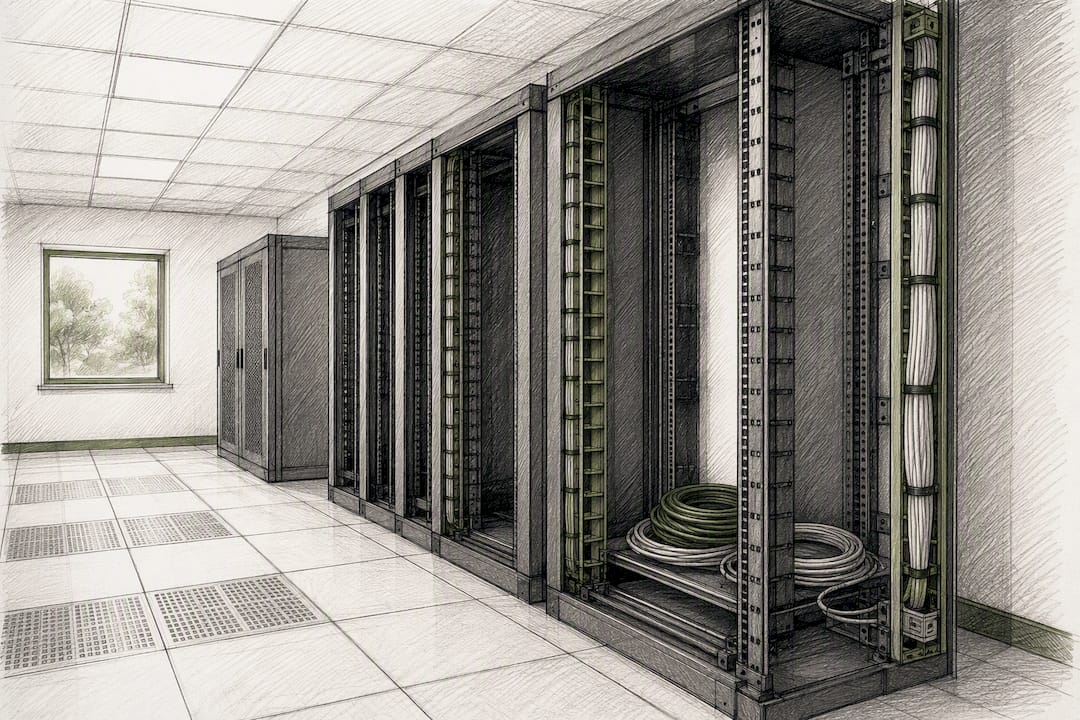
Tray and ladder planning should follow similar restraint. Even though IEC 61537 rates trays for a maximum load, designing for nominal fill around half capacity leaves room for growth without a rebuild in eighteen months.
A few planning rules save real headaches later:
- Seal underfloor penetrations and cutouts to preserve pressurized airflow in raised-floor environments.
- Choose overhead tray runs where underfloor space competes with cooling or power distribution.
- Use top-of-rack cabling in high-density racks to shorten runs and simplify tracing.
- Reserve end-of-row aggregation for larger rooms where consolidating patch points reduces total cable count.
What ties and supports should you actually spec?
IEC 62275 sorts cable ties by material, tensile strength, and environmental resistance, and that classification should drive your procurement, not the price sticker.
- Match the tie to the environment. Metallic ties handle high heat and mechanical stress near power gear; non-metallic and composite ties suit standard data racks; adhesive-mount fixing devices work where drilling isn't an option.
- Skip anything without a temperature or UV rating listed, especially outdoors or near HVAC equipment where heat cycling degrades cheap plastic fast.
- Never overtighten. A crushed cable jacket changes impedance and can fail certification testing months later, even if it looks fine on install day.
- Leave service loops at both ends of every run, and favor hook-and-loop fasteners anywhere cables get moved or added to regularly.
- Ask vendors for tensile strength, temperature range, and fire-contribution test declarations before you buy in bulk, along with batch traceability markings.
How should you label and document a cabling installation?
ANSI/TIA-606 exists because undocumented cabling turns every future service call into an investigation. The core discipline: assign a unique identifier to every cable, label both ends identically, and keep rack elevation diagrams current as equipment changes.
For anything spanning multiple buildings or a campus, plan for Class 4 administration, which extends the labeling hierarchy across outside plant and multiple telecommunications rooms. Choose between physical labels and automated infrastructure management (AIM) systems based on how often the environment changes; AIM earns its cost in high-churn data centers, while smaller closets often do fine with durable printed labels.
At handover, collect:
- Final cable counts by type and run length
- Certification and continuity test reports
- Photos of tray fill, termination points, and rack elevations
- A named contact responsible for future changes
What separation, bend radius, and airflow rules matter most?
Power and data cables run in separate pathways, or at minimum cross at 90 degree angles, to limit electromagnetic interference. Parallel runs over long distances are where EMI problems actually show up, not brief crossings.
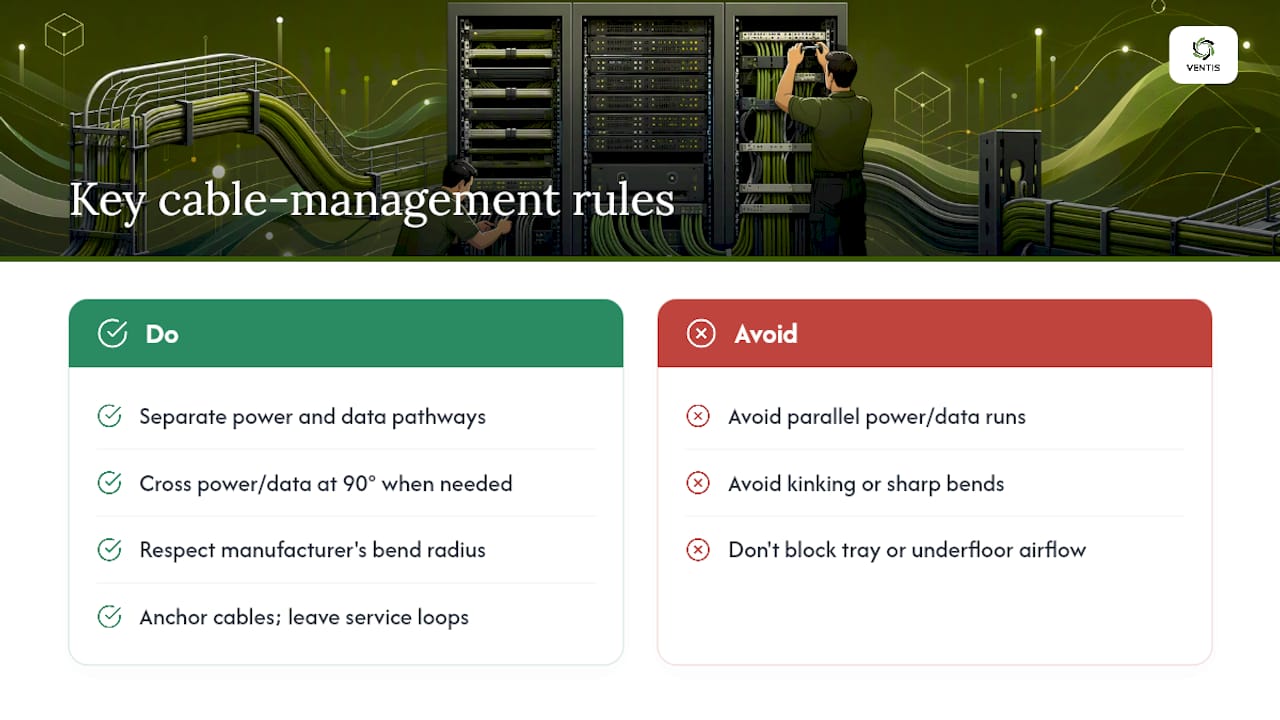
Bend radius limits protect signal integrity in copper and light transmission in fiber, and the exact multiplier varies by cable type and jacket construction, so check the manufacturer's data sheet or the relevant TIA-568 table rather than assuming a universal number. Enforce it during installation, not during a post-mortem after a failed certification test, since a kinked cable often tests fine on day one and degrades under thermal cycling.
Strain relief matters as much as bend radius. Anchor cables near connectors so the termination itself never bears mechanical load, and size service loops generously enough to allow a re-termination without pulling new cable.
Airflow suffers when nobody accounts for it. Keep front-to-back corridors clear of cable bulk, and coordinate tray and underfloor fill with the mechanical team so cabling never becomes an obstruction that causes bypass airflow or localized hotspots. Dense deployments sometimes warrant CFD modeling to catch conflicts a visual inspection would miss.
What's the operational checklist for testing and ongoing compliance?
Commissioning a cable plant isn't finished when the last cable is dressed. It's finished when the paperwork matches the physical install.
At handover:
- Verify every label matches the documentation and rack elevation diagram.
- Run continuity and certification tests on every link, not a sample.
- Flag and correct any non-compliant tie, bend radius, or unsealed penetration before sign-off.
- Deliver documentation as a package, not scattered emails.
On a recurring cadence:
- Visual audits of tray fill and tie condition, since ties degrade with heat and UV exposure faster than most people expect.
- Airflow verification after any significant equipment change.
- Recertification whenever a run is spliced, extended, or rerouted.
- Retained spec sheets, batch traceability records, and vendor test declarations for every material used.
Pro Tip: The blind spots that cause the most trouble are the ones nobody looks at during a walkthrough: overtensioned ties buried under a bundle, and underfloor cable fills that quietly crept past design limits over two years of "just one more run." Schedule a dedicated underfloor and tray inspection separate from your general rack audit.
How does Ventis Consulting Group apply these standards for SMB clients?
Ventis Consulting Group builds cabling projects around the same standards covered here: IEC 61537 for tray selection, IEC 62275 for tie procurement, and ANSI/TIA-606 for labeling that survives staff turnover. Scoping starts with rack and pathway capacity math, not a parts list, because undersized management space is the most common reason a "finished" install needs rework within a year.
For small and mid-sized businesses, the tradeoff usually comes down to where to spend first: documentation and labeling pay off longer than premium tray hardware in most closets. Readers building out PoE-heavy deployments should also check our PoE standards guide and our retail infrastructure guide for adjacent planning details. If you want a structured assessment of your own rack room or data closet, our unified communications and network services team can scope it against these exact standards.
Where to verify these standards directly
Consult IEC 61537 for tray and ladder specs, and IEC 62275 for tie performance requirements. For hardware sourcing, CommsBuyer's rack and cabinet catalog and YDA's structured cabling service page offer practical, contractor-level detail beyond the standards text itself.
The gap between "compliant" and "maintainable"
Most cable management failures I've seen written up don't come from ignoring the standards. They come from meeting the letter of TIA-568 or IEC 61537 on install day and then losing the discipline six months later when someone adds three switches and nobody updates the documentation. The standards cover the physical install thoroughly. They say almost nothing about what happens after handover, and that's exactly where most data closets fall apart.
The uncomfortable truth for a lot of IT teams: labeling and documentation get treated as the optional finishing touch, when they're actually the part that determines whether the next person who opens that rack spends ten minutes or four hours finding a problem. Tray hardware and premium ties matter, but they're forgiving. A mislabeled cross-connect during a 2 AM outage is not.
If there's one place to overinvest relative to what feels urgent, it's ANSI/TIA-606 administration and handover documentation. Everything else on this list, from bend radius to tray fill percentage, is easier to fix later than a cabling plant nobody can read.
— Greg