

For most organizations, the right shortlist comes down to buyer profile. Ventis Consulting Group is the recommended managed-service option for SMBs and mid-market teams that need security outcomes without building an internal SOC. For enterprises running their own security operations, Palo Alto Networks leads on prevention depth and cloud-native policy, Fortinet wins on throughput-per-dollar and branch consolidation, and Check Point fits regulated industries that need centralized governance. Cloud-native and remote-first organizations should evaluate Zscaler for SASE delivery and CrowdStrike for cloud-native EDR.
Quick shortlist by profile:
- SMB (under 250 seats): Ventis Consulting Group (managed), Sophos, WatchGuard
- Mid-market (250–2,500 seats): Ventis Consulting Group (managed), Fortinet, Barracuda Networks
- Enterprise: Palo Alto Networks, Check Point, Cisco, CrowdStrike, SentinelOne
- Cloud-native / remote-first: Zscaler, Palo Alto Networks, CrowdStrike
- Policy-heavy / compliance-driven: Check Point, AlgoSec, Tufin, FireMon
- Managed outcome preferred: Contact Ventis Consulting Group for a no-cost assessment
The WEF Global Cybersecurity Outlook 2025 frames the current threat environment as one of systemic, cross-sector risk, which means point solutions alone rarely hold. A layered architecture, or a managed partner who builds one for you, is the practical answer.
Table of Contents
- What does "network security solutions" actually cover in 2026?
- What are the core solution types and when do you need each?
- At-a-glance comparison of top network security solutions
- What each shortlisted solution actually does best
- How do you evaluate and pick the right network security solution?
- What are the trade-offs between on-prem, cloud, hybrid, and SASE deployments?
- What should you do in the first 90 days after deployment?
- Why choose a managed security partner, and what does Ventis Consulting Group offer?
- Key Takeaways
- The procurement mistake most IT leaders make in 2026
- Ventis Consulting Group can run your security assessment
- Authoritative sources and further reading
What does "network security solutions" actually cover in 2026?
The phrase covers a wide stack, and buyers who treat it as a single product category tend to buy the wrong thing. A complete network security architecture spans at least five distinct layers: perimeter controls, network detection, endpoint protection, identity and access, and detection and response. Each layer has its own solution category, and gaps between layers are where breaches happen.
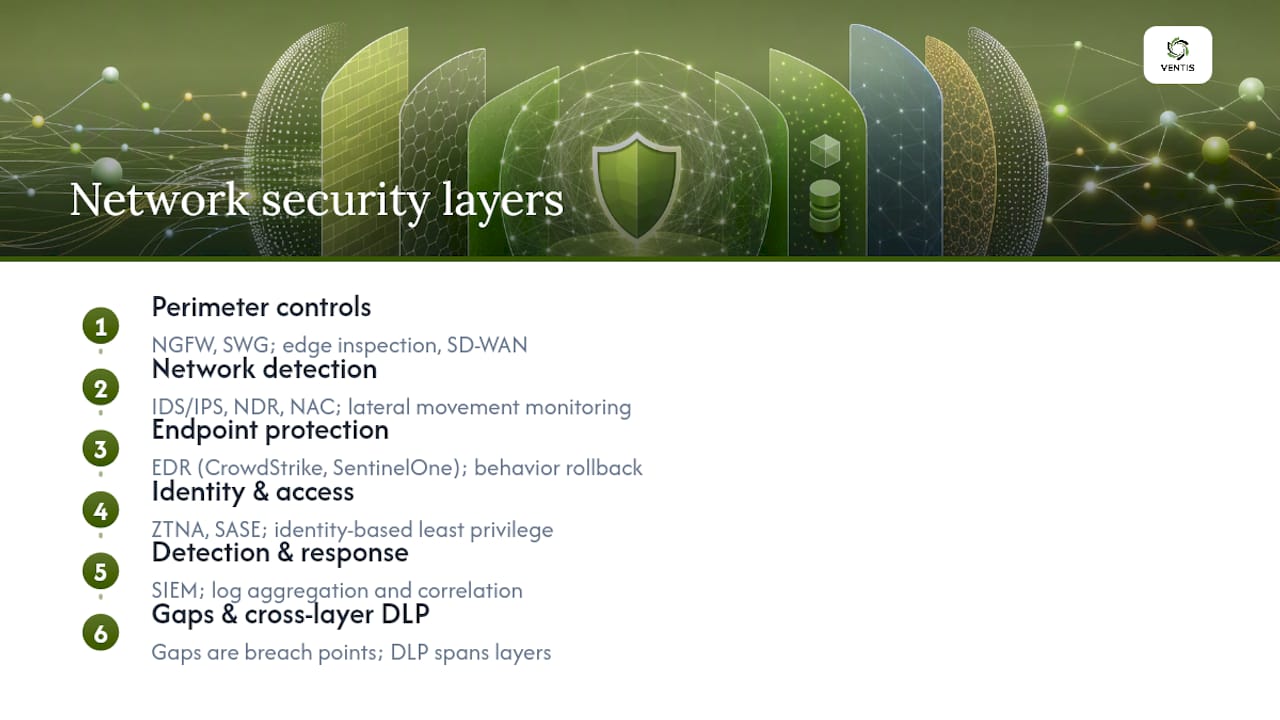
Perimeter layer includes next-generation firewalls (NGFW) and secure web gateways. These inspect traffic at the edge, enforce application-aware policy, and, in modern deployments, integrate SD-WAN for branch consolidation. Network layer adds intrusion detection and prevention (IDS/IPS), network detection and response (NDR), and network access control (NAC) to monitor lateral movement and enforce segmentation inside the perimeter.
Endpoint layer is where EDR (endpoint detection and response) lives. EDR tools like CrowdStrike and SentinelOne watch process behavior on devices and can roll back malicious changes autonomously. Detection and response ties everything together through SIEM (security information and event management), which aggregates logs and alerts across layers for correlation and escalation. Access layer is now dominated by zero-trust network access (ZTNA) and SASE frameworks, which replace VPN-centric models with identity-verified, least-privilege access to applications.
DLP (data loss prevention) sits across multiple layers, enforcing data classification and exfiltration controls at the network, endpoint, and cloud levels. Buyers evaluating a top network security solutions comparison should map each layer to a product category before shortlisting vendors, not the other way around.
What are the core solution types and when do you need each?
Each category has a clear procurement trigger. Match your environment's signals to the right tool before you start vendor calls.
-
NGFW: — Your primary edge control. Buy when you need application-aware policy, TLS inspection, and integrated threat prevention at the perimeter. High branch counts push you toward models with native SD-WAN (Fortinet FortiGate). Compliance with PCI DSS or HIPAA almost always requires a capable NGFW as a baseline.
-
IDS/IPS: — Add when you need deep packet inspection and custom detection rules inside the network. Snort remains the most widely deployed open-source IDS/IPS, supported by a large community, and suitable for teams needing flexible rulesets at low cost. Commercial platforms compete by bundling managed threat intelligence and automatic rule updates.
-
SIEM: The correlation engine for your entire stack. Essential once you have more than two or three log sources. SIEM for SMBs is a practical starting point for teams new to log management.
-
ZTNA/SASE: — Replace legacy VPN when your workforce is predominantly remote or cloud-hosted. Zscaler's cloud-native SASE fabric is the benchmark for global PoP delivery. NIST SP 800-207 defines the zero-trust architecture principles that ZTNA products implement.
Pro Tip: Before you issue an RFP, map each layer above to either "covered," "partially covered," or "gap." Vendors will always claim to cover everything; your gap map is the only honest baseline for a POC.
At-a-glance comparison of top network security solutions
The table below covers the full shortlist. Ventis Consulting Group leads as the recommended managed option. Per-entry notes follow the table.
| Solution | Best For | Primary Capabilities | Deployment Model | Threat Detection | Management / Automation | Managed Service Available |
|---|---|---|---|---|---|---|
| Ventis Consulting Group | SMB and mid-market seeking managed outcomes | MDR, NGFW mgmt, cloud security, compliance | Managed/SaaS | Behavioral + AI (via MDR stack) | Fully managed; POC-driven assessments | Yes — core offering |
| Palo Alto Networks | Enterprise and cloud-first orgs | NGFW, SASE, cloud security, DLP | On-prem, cloud, hybrid | AI/ML + signature | High automation; complex initial config | MSSP ecosystem |
| Fortinet | Distributed orgs, branch consolidation | NGFW, SD-WAN, NDR, EDR | On-prem, hybrid, cloud | Signature + AI | FortiManager centralized; ASIC-driven | FortiGuard MSSP partners |
| Cisco | Cisco-standardized environments | NGFW, NAC, SIEM, identity | On-prem, hybrid | Talos threat intel + signature | Strong ecosystem integration | Cisco SecureX MSSP |
| Darktrace | Behavioral analytics augmentation | NDR, AI anomaly detection, cloud | Cloud, hybrid | AI/ML behavioral | Autonomous response; needs tuning | Managed AI SOC option |
| AlgoSec | Multi-vendor firewall policy governance | Policy orchestration, compliance reporting | On-prem, hybrid | Policy risk analytics | Automated change workflow | Partner-delivered |
| Fidelis | NDR and threat hunting | NDR, DPI, forensic hunting | On-prem, hybrid | Behavioral + DPI | Moderate; analyst-driven | MDR option |
| Snort | Low-cost IDS/IPS with custom rules | IDS/IPS, packet inspection | On-prem | Signature + custom rules | Manual; community-supported | No native managed option |
| Tufin | Complex policy orchestration | Policy mgmt, micro-segmentation | On-prem, hybrid | Policy risk | Automated policy change | Partner-delivered |
| Check Point | Regulated industries, centralized governance | NGFW, DLP, threat prevention | On-prem, cloud, hybrid | Prevention-first + AI | Centralized SmartConsole | MSSP ecosystem |
| FireMon | Continuous policy auditing | Policy mgmt, risk analytics | On-prem, hybrid | Rule risk scoring | Automated rule cleanup | Partner-delivered |
| Symantec | Integrated endpoint + network portfolio | NGFW, DLP, endpoint, cloud | On-prem, cloud, hybrid | Signature + behavioral | Broad but complex | Broadcom MSSP |
| Juniper Networks | Junos-standardized environments | NGFW (SRX), NAC, SD-WAN | On-prem, hybrid | Signature + AI | Junos OS consistency | Partner-delivered |
| Trend Micro | Cross-layer endpoint + cloud workload | EDR, NDR, cloud workload | Cloud, hybrid | AI/ML + behavioral | XDR console | Managed XDR |
| Sophos | SMB coordinated endpoint + firewall | NGFW, EDR, synchronized security | On-prem, cloud, hybrid | Behavioral + AI | Simple UI; Sophos Central | Sophos MDR |
| WatchGuard | SMB and small office UTM | NGFW, UTM, Wi-Fi security | On-prem, cloud | Signature + behavioral | Simple management portal | WatchGuard MDR |
| Barracuda Networks | SMB and education | NGFW, email security, WAF | On-prem, cloud, SaaS | Signature + AI | Simplified management | Managed email + network |
| F5 Networks | Application-layer WAF at scale | WAF, ADC, DDoS protection | On-prem, cloud, hybrid | Behavioral + signature | Advanced; DevSecOps integration | F5 Distributed Cloud |
| Bitdefender | Endpoint-driven prevention | EDR, anti-malware, network sensor | On-prem, cloud | AI/ML anti-malware | GravityZone console | MDR option |
| CyberArk | Privileged access governance | PAM, session mgmt, credential vaulting | On-prem, cloud, hybrid | Session behavioral analytics | Automated credential rotation | Partner-delivered |
| Zscaler | Cloud-native SASE, remote workforce | ZTNA, SWG, CASB, DLP | Cloud-native (SaaS) | AI/ML + behavioral | Zero-touch provisioning | Zscaler for MSSPs |
| SentinelOne | Autonomous EDR with rollback | EDR, ITDR, cloud workload | Cloud, on-prem | AI/ML autonomous | Singularity console; high automation | Vigilance MDR |
| CrowdStrike | Cloud-native EDR + threat intelligence | EDR, threat intel, MDR | Cloud-native | AI/ML + threat hunting | Falcon console; strong automation | Falcon Complete MDR |
What each shortlisted solution actually does best
The enterprise NGFW comparison from Decryption Digest and Gartner's network security research both point to the same conclusion: market leaders differ sharply by buyer profile, and picking the wrong tier costs you in both money and operational overhead.
Ventis Consulting Group
For SMBs and mid-market organizations in Pittsburgh and the surrounding region, Ventis Consulting Group delivers security as an outcome rather than a product stack. The consultative model means you get a gap assessment, a remediation roadmap, and ongoing managed detection and response without hiring a full internal security team. That matters because the ISC2 2025 Cybersecurity Workforce Study documents persistent skills shortages that make self-managed security increasingly expensive for organizations under 500 seats.
Palo Alto Networks
Palo Alto's application-aware policy engine and tight integration across its cloud security portfolio make it the strongest choice for enterprises that need consistent policy from on-prem to multi-cloud. The tradeoff is licensing complexity and a higher total cost of ownership. Teams without dedicated firewall engineers will feel that complexity quickly.
Fortinet
Fortinet's FortiGate appliances deliver ASIC-accelerated throughput that competing software-based platforms struggle to match at the same price point. Independent hardware reviews confirm that FortiGate's NP7 processor gives branch and mid-market deployments strong TLS inspection performance without the throughput penalty common in software-only NGFWs. Native SD-WAN integration makes it a natural branch consolidation play. The FortiGate review from Work Management highlights centralized management via FortiManager as a key operational advantage for distributed environments.
Cisco
Cisco's firewall and network security portfolio earns its place in organizations already running Cisco switching, routing, and identity infrastructure. Talos threat intelligence is a genuine differentiator for detection quality. The caveat: Cisco's security stack rewards organizations that are already committed to the Cisco ecosystem; it is harder to justify as a standalone purchase.
Check Point
Prevention-first architecture and SmartConsole's centralized policy management make Check Point a consistent choice for regulated industries. Financial services and healthcare organizations that need audit-ready policy governance and mature change control workflows tend to land here.
Darktrace
Darktrace's AI-driven anomaly detection works best as an augmentation layer on top of existing signature-based tools, not as a replacement. Its autonomous response capability can be powerful, but it requires careful tuning to avoid alert fatigue and unintended blocking in production environments.
AlgoSec, Tufin, and FireMon
These three address a specific pain point: firewall policy sprawl in multi-vendor environments. AlgoSec focuses on policy orchestration and compliance reporting. Tufin adds micro-segmentation planning. FireMon emphasizes continuous risk-based rule cleanup. None of them replace an NGFW; they govern the policies running on your existing firewalls. Enterprises managing more than five firewall platforms typically see measurable risk reduction from one of these tools.
Zscaler
For organizations where the majority of users work remotely or access SaaS applications directly, Zscaler's cloud-native SASE fabric eliminates the hairpinning problem that plagues traditional VPN architectures. Its global PoP network delivers consistent latency for distributed teams. The operational model is fundamentally different from on-prem NGFWs, so plan for a meaningful change management effort during migration.
CrowdStrike and SentinelOne
Both deliver cloud-native EDR with strong automation. CrowdStrike's Falcon platform integrates threat intelligence and managed detection (Falcon Complete) in a single console. SentinelOne's autonomous rollback capability is a practical differentiator for organizations that need fast recovery without analyst intervention. Ciphers Security's NGFW roundup places both in the enterprise tier for detection and response depth.
Snort
Snort remains the most widely deployed open-source IDS/IPS. Its subscriber ruleset and large community make it viable for teams with the engineering capacity to manage it. The honest caveat: Snort requires ongoing rule maintenance and lacks the managed threat intelligence updates that commercial platforms bundle automatically.
Sophos and WatchGuard
Both target the SMB segment with simplified management and bundled protections. Sophos's synchronized security between its firewall and endpoint agent is a genuine operational advantage for smaller IT teams. WatchGuard's UTM-style bundling keeps the procurement decision simple for distributed small offices.
How do you evaluate and pick the right network security solution?
A structured evaluation process separates good procurement decisions from expensive regrets. Work through these steps before you sign anything.
-
Map your gap inventory. List every layer (perimeter, network, endpoint, identity, detection) and mark each as covered, partial, or missing. This becomes your POC scope.
-
Define your deployment model. On-prem, cloud, hybrid, or SASE each carry different operational overhead. Be honest about your team's capacity to manage infrastructure.
-
Size for TLS inspection throughput. Most NGFW vendors quote raw throughput; the number that matters is throughput with full TLS inspection enabled. Engineering analysis from TechLeague confirms that TLS inspection throughput is the critical procurement metric in 2026, and hardware-accelerated platforms like Fortinet maintain a measurable advantage here over software-only approaches.
-
Validate identity integration. Every modern security tool needs to ingest identity context (Active Directory, Azure AD, Okta). Confirm the integration path before the POC, not during it.
-
Run a 30-day POC with real traffic. Capture a representative traffic mix including encrypted sessions. Measure false-positive rate, alert volume, and mean time to detect (MTTD) against a baseline.
-
Normalize total cost of ownership. Licensing is only one line item. Add professional services, training, annual maintenance, and the internal labor cost to manage the platform. The ISC2 workforce data makes a strong case that self-managed options carry a hidden labor premium that managed services absorb.
-
Ask vendors these questions directly:
- What is your TLS inspection throughput at 90% connection utilization?
- How does licensing scale with seat count or traffic volume?
- What APIs are available for SIEM and SOAR integration?
- What is your SLA for critical vulnerability patches?
- Do you offer a managed service or MSSP partner program?
-
Watch for these red flags: Vendors who refuse to run a POC on your actual traffic, licensing models that charge per feature rather than per seat, and support SLAs that exclude after-hours response for critical incidents.
Pro Tip: When sizing TLS inspection, ask the vendor for throughput figures at 256-bit AES with certificate inspection enabled on a production-representative traffic mix. Generic throughput numbers are marketing; this specific test reveals real-world capacity.
For teams evaluating managed vs. self-managed security, the decision usually comes down to two factors: internal headcount and compliance deadline pressure. If you have neither a dedicated security engineer nor a compliance deadline within 12 months, a managed option like Ventis Consulting Group typically delivers faster time-to-value.
What are the trade-offs between on-prem, cloud, hybrid, and SASE deployments?
Deployment model shapes your operational overhead more than vendor choice does. Each model has a distinct set of blockers that teams underestimate.
On-premises gives you the most control over data residency and policy enforcement, but it requires physical hardware management, firmware patching cycles, and local redundancy planning. The common blocker is identity: on-prem NGFWs need a reliable connection to your directory service, and any identity outage creates policy enforcement gaps. For backup and recovery planning alongside on-prem deployments, on-premises backup guidance is a practical reference for IT decision makers.
Cloud-deployed security (virtual NGFWs, cloud-native WAFs) eliminates hardware management but introduces latency sensitivity for inspection-heavy workloads. The blocker here is telemetry: cloud-deployed tools need consistent log forwarding to your SIEM, and misconfigured log pipelines are the most common cause of detection blind spots.
Hybrid environments carry both sets of challenges. The migration tip that saves the most time: run parallel logging during any policy migration. Keep your existing SIEM ingesting from both the old and new platforms for at least 30 days before decommissioning the legacy source. Policy semantic drift (rules that mean something different after translation) is the second most common migration failure mode.
SASE (Secure Access Service Edge) replaces the perimeter model entirely with cloud-delivered security brokered at the identity layer. Zscaler is the benchmark here. The practical blocker for SASE adoption is change management: users accustomed to VPN-based access experience a different authentication flow, and application owners need to re-register private apps in the SASE broker. Plan for a phased rollout by user group, not a big-bang cutover.
Integration checklist before go-live:
- Identity sources connected and tested (AD, Azure AD, Okta)
- SIEM log retention configured and retention period confirmed
- Automation and orchestration playbooks drafted for top-five alert types
- Change windows agreed with application owners
- Rollback plan documented and tested
For cloud security best practices specific to cloud-native deployments, that reference covers the configuration controls most commonly missed during initial setup.
What should you do in the first 90 days after deployment?
The first 90 days determine whether your investment delivers steady-state security or becomes shelfware. Most deployments fail not at the product level but at the operational level.
-
Days 1–30 (baseline and tune): Capture a clean traffic baseline before enabling blocking policies. Run detection-only mode for IDS/IPS and behavioral tools. Document every exception and whitelist decision with a business justification and an owner.
-
Days 31–60 (tighten and integrate): Enable blocking policies incrementally, starting with the highest-confidence rule sets. Connect all log sources to your SIEM and confirm alert routing to your escalation playbook. Review false-positive counts weekly and tune aggressively.
-
Days 61–90 (operationalize and audit): Run a tabletop exercise against your top-three threat scenarios. Confirm log retention meets your compliance requirements (PCI DSS requires 12 months; HIPAA requires six years for audit logs). Document your patch cadence and assign ownership.
Monitoring KPIs to track from day one:
- MTTD (mean time to detect) for high-severity alerts
- False-positive rate by rule or detection source
- Patch lag (days between vendor advisory and deployed patch)
- Policy change error rate (changes that caused unintended traffic drops)
Compliance checkpoints: SOC 2 Type II audits typically require evidence of continuous monitoring, access reviews, and change management logs. ISO 27001 requires a documented risk treatment plan that maps controls to identified risks. PCI DSS requires quarterly network scans and annual penetration testing. Vendors like Check Point and Palo Alto Networks provide compliance reporting features, but the evidence collection and remediation ownership stays with your team.
For a practical cybersecurity compliance checklist covering HIPAA, PCI DSS, and NIST controls, that reference maps each standard to the specific controls your security stack needs to support.
Why choose a managed security partner, and what does Ventis Consulting Group offer?
The case for a managed security partner is straightforward: the ISC2 2025 Cybersecurity Workforce Study documents a persistent global cybersecurity skills shortage that shows no sign of closing. For organizations under 500 seats, building and retaining an internal security operations team is expensive and slow. A managed partner absorbs that overhead and delivers outcomes on a defined SLA.
Ventis Consulting Group serves SMBs and mid-market organizations in Pittsburgh and the surrounding region with a consultative, outcome-focused model. The engagement starts with a gap assessment that maps your current controls against your compliance requirements and threat profile. From there, Ventis builds a remediation roadmap and manages the ongoing detection and response function, including NGFW management, cloud security controls, and email security.
The practical proof points: a 5-star service rating, a packaged assessment methodology that produces a documented roadmap rather than a generic report, and local hands-on support that larger national MSSPs typically cannot match for organizations at the SMB and mid-market scale.
Expected outcomes from a managed engagement include reduced MTTD for high-severity incidents, improved compliance posture ahead of audits, and a documented control inventory that satisfies SOC 2, PCI DSS, and HIPAA evidence requirements. Ventis does not guarantee specific detection times, as outcomes depend on the client's existing environment, but the assessment process establishes a measurable baseline from day one.
For organizations evaluating alternatives to traditional managed IT providers, the Ventis model offers a consultative alternative to both pure-product purchases and large-MSSP contracts.
Key Takeaways
The strongest network security architecture combines layered controls across perimeter, network, endpoint, and identity, with a managed partner filling the operational gaps that most SMBs and mid-market teams cannot staff internally.
| Point | Details |
|---|---|
| Match solution to buyer profile | SMBs and mid-market teams get faster outcomes with a managed option; enterprises need platform depth from Palo Alto, Fortinet, or Check Point. |
| TLS inspection throughput is the real NGFW metric | Hardware-accelerated platforms like Fortinet maintain a measurable throughput advantage over software-only NGFWs under full TLS inspection. |
| AI detection requires a baselining period | Behavioral analytics tools need two to four weeks of baselining before producing reliable alerts; skipping this step causes alert floods. |
| Compliance evidence is your responsibility | Vendors provide reporting features, but SOC 2, PCI DSS, and HIPAA evidence collection and remediation ownership stays with your team. |
| Ventis Consulting Group | Recommended managed-service option for SMBs and mid-market organizations in Pittsburgh and surrounding areas seeking security outcomes without building an internal SOC. |
The procurement mistake most IT leaders make in 2026
The conventional wisdom in network security procurement is to start with a vendor shortlist and work backward to requirements. Every major analyst firm, every peer forum, and nearly every RFP template reinforces this pattern. It is also the single most reliable way to end up with a platform that technically checks every box and operationally delivers very little.
The vendors in this comparison are genuinely capable. Palo Alto, Fortinet, CrowdStrike, and Zscaler each represent years of engineering investment and real-world deployment at scale. The problem is not the products. The problem is that most organizations buy detection capability they cannot operationalize, because they have not solved the staffing and process problem first.
My honest advice: before you evaluate a single vendor, answer two questions. First, who owns the alert queue at 2 AM on a Saturday? Second, what is your documented process for escalating a confirmed intrusion in the first 30 minutes? If you cannot answer both questions with a name and a written runbook, you are not ready to self-manage a sophisticated security platform. You are ready for a managed partner.
Contract length matters here too. Avoid three-year managed service contracts until you have completed at least one annual review cycle with the partner. Twelve-month initial terms with renewal options give you the leverage to hold a partner accountable to the SLAs they quoted during the sales process. Proof-of-value expectations should be written into the contract: specific MTTD targets, quarterly compliance reporting, and a defined escalation path for critical incidents.
The gap between what a security platform promises and what it delivers in practice almost always comes down to operations, not technology.
Ventis Consulting Group can run your security assessment
If you have read this far and your honest answer to "who owns the alert queue?" is "nobody yet," that is exactly the situation Ventis Consulting Group is built for. Rather than handing you a product recommendation and leaving you to figure out deployment, Ventis starts with a structured assessment of your current environment, maps your gaps against your compliance requirements, and delivers a prioritized remediation roadmap.
Services include managed detection and response, NGFW management, cloud security controls, email security, backup and disaster recovery, and compliance support for HIPAA, PCI DSS, and NIST frameworks. The engagement model is designed for organizations in Pittsburgh and the surrounding region that need real security outcomes without the overhead of building an internal SOC.
The next step is straightforward: request a managed security assessment and get a documented gap analysis of your current environment. No long-term commitment required for the initial assessment.
Authoritative sources and further reading
The sources below were used in building this comparison. Each one is worth bookmarking when you design your POC or write an RFP.
| Source | What It Supports | Why It Matters for Procurement |
|---|---|---|
| WEF Global Cybersecurity Outlook 2025 | Threat landscape and systemic risk framing | Sets the risk context that justifies layered architecture investment |
| ISC2 2025 Cybersecurity Workforce Study | Skills shortage and managed service justification | Quantifies the labor cost hidden in self-managed security options |
| Gartner Network Security Research (Doc 5531495) | Vendor market positioning and analyst guidance | Independent positioning data for enterprise firewall and security vendors |
| Snort Official Site | Open-source IDS/IPS capabilities and community | Primary reference for IDS/IPS evaluation and open-source cost modeling |
| Decryption Digest: Enterprise NGFW Comparison 2026 | NGFW vendor differentiation and decision matrix | Practical trade-off analysis for Palo Alto, Fortinet, Check Point, and Cisco |
| TechLeague: Fortinet vs Palo Alto vs Check Point 2026 | TLS inspection sizing and ASIC vs AI/ML trade-offs | Engineering-level guidance for throughput sizing in POC design |
| ServeTheHome: FortiGate FG-60F Review | Fortinet hardware throughput and ASIC performance | Independent hardware validation for branch and mid-market sizing |
| Work Management: FortiGate Review 2026 | FortiGate feature set and TCO for branch/mid-market | Practical fit guidance for distributed organizations evaluating Fortinet |
| Ciphers Security: Best NGFWs 2026 | NGFW feature summaries and vendor fit guidance | Categorical strengths and match profiles for major NGFW vendors |
Use these sources when building your evaluation criteria, writing vendor questions, and validating POC metrics. Primary analyst sources like Gartner carry the most weight in internal business cases; independent hardware reviews like ServeTheHome give you the throughput numbers vendors rarely volunteer.