

A multi-cloud strategy is defined as the intentional use of two or more public cloud providers to meet specific business, technical, or compliance objectives. This approach differs fundamentally from simply ending up with multiple cloud accounts through shadow IT or departmental sprawl. Organizations that adopt a deliberate multi-cloud approach gain operational resilience, pricing leverage over vendors, and access to best-in-class services from each provider. Understanding what a multi-cloud strategy actually requires, and how it differs from hybrid cloud, is the first step toward building one that delivers real results.
What is multi-cloud strategy, and how does it differ from hybrid cloud?
The single most important word in multi-cloud strategy is "intentional." A true multi-cloud approach means your organization has made a deliberate decision to place specific workloads on specific providers based on defined criteria. That is very different from discovering you have three cloud accounts because three different teams signed up independently.

Hybrid cloud is a separate concept that leaders often confuse with multi-cloud. Hybrid cloud combines public cloud with private or on-premises infrastructure, such as running sensitive workloads in your own data center while using a public cloud for burst capacity. Multi-cloud, by contrast, uses two or more public cloud platforms without necessarily involving private infrastructure at all. You can run a hybrid cloud with a single public provider, and you can run a multi-cloud environment with no on-premises hardware.
The third scenario IT leaders must recognize is accidental multi-cloud. This happens when shadow IT, mergers, or departmental purchasing decisions create a fragmented cloud environment with no central governance. The result is duplicated spending, inconsistent security policies, and no negotiation leverage with any single vendor.
Here is how the three models compare:
- Intentional multi-cloud: Two or more public providers selected deliberately for workload fit, compliance, or resilience goals.
- Hybrid cloud: At least one public cloud combined with private or on-premises infrastructure.
- Accidental multi-cloud: Multiple cloud accounts accumulated without a governing strategy, creating sprawl and risk.
Accidental multi-cloud is the most dangerous state. You carry all the operational complexity of managing multiple providers with none of the strategic benefits.
What are the primary benefits of a multi-cloud approach?
Operational resilience is the most cited reason organizations adopt a multi-cloud model. When one provider experiences an outage, workloads running on a second provider continue without interruption. This requires tested failover procedures, not just the theoretical ability to move workloads. Active-active and active-passive failover models each carry trade-offs in cost and latency that must be evaluated before an incident occurs.
Negotiation leverage is a benefit that surprises many IT leaders. When your organization can credibly demonstrate the ability to migrate workloads, you shift from being a price-taker to a negotiator. Organizations with credible workload portability consistently secure better contract terms and support commitments from cloud vendors. That leverage disappears the moment a vendor knows you are locked in.
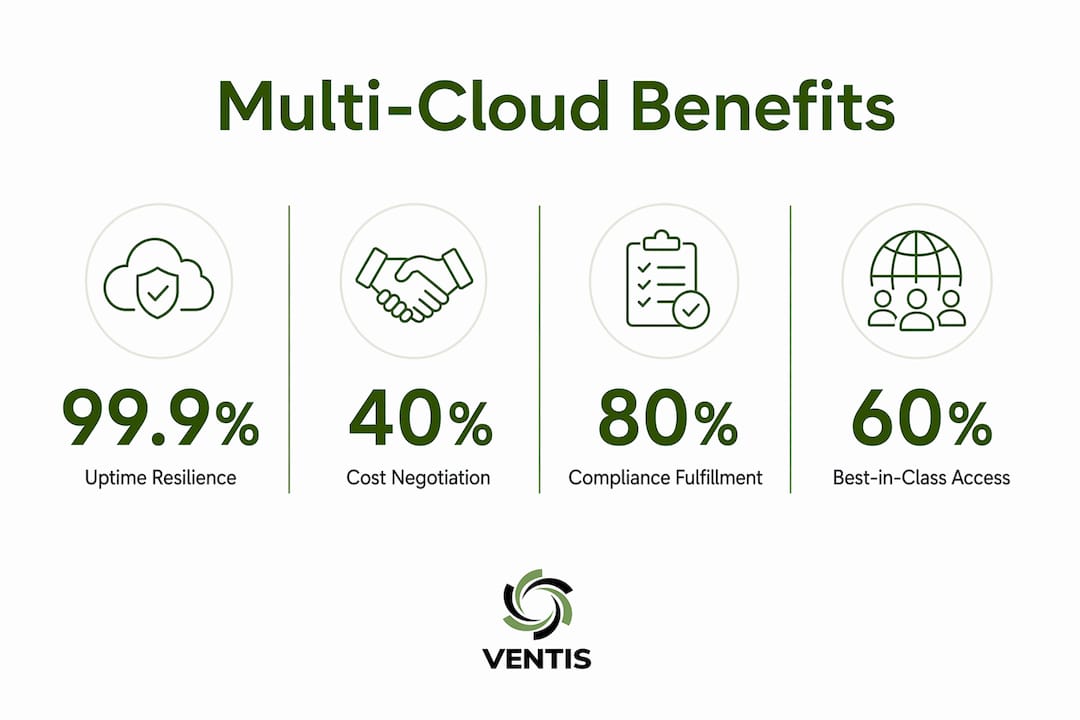
Compliance and data residency requirements drive multi-cloud adoption in regulated industries. Financial services, healthcare, and government organizations often face rules that require data to remain within specific geographic boundaries. Using a provider with a data center in the required region, while running other workloads elsewhere, satisfies those requirements without forcing a full migration.
Access to best-in-class services is the fourth major advantage. Different providers lead in different capability areas. An organization might use one provider for its machine learning infrastructure and a second for its global content delivery network, selecting the strongest tool for each job rather than accepting a single vendor's full catalog.
Pro Tip: Do not assume multi-cloud automatically reduces costs. Hidden costs like duplicated CI/CD pipelines and egress fees can erode savings quickly. Build a full total cost of ownership model before committing to a second provider.
How to implement multi-cloud: phases and architecture patterns
Effective multi-cloud implementation follows a structured sequence of phases. Skipping phases, especially the assessment and automation phases, is the most common reason organizations end up with accidental complexity rather than strategic capability.
- Assessment: Catalog your existing workloads, dependencies, and compliance requirements. Identify which workloads are candidates for portability and which are better left with a single optimized provider.
- Pilot: Move one non-critical workload to a second provider. Use this to test your tooling, networking, and operational processes before scaling.
- Automation: Build CI/CD pipelines that can deploy to multiple targets. This is the foundational step that makes everything else manageable.
- Integration: Connect networking, identity, and monitoring across providers. Cross-cloud latency and identity federation require deliberate design.
- Optimization: Analyze cost and performance data across providers. Adjust workload placement based on real usage patterns, not assumptions.
- Governance: Enforce policy, tagging standards, and access controls consistently across all providers.
Three architecture patterns appear most frequently in mature multi-cloud environments. The Active-Active pattern runs the same workload simultaneously across two providers for maximum resilience. Cloud Bursting keeps workloads on a primary provider and spills overflow to a second during peak demand. The Data Gravity Split places workloads near the data they consume, which reduces egress costs and latency. These patterns each address different resilience and cost trade-offs and are not mutually exclusive.
The enabling infrastructure matters as much as the architecture pattern. Unified secrets management, infrastructure as code, and observability platforms are the three capabilities that separate organizations that manage multi-cloud well from those that struggle with it. Build these capabilities before expanding your cloud footprint, not after.
Pro Tip: Containerization is not optional for active multi-cloud capability. Achieving dynamic workload migration requires containerized applications, rigorous identity management, and tested operational runbooks. Start containerizing before you add a second provider.
What challenges come with multi-cloud, and how do you address them?
Multi-cloud increases your attack surface. Each provider has its own identity and access management model, audit log format, and security tooling. Security fragmentation across multiple clouds creates gaps that attackers exploit. The answer is standardizing security policies before you expand, not after.
The operational overhead is real and often underestimated. Managing billing, support contracts, and tooling across multiple providers requires dedicated effort. Organizations that treat each cloud as a silo end up with teams that specialize in one provider and cannot support the others. Building platform-level abstractions rather than managing each cloud separately is the only way to keep operational costs from scaling linearly with provider count.
The most common challenges and their mitigations:
- IAM fragmentation: Standardize identity federation using a single identity provider that federates to all clouds.
- Security policy drift: Use policy-as-code tools to enforce consistent controls across providers.
- Egress cost surprises: Design workload boundaries to minimize data movement between providers. Egress charges for data leaving cloud providers can be substantial.
- Observability gaps: Consolidate logs and metrics into a single observability platform rather than using each provider's native tools in isolation.
- Secrets sprawl: Centralize credential rotation and access with unified secrets management. Unified secrets management eliminates the most common multi-cloud security failure modes by removing credential silos.
Reviewing your cybersecurity compliance practices before adding a second cloud provider is a practical first step. The compliance gaps that exist in a single-cloud environment multiply when you add providers.
Pro Tip: Treat multi-cloud as a deliberate choice, not a default. Not every organization needs two providers. The complexity is only worth carrying if the resilience, compliance, or leverage benefits are specific and measurable for your situation.
What do successful multi-cloud strategy examples look like?
Mature multi-cloud adoption follows a clear maturity progression. The stages move from accidental shadow IT through strategic redundancy, workload optimization, and finally a unified platform with automated workload migration. Most organizations sit somewhere in the middle of that spectrum and benefit from knowing which stage they are in before deciding what to build next.
A practical example of workload-based placement: an organization running analytics workloads on one provider for its data processing strengths while using a second provider for global application delivery. Spotify-style workload distribution across providers for analytics and storage is a well-documented pattern. The key decision is which workloads benefit from portability and which are better left optimized for a single provider's native services.
Decision-makers should evaluate workloads across three dimensions:
- Portability value: Does this workload benefit from being movable, or does it depend on provider-specific services that would be costly to abstract?
- Resilience requirement: Does this workload need cross-cloud failover, or is single-provider redundancy sufficient?
- Cost sensitivity: Does the workload generate significant egress traffic that would make cross-cloud placement expensive?
The all-or-nothing migration trap is the most expensive mistake in multi-cloud adoption. Moving every workload to a second provider for the sake of consistency adds cost and complexity without proportional benefit. The goal is placing the right workloads on the right platforms, not achieving symmetry across providers.
Key Takeaways
A multi-cloud strategy delivers resilience, negotiation leverage, and compliance capability only when built on intentional workload placement, unified tooling, and standardized security policies from the start.
| Point | Details |
|---|---|
| Intentionality defines success | Accidental multi-cloud carries all the complexity with none of the strategic benefits. |
| Unified tooling is non-negotiable | Secrets management, infrastructure as code, and observability must span all providers before you scale. |
| Negotiation leverage is real | Credible workload portability shifts your organization from price-taker to negotiator with cloud vendors. |
| Hidden costs require full TCO modeling | Egress fees and duplicated pipelines can erase savings without careful workload boundary design. |
| Maturity stages guide prioritization | Knowing your current stage, from accidental to intentional, determines what to build next. |
Why intentionality is the only thing that matters in multi-cloud
I have worked with organizations that believed they had a multi-cloud strategy because they had accounts with two providers. What they actually had was two separate IT silos with no shared tooling, no unified security posture, and no ability to move a workload between them without a months-long project. That is not a strategy. That is expensive sprawl with a better-sounding name.
The shift that actually matters is moving from thinking about clouds to thinking about platforms. When you build unified observability, centralized identity, and infrastructure as code that targets multiple providers, you stop managing clouds and start managing a platform that happens to run on multiple clouds. That shift is harder than it sounds, and most organizations underestimate how much foundational work it requires before the first workload moves.
The negotiation leverage benefit is real, but only if your portability is credible. A vendor's account team will probe whether you can actually move. If your answer is "theoretically, yes, but it would take six months," you have no leverage. If your answer is "we ran a full migration drill last quarter," you negotiate from a position of strength.
My honest advice: start with the tooling, not the migration. Build the enabling capabilities first. The workload placement decisions get much easier once you have the platform to support them.
— Greg
How Ventis Consulting Group can support your multi-cloud goals
Multi-cloud strategy works best when you have experienced guidance on the foundational decisions: workload assessment, security standardization, and tooling selection. Getting those decisions right early prevents the operational complexity that derails most multi-cloud initiatives.

Ventis Consulting Group works with small and mid-sized businesses to build cloud strategies that match their actual requirements, not a generic template. From managed IT services that include cloud strategy consulting to unified security and infrastructure support, Ventis Consulting Group brings the practical expertise to help you move from accidental sprawl to intentional architecture. If you are ready to build a cloud environment that works for your business, reach out to Ventis Consulting Group to start the conversation.
FAQ
What is the difference between multi-cloud and hybrid cloud?
Multi-cloud uses two or more public cloud providers, while hybrid cloud combines at least one public cloud with private or on-premises infrastructure. The two models are not mutually exclusive and can be used together.
What are the main benefits of multi-cloud?
The primary benefits are operational resilience through cross-cloud failover, negotiation leverage with vendors, compliance with data residency requirements, and access to best-in-class services from each provider.
How do you start implementing a multi-cloud strategy?
Start with a workload assessment to identify portability candidates, then build unified tooling including infrastructure as code and observability before migrating any workloads to a second provider.
What hidden costs should organizations watch for in multi-cloud?
Egress fees for data moving between providers and duplicated CI/CD pipeline costs are the most common hidden expenses. A full total cost of ownership model must account for both before committing to a second provider.
Is multi-cloud right for every organization?
Multi-cloud is the right choice only when the resilience, compliance, or leverage benefits are specific and measurable. Organizations without a clear use case for a second provider add complexity without proportional gain.