

External threat detection is the proactive practice of monitoring and analyzing cyber threats that originate outside your organization's internal network before they cause damage. Most business leaders assume their firewall and antivirus software cover the full picture. They do not. The real risk lives outside your perimeter, on the dark web, in compromised credential databases, and across forgotten cloud assets your IT team does not know exist. Understanding why businesses need external threat detection is the first step toward closing the gaps that attackers actively exploit.
Why businesses need external threat detection now
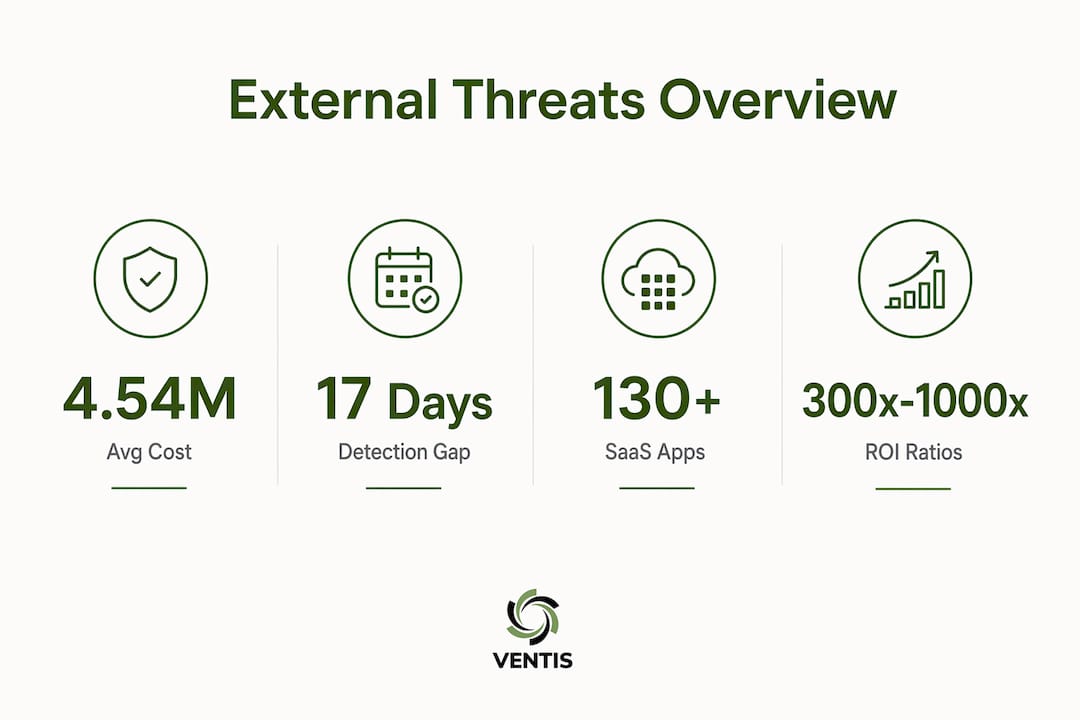
The financial case is direct. The average ransomware incident costs $4.54 million, and that figure does not include reputational damage or regulatory penalties. External threat detection provides return-on-investment ratios of 300x to 1,000x by catching attacks before they execute. That math alone justifies the investment for any business leader weighing budget priorities.

The detection gap is the core problem. Organizations without external intelligence face a 17-day window between when credentials are exposed and when ransomware deploys. Seventeen days is enough time for an attacker to map your network, escalate privileges, and position for a full breach. External intelligence shrinks that window to near zero by flagging the exposure the moment it appears.
The National Institute of Standards and Technology (NIST) Cybersecurity Framework and the ISO/IEC 27001 standard both call for continuous monitoring that extends beyond internal systems. Compliance with these frameworks requires external visibility. Businesses that skip it are not just exposed to attackers. They are exposed to auditors.
What are the main types of external cyber threats businesses face?
External threats are not random. Attackers follow repeatable patterns, and knowing those patterns helps you defend against them.
- Phishing and spear phishing. Attackers craft emails that impersonate trusted vendors, executives, or banks. A single click can hand over credentials or install malware. Email remains the top cyberattack vector for this reason.
- Ransomware. Attackers encrypt your files and demand payment. The average incident now costs $4.54 million and disrupts operations for weeks.
- Credential theft. Usernames and passwords stolen from third-party breaches appear on dark web marketplaces within hours. Attackers buy them and test them against your systems automatically.
- Supply chain attacks. Attackers compromise a vendor or software provider you trust, then use that trust to reach you. The SolarWinds breach demonstrated how one compromised update can affect thousands of downstream organizations.
- DDoS attacks. Distributed denial-of-service attacks flood your systems with traffic, taking websites and services offline. These are often used as distractions while a secondary attack runs quietly.
- AI-driven attacks. Attackers now use artificial intelligence to generate convincing phishing content, automate credential stuffing, and identify vulnerabilities faster than human analysts can patch them.
Identity is the new perimeter. Attackers exploit credentials, privilege escalations, and trust relationships to bypass traditional defenses entirely. This shift compresses attack timelines and makes external monitoring of identity exposure non-negotiable.
Pro Tip: Set up alerts for your company's domain on breach notification services. Knowing when your employees' credentials appear in a data dump gives you days to force password resets before attackers act.
How does external threat detection differ from internal detection methods?
Internal detection tools and external detection tools solve different problems. Confusing them leaves gaps that attackers walk right through.
SIEM, IDS, and EDR systems provide strong internal detection. They monitor traffic inside your network, flag anomalies, and alert your team to suspicious behavior. The limitation is their boundary. They see what happens inside your walls. They cannot see a stolen password being sold on a dark web forum or a misconfigured cloud storage bucket sitting exposed on the public internet.
External threat detection monitors beyond your network boundary. It scans the dark web for leaked credentials, watches public internet sources for mentions of your organization, and tracks threat actor activity targeting your industry. The two approaches are not interchangeable. They are complementary.
| Capability | Internal detection tools | External detection |
|---|---|---|
| Network traffic monitoring | Yes | No |
| Dark web credential monitoring | No | Yes |
| Misconfigured cloud asset discovery | Limited | Yes |
| Threat actor reconnaissance tracking | No | Yes |
| Shadow IT visibility | No | Yes |
| Insider threat detection | Yes | No |
External cybersecurity experts bring an adversarial mindset that internal teams cannot replicate. Internal teams normalize what they see every day. A misconfiguration that has existed for two years stops looking like a risk. An outside expert sees it immediately because they approach your environment the way an attacker would. This is called normalization of deviance, and it is one of the most common reasons internal-only security programs miss critical exposures.
Pro Tip: Schedule an external cybersecurity review at least once per year. Treat it the same way you treat a financial audit. The goal is to find what your team has stopped seeing.
Why is external attack surface management critical for organizations?
External attack surface management (EASM) is the practice of discovering, cataloging, and monitoring every internet-facing asset your organization owns, including the ones your IT team does not know about. It mimics what an attacker does during reconnaissance, but you do it first.
The average organization uses more than 130 SaaS applications. Each application is a potential entry point. Shadow IT, meaning applications employees adopt without IT approval, adds more assets that no one is monitoring. EASM tools scan externally without requiring internal access or credentials. That agentless approach means they find what attackers find.
Most organizations cannot inventory all internet-facing assets. The assets they do not know about carry the highest risk because no one is patching or monitoring them. EASM uncovers forgotten subdomains, misconfigured cloud storage, exposed admin panels, and legacy systems still connected to the internet.
The consequences of unmonitored assets are serious:
- Attackers use forgotten subdomains to host phishing pages that impersonate your brand.
- Exposed admin panels give attackers direct access to databases without needing to breach the perimeter.
- Misconfigured cloud storage buckets leak customer data publicly, triggering regulatory penalties under frameworks like GDPR and HIPAA.
- Legacy systems running outdated software become easy entry points for lateral movement into your core network.
A cybersecurity risk assessment that includes EASM gives you a complete picture of your exposure. Without it, you are defending a perimeter you cannot fully see.
How can organizations implement external threat detection effectively?
Effective implementation follows a clear sequence. Skipping steps creates the same gaps you are trying to close.
-
Conduct a baseline external assessment. Before deploying any tool, map what is visible from the outside. Use EASM scanning to discover all internet-facing assets. Document what you find and prioritize by risk level.
-
Deploy continuous external threat intelligence monitoring. One-time assessments go stale within weeks. Continuous monitoring tracks dark web activity, credential exposures, and threat actor behavior in real time. This is what closes the 17-day detection gap between exposure and attack.
-
Integrate external intelligence with internal tools. Your SIEM, EDR, and incident response workflows need to receive external threat feeds. Integration means an alert about a leaked credential automatically triggers a password reset workflow rather than sitting in a separate dashboard no one checks.
-
Automate response to high-confidence alerts. Automated response to verified threats reduces dwell time and breach costs. When a credential exposure is confirmed, the system should lock the account and notify the user without waiting for a human to act.
-
Bring in external experts. Internal teams carry bias toward their own configurations. External security professionals provide the adversarial perspective needed to find what your team has normalized. Managed detection and response (MDR) services combine tooling with human expertise. Learn more about what MDR detects to understand the full scope of coverage.
-
Review and update quarterly. Your attack surface changes every time you add a SaaS application, spin up a cloud resource, or onboard a new vendor. Quarterly reviews keep your detection program aligned with your actual environment.
Pro Tip: Align your external threat detection program with your business risk priorities, not just your technical vulnerabilities. A breach that takes down your payment processing system is far more damaging than one affecting a low-traffic internal tool. Prioritize accordingly.
Key takeaways
External threat detection is the single most effective way to close the gap between when attackers find your vulnerabilities and when you do.
| Point | Details |
|---|---|
| The 17-day detection gap | Without external intelligence, credentials can be exposed for 17 days before you know, giving attackers time to deploy ransomware. |
| EASM reveals hidden assets | Most organizations have internet-facing assets they do not know about; EASM finds them before attackers do. |
| Internal tools have blind spots | SIEM, IDS, and EDR cannot monitor dark web exposures or public internet misconfigurations. |
| External experts reduce bias | Outside security professionals catch misconfigurations that internal teams have normalized and stopped seeing. |
| Automation cuts breach costs | Automated response to high-confidence external alerts reduces dwell time and lowers the total cost of a breach. |
The blind spot most business leaders do not see until it is too late
I have worked with business leaders who run tight operations. They have firewalls, endpoint protection, and a capable IT person on staff. They feel covered. What they do not realize is that their biggest exposure is not inside their network. It is the credential their CFO reused on a breached third-party site, now sitting in a dark web database for $3.
The hardest part of this conversation is not the technology. It is the assumption that internal visibility equals full visibility. It does not. Your internal tools are excellent at watching what happens inside your walls. They are blind to what is happening outside them, and attackers spend most of their time outside, doing reconnaissance, before they ever touch your systems.
The organizations I have seen recover fastest from attempted breaches are the ones that treated external monitoring as a baseline, not an upgrade. They knew about the exposed credential before the attacker used it. They found the forgotten subdomain before it became a phishing page. That lead time is the entire game.
Aligning your detection program with your actual business risks, not just a checklist of technical controls, is what separates a security program that protects you from one that just looks good on paper. The importance of reducing dwell time cannot be overstated. Every day an attacker sits undetected inside your environment is a day they are learning your systems and preparing a bigger impact.
— Greg
How Ventis Consulting Group can strengthen your security posture
Ventis Consulting Group works with small and mid-sized businesses in Pittsburgh and the surrounding region to build cybersecurity programs that include external threat detection from the ground up.

If your current security setup relies entirely on internal tools, you have gaps you cannot see. Ventis Consulting Group provides managed IT and cybersecurity services that combine continuous external monitoring, expert-led assessments, and practical guidance tailored to your business. The goal is not to sell you a product. It is to make sure you know about a threat before it costs you $4.54 million to clean up. Reach out to Ventis Consulting Group to schedule a cybersecurity assessment and find out what is visible from the outside.
FAQ
What is external threat detection?
External threat detection is the continuous monitoring of threats that originate outside your organization's internal network, including dark web credential leaks, public internet exposures, and threat actor activity targeting your business.
How does external detection differ from a firewall?
A firewall blocks unauthorized traffic at your network boundary. External threat detection monitors what attackers are doing before they reach that boundary, including credential theft, reconnaissance, and attack planning.
What are the signs you need external threat detection?
If your organization uses more than a handful of SaaS applications, has remote employees, or has never conducted an external asset scan, you almost certainly have exposures you are not monitoring.
How much does a breach cost without external detection?
The average ransomware incident costs $4.54 million. External detection provides ROI ratios of 300x to 1,000x by preventing breaches before they execute.
Can small businesses afford external threat detection?
Managed detection and response services make external threat monitoring accessible at a monthly cost far below the average breach cost. Ventis Consulting Group offers cybersecurity solutions sized for small and mid-sized businesses.