

A cybersecurity risk assessment is defined as a systematic process for identifying, analyzing, and evaluating cyber threats and vulnerabilities in the context of their business impact and organizational risk tolerance. The industry term for this practice is "cyber risk assessment," and it sits at the center of every mature cyber risk management strategy. The global average data breach now costs $4.88 million per incident. That number alone makes the role of cybersecurity risk assessment one of the most consequential decisions a business owner or executive will make in 2026.
What is the core role of cybersecurity risk assessment in business?
A cybersecurity risk assessment does three things: it identifies what you have to lose, quantifies how likely you are to lose it, and tells you where to spend your security budget first. Without this process, security spending is guesswork. With it, every dollar maps to a specific, prioritized threat.
The process follows a structured sequence that most frameworks, including NIST and ISO 27001, recognize as standard practice:
- Asset inventory. Catalog every system, data set, and process that supports your business operations.
- Threat identification. Map known threat actors and attack vectors relevant to your industry and size.
- Vulnerability analysis. Identify weaknesses in controls, configurations, and human behavior.
- Impact and likelihood scoring. Assign a business impact value and probability to each risk scenario.
- Risk prioritization. Rank risks by combined score to guide remediation planning and resource allocation.
- Mitigation roadmap. Assign ownership, timelines, and budget to each high-priority finding.
This sequence turns a technical exercise into a business decision tool. A finding scored "critical" by a CVSS technical score may carry low business impact if the affected system is isolated. Conversely, a medium-severity vulnerability in a payment processing system can represent catastrophic financial and reputational exposure. The assessment connects those dots.
Pro Tip: Map every risk finding to a specific business process or revenue stream before presenting results to leadership. Executives respond to dollar figures and operational downtime, not CVSS scores.
Proactive risk management also changes your posture from reactive to preventive. 62% of mature cyber risk programs operate proactively, meaning they identify and address threats before incidents occur. That shift in posture is the direct result of running structured, repeatable assessments.

How do risk assessments differ from vulnerability scans and pen tests?
Business owners frequently treat these three processes as interchangeable. They are not. Each serves a distinct purpose, and confusing them leads to gaps in your security program.
| Process | Focus | Output | Business Context |
|---|---|---|---|
| Vulnerability Scan | Technical weaknesses in systems | List of CVEs and patch gaps | None |
| Penetration Test | Exploitability of specific vulnerabilities | Proof-of-concept attack paths | Minimal |
| Cybersecurity Risk Assessment | Business risk from threats and controls | Prioritized risk register with mitigation plan | Central |
The key distinction is business context. Risk assessments incorporate threat intelligence, existing control effectiveness, and your organization's specific risk appetite to produce a prioritized mitigation roadmap. A vulnerability scan tells you a door is unlocked. A risk assessment tells you whether that door leads to your most valuable assets, how likely someone is to try it, and what it costs you if they get through.
Vulnerability scans and penetration tests are inputs into a risk assessment, not substitutes for one. Here is how they feed the process:
- Vulnerability scan results populate the vulnerability analysis step of the assessment.
- Penetration test findings validate whether theoretical risks are actually exploitable.
- Both provide technical data that the assessment translates into business risk language.
You can learn more about how penetration testing fits into your broader security program and where it stops and risk assessment begins.
What are the measurable benefits of mature risk assessments?
The financial case for formal risk assessments is well documented. Organizations with mature assessment practices reduce average breach costs by approximately $1.5 million and detect breaches 40% faster than less mature peers. Faster detection means shorter dwell time, which directly limits the scope of damage an attacker can cause.
"Risk assessments reveal security gaps, reducing financial impact, downtime, and reputational damage, while supporting regulatory compliance." — SafetyCulture
The benefits extend beyond breach cost reduction. Here is a summary of the measurable outcomes tied to assessment maturity:
| Benefit | Impact |
|---|---|
| Breach cost reduction | ~$1.5 million average savings per incident |
| Breach detection speed | 40% faster detection in mature programs |
| Board-defined risk appetite | 97% of mature programs have defined risk appetite levels |
| Proactive security posture | 62% of mature programs operate proactively |
| Regulatory compliance | Required by ISO 27001, NIST, HIPAA, and PCI DSS |
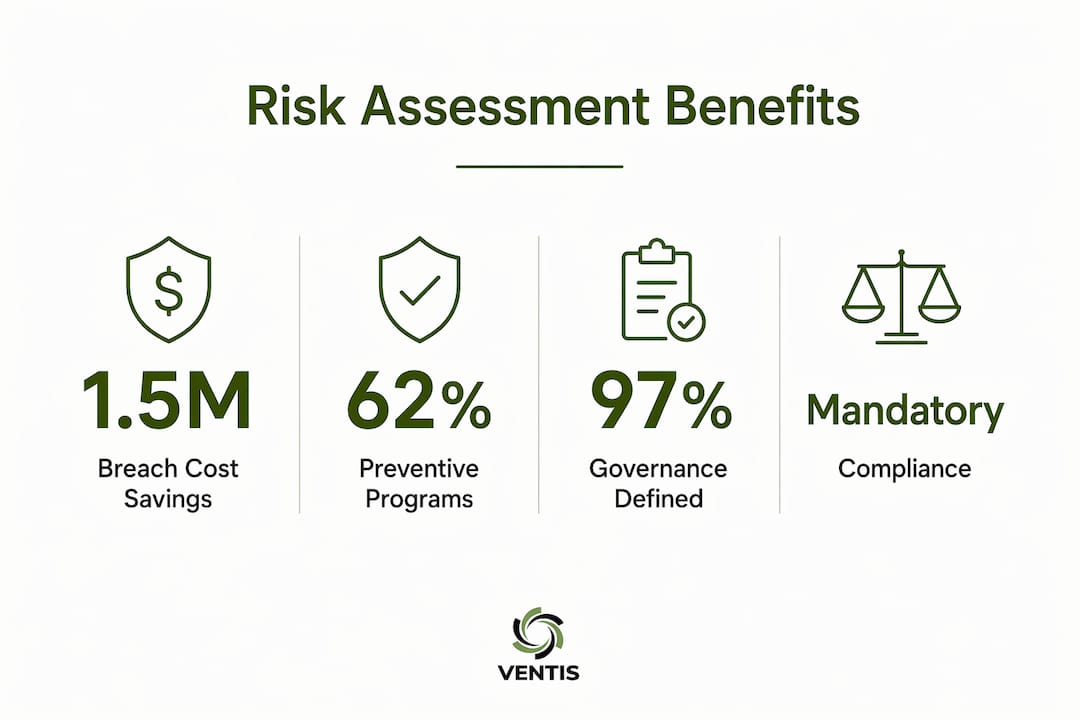
The governance numbers are particularly telling. 97% of organizations with mature cyber risk programs have defined risk appetite levels, and the majority of those are board-approved. That level of executive engagement does not happen without a formal assessment process to give the board something concrete to respond to.
Compliance is another non-negotiable driver. Frameworks like ISO 27001 and NIST explicitly require cybersecurity risk assessments as a condition of certification. If your business operates in healthcare, finance, or any regulated sector, an assessment is not optional. It is a compliance requirement with legal and contractual consequences for non-compliance. You can review cybersecurity compliance best practices to understand what specific regulations require from your assessment program.
How should organizations integrate risk assessments into governance?
A risk assessment filed in a drawer after completion is a wasted investment. The real value comes from embedding assessments into your governance structure and treating them as living documents.
Define board and management roles clearly
The board and management have distinct roles in cyber risk governance. The board defines risk appetite, which is the level of cyber risk the organization is willing to accept in pursuit of its business objectives. Management executes the risk program, translating that appetite into specific controls, budgets, and response plans. When these roles are clearly separated and documented, cyber risk gets treated as a quantified business risk rather than a technical problem delegated entirely to IT.
Run assessments continuously, not annually
Many organizations treat assessments as one-time checks. That approach fails because the threat environment changes faster than an annual review cycle can track. New vendors, new software deployments, workforce changes, and emerging threat actor tactics all create new risk exposure between scheduled assessments. Continuous risk assessment, supported by automation tools, keeps your risk register current and your mitigation priorities accurate.
- Assign ownership to each risk item with a named individual responsible for remediation.
- Set review triggers beyond the calendar, including new system deployments, vendor changes, and significant incidents.
- Use automation to monitor control effectiveness between formal assessment cycles.
- Integrate assessment findings into your annual tech budget planning so security investments align with actual risk priorities.
Translate technical findings into business language
Technical vulnerability scores do not translate directly to business risk. A CVSS score of 9.8 means nothing to a CFO deciding whether to approve a security budget. Effective communication requires converting technical findings into financial and operational impact terms. State the potential revenue loss, the regulatory fine exposure, or the operational downtime cost. That language secures board-level support and funding.
Pro Tip: Build a one-page executive summary for every assessment that leads with dollar-denominated risk exposure. Keep the technical appendix separate. Executives need to make decisions, not read vulnerability reports.
The most common failure mode in risk assessment programs is prioritizing low-impact technical findings without integrating business impact. This wastes resources on low-value fixes while high-impact risks remain unaddressed. Aligning your assessment process with a recognized cybersecurity framework like NIST CSF or ISO 27001 prevents this by forcing business context into every prioritization decision.
Key takeaways
A mature cybersecurity risk assessment program is the single most effective way to reduce breach costs, accelerate detection, and align security spending with actual business risk.
| Point | Details |
|---|---|
| Assessment vs. scanning | Risk assessments add business context that vulnerability scans and penetration tests cannot provide alone. |
| Financial impact | Mature programs reduce average breach costs by $1.5 million and detect breaches 40% faster. |
| Governance integration | Boards define risk appetite; management executes. Both roles require a formal assessment process to function. |
| Continuous practice | Treat assessments as living documents with assigned ownership, not annual compliance checkboxes. |
| Compliance requirement | ISO 27001, NIST, HIPAA, and PCI DSS all mandate formal risk assessments for certification and regulatory standing. |
What i've learned running risk assessments for small businesses
After working with dozens of small and mid-sized businesses in the Pittsburgh area, the pattern I see most often is this: companies invest in security tools but skip the assessment that would tell them which tools actually matter for their specific risk profile. They buy endpoint protection, set up a firewall, and call it done. Then a phishing attack hits an unprotected email account and takes down operations for three days.
The assessment is not the expensive part of cybersecurity. It is the part that makes everything else worth buying. When you know your actual risk exposure, you stop spending on low-priority controls and start addressing the threats that could genuinely put you out of business.
The other mistake I see regularly is treating the assessment report as a deliverable rather than a starting point. A 40-page PDF that nobody reads does not reduce your risk. What reduces risk is assigning a named owner to each finding, setting a remediation deadline, and reviewing progress in your next leadership meeting. That operational discipline is what separates organizations that improve their security posture from those that repeat the same findings year after year.
Board engagement matters more than most executives realize. When leadership understands the dollar-denominated risk exposure from an assessment, security budget conversations change completely. The question shifts from "why do we need to spend this?" to "what happens if we don't?" That shift in framing is worth more than any single security tool you could buy.
— Greg
Ready to assess your cybersecurity risk? ventis consulting group can help
Knowing your risk is the first step. Acting on it is where most businesses need support.

Ventis Consulting Group works with small and mid-sized businesses across Pittsburgh to conduct thorough cybersecurity assessments and build practical risk management programs that fit your budget and operations. Our managed IT services include continuous security monitoring, compliance support, and hands-on guidance so your assessment findings translate into real protection. We do not hand you a report and walk away. We stay engaged to help you close gaps, track progress, and keep your risk posture current as your business grows. If you want to know exactly where your business stands, contact Ventis Consulting Group to schedule your assessment today.
FAQ
What is the role of cybersecurity risk assessment in a business?
A cybersecurity risk assessment identifies, analyzes, and prioritizes cyber threats based on their likelihood and business impact. It gives executives the information they need to allocate security resources where they matter most.
How often should a company conduct a cybersecurity risk assessment?
Most frameworks recommend at least annual assessments, but continuous monitoring is the current best practice. Any significant change to your systems, vendors, or workforce should also trigger a review.
What is the difference between a risk assessment and a vulnerability scan?
A vulnerability scan identifies technical weaknesses in systems. A risk assessment incorporates those findings alongside business context, existing controls, and risk tolerance to produce a prioritized remediation plan.
Does a cybersecurity risk assessment help with regulatory compliance?
Yes. Frameworks including ISO 27001, NIST, HIPAA, and PCI DSS all require formal risk assessments as part of their compliance requirements. Skipping the assessment creates direct regulatory exposure.
How do small businesses start a cybersecurity risk assessment?
Start with an SMB-focused assessment checklist to inventory your assets and identify your highest-priority risks. From there, work with a managed IT provider to build a remediation roadmap tied to your specific business operations.