

Email is the single most exploited attack surface in cybersecurity, accounting for 8.3 billion phishing threats detected in Q1 2026 alone. That number is not a warning sign. It is the current reality. Phishing constitutes 48% of all malicious email activity, and business email compromise (BEC) now costs organizations more than $2.9 billion annually. Understanding why email is the top cyberattack vector requires looking at both the technical architecture of email and the psychological mechanics attackers exploit every day. This article breaks down both, with data from Microsoft Security, Abnormal AI, and RSA Conference 2026 research.
Why email is the primary cyberattack vector
Email is the primary attack vector in cybersecurity because it combines near-universal business adoption with a trust model that attackers can manipulate at scale. Every employee uses it. Every business depends on it. That ubiquity makes it the highest-value target in any threat actor's playbook.
The technical trust model behind email was built for communication, not security. Standard protocols like SMTP were designed to deliver messages, not verify intent. Even with modern additions like DMARC, DKIM, and SPF, the authentication layer only confirms domain identity. It does not verify whether the sender's intent is legitimate.

Beyond the technical gaps, email exploits human psychology in ways that few other attack surfaces can. Researchers at RSA Conference 2026 confirmed that phishing exploits "System 1" thinking, the brain's fast, automatic decision-making mode, by triggering emotions like fear, urgency, and authority. When a message appears to come from your CEO demanding immediate wire transfer approval, your brain processes it as a routine task under pressure, not a threat to analyze.
Here is what makes email uniquely dangerous as an attack surface:
- Volume and access: Every employee is a potential entry point, and most receive dozens of messages daily.
- Workflow integration: Email is embedded in approvals, invoices, HR communications, and vendor coordination.
- Emotional triggers: Fear, urgency, and authority framing increase click rates 2.1x compared to neutral messages.
- Gateway limitations: Traditional secure email gateways rely on signature and reputation-based detection, which fails against novel or hosted threats.
- Identity over malware: Attackers have shifted from delivering malicious files to stealing credentials and identity, which leaves fewer technical traces.
Pro Tip: If your email security stack still relies primarily on a legacy secure email gateway, you are defending against 2018 attack patterns. Modern threats require behavioral detection layered on top.
How email attack tactics have evolved in 2026
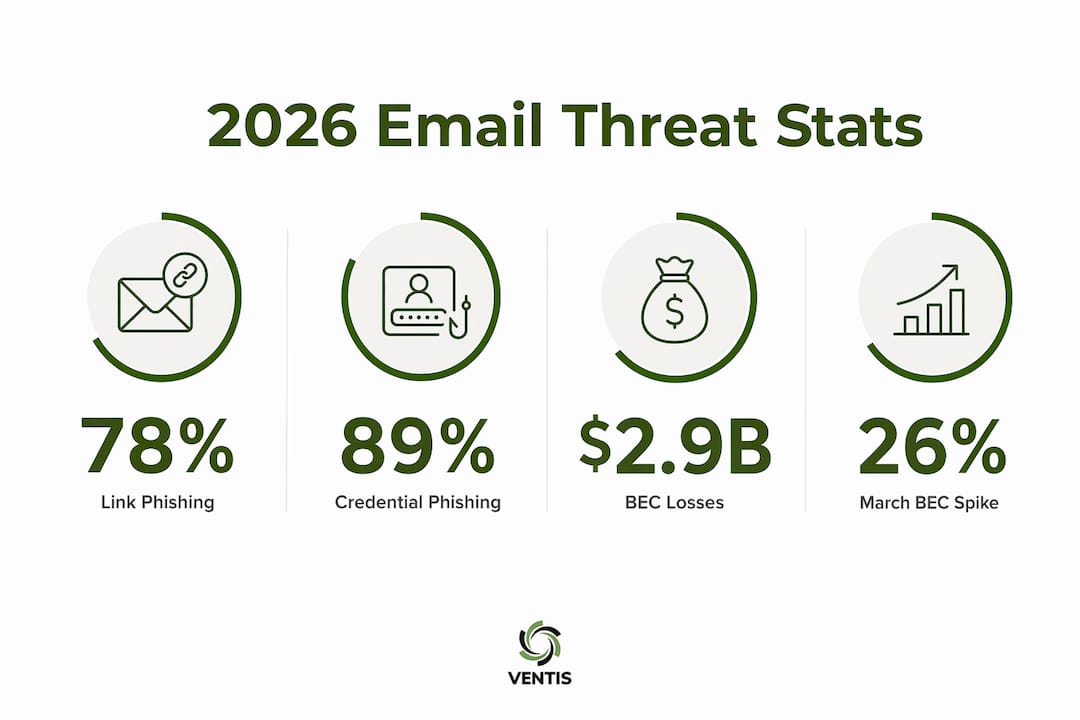
The email threat landscape has shifted significantly. Attackers are no longer relying on malicious attachments as their primary delivery method. 78% of email-based threats now use link-based delivery focused on credential harvesting. That shift reflects a deliberate response to improved attachment scanning by security tools.
Credential phishing has become the dominant payload strategy. Its share of payload-based attacks grew from 89% in January to 95% in February 2026. That trajectory means nearly every email-borne payload attack you face this year is designed to steal login credentials, not install ransomware directly.
| Attack method | 2026 trend | Primary goal |
|---|---|---|
| Link-based phishing | 78% of all email threats | Credential harvesting |
| Business email compromise | 26% surge in March 2026 | Financial fraud |
| QR code phishing | Rising sharply | Bypass link scanners |
| CAPTCHA-gated phishing | Increasing adoption | Evade automated analysis |
| AI-generated lures | Widespread via PhaaS kits | Scale and personalization |
BEC deserves special attention. BEC losses exceed $2.9 billion annually, and March 2026 saw a 26% spike in attacks. BEC does not require malware. It requires a convincing email that looks like it came from a trusted colleague or vendor. That simplicity is exactly what makes it so effective and so hard to block with technical controls alone.
Attackers are also using multi-hop redirect chains and URL shorteners to obscure final malicious destinations. A link that passes through three legitimate-looking redirect services before landing on a credential harvesting page will bypass most gateway inspection tools. The final URL is never exposed until the user clicks.
AI-generated phishing templates and phishing-as-a-service platforms now sell commercial toolkits for around $200 per month. That price point puts sophisticated, automated campaign creation within reach of low-skill threat actors. The result is a higher volume of well-crafted attacks at a fraction of the previous cost.
How attackers exploit trust and human behavior to bypass defenses
The most effective cyberattack email tactics do not beat your firewall. They beat your employees' judgment. Attackers study routine business workflows and craft messages that fit naturally into them. An invoice that matches your vendor's format, a DocuSign request that mirrors your internal approval process, a Microsoft 365 password reset that looks identical to the real thing.
Legitimate platforms like DocuSign and Microsoft 365 are now routinely used to host phishing content. Because these platforms have strong domain reputations, traditional gateway filters pass the messages without flagging them. The phishing page lives on a verified domain, which means reputation-based detection fails completely.
The psychological mechanics are precise. Phishing is designed to exploit authority bias and the scarcity effect, pushing victims to act before engaging analytical thinking. A message that says "Your account will be suspended in 2 hours" does not invite careful review. It triggers a reflex.
"Phishing persists because it targets how human brains function, not software. Exploiting cognitive shortcuts and emotions rather than technical vulnerabilities is the core of the attack."
Traditional security awareness training addresses this problem poorly. Static training fails against phishing that exploits predictable cognitive states under stress and routine task conditions. Employees who score well on phishing simulations still click malicious links when they are busy, distracted, or under deadline pressure. Knowledge does not override instinct in the moment.
The shift from malware payloads to identity theft compounds this problem. When an attacker steals credentials rather than installing software, there is no malware signature to detect. The compromise looks like a legitimate login from a known user. Detection requires behavioral analysis, not signature matching.
Pro Tip: Pair phishing simulations with immediate, contextual feedback at the moment of the click. Post-training reviews delivered hours later do not reinforce the right cognitive associations.
What strategies actually reduce email-based cyber risk
Reducing risk from email-based cyber threats requires a layered approach. No single control stops modern attacks. The goal is to make each layer compensate for the gaps in the others.
-
Deploy AI-driven behavioral detection. Behavioral AI analyzes communication patterns, login anomalies, and message content in context. It catches BEC and account takeover attempts that signature-based tools miss entirely. Tools in this category include Microsoft Defender for Office 365 and Abnormal Security.
-
Harden your email authentication configuration. DMARC, DKIM, and SPF must be configured correctly and set to enforcement mode, not monitor mode. A surprising number of organizations have these protocols in place but not enforced, which provides no real protection.
-
Reduce human decision points in high-risk workflows. Automate approval processes for wire transfers, vendor payment changes, and credential resets wherever possible. Removing humans from risky decision loops is more reliable than training them to make better decisions under pressure.
-
Update phishing simulations to mirror current tactics. Run simulations that use QR codes, CAPTCHA-gated pages, and legitimate platform spoofing. If your simulations still rely on obvious fake login pages, you are not testing against real threats. Review the cybersecurity threats facing mid-sized businesses to align your simulation scenarios with current attack patterns.
-
Build a "slow down" culture for specific triggers. Train employees to pause on any message requesting payment changes, credential entry, or urgent approvals. The goal is not to make them suspicious of everything. It is to create a deliberate pause for a defined set of high-risk actions.
-
Develop an email-specific incident response plan. Define clear steps for suspected BEC, credential phishing, and account compromise. Speed of response directly limits the financial damage from BEC attacks. Review how to train employees in cybersecurity awareness to build response habits alongside detection skills.
Pro Tip: Test your incident response plan with a tabletop exercise focused specifically on a BEC scenario. Most organizations discover their escalation paths are unclear until they run the drill.
Key takeaways
Email is the top cyberattack vector because it combines universal business access, exploitable human psychology, and technical trust gaps that no single security control can fully close.
| Point | Details |
|---|---|
| Email dominates attack volume | 8.3 billion phishing threats hit inboxes in Q1 2026, making email the highest-volume attack surface. |
| Links replaced attachments | 78% of email threats now use link-based delivery to harvest credentials and evade attachment scanners. |
| BEC is the costliest threat | Business email compromise causes over $2.9 billion in annual losses and requires no malware to execute. |
| Psychology beats technology | Phishing exploits System 1 fast thinking, making awareness training alone an insufficient defense. |
| Layered defense is required | Behavioral AI, enforced authentication protocols, and automated workflows together reduce risk more than any single control. |
Why I think we are still underestimating the email threat
I have worked with IT teams across Pittsburgh and the surrounding region for years, and the pattern I see most often is not a lack of security tools. It is a mismatch between the tools organizations deploy and the attacks they actually face.
Most businesses I talk to have a secure email gateway. Many have completed annual phishing awareness training. A few have DMARC configured. But almost none have behavioral AI in place, and almost none have tested their incident response against a realistic BEC scenario. That gap is where the real risk lives in 2026.
The research from RSA Conference 2026 on System 1 versus System 2 thinking genuinely changed how I frame email security conversations with clients. The problem is not that employees are careless. The problem is that attackers are deliberately engineering conditions that make careful thinking neurologically harder. That reframes the solution. You cannot train your way out of a cognitive exploit. You need to either remove the human decision point or slow it down with a process control.
The rise of phishing-as-a-service at $200 per month also matters more than most organizations realize. It means the volume and quality of attacks will keep increasing regardless of how well defenders improve. The asymmetry between attack cost and defense cost is getting worse, not better. That is the honest reality, and it is why I push clients toward automation and behavioral detection rather than more training hours.
The good news is that the defensive tools are genuinely improving. Behavioral AI is more accessible than it was two years ago. DMARC enforcement is straightforward if you have the right support. And building a culture of deliberate pauses for high-risk email actions is a low-cost, high-impact change that any organization can make this quarter.
— Greg
How Ventis Consulting Group helps you close the email security gap

Email-based threats are the most common entry point for breaches affecting small and mid-sized businesses in the Pittsburgh area. Ventis Consulting Group provides managed IT and security solutions that address the full email threat lifecycle, from configuration hardening and behavioral detection to employee training and incident response planning. The team at Ventis Consulting Group does not hand you a generic security checklist. They assess your specific environment, identify gaps in your current email defenses, and build a protection plan that fits your workflows and your budget. If you want to know exactly where your email security stands right now, reach out to Ventis Consulting Group for a direct conversation.
FAQ
Why is email the top cyberattack vector?
Email combines universal business adoption with exploitable human psychology and technical trust gaps. Microsoft Security data shows 8.3 billion phishing threats were detected in Q1 2026 alone, confirming email as the highest-volume attack surface in cybersecurity.
What makes phishing attacks so hard to stop?
Phishing exploits the brain's fast, automatic decision-making process by triggering fear, urgency, and authority bias. This means employees can click malicious links even when they know what phishing looks like, because the attack is designed to bypass analytical thinking.
How does business email compromise differ from standard phishing?
BEC does not use malware or malicious links. Attackers impersonate trusted colleagues or vendors to request wire transfers or credential changes, causing over $2.9 billion in annual losses through social engineering alone.
Are email attachments still a major threat in 2026?
Attachments have largely been replaced as the primary delivery method. In 2026, 78% of email threats use link-based delivery focused on credential harvesting, because link scanning is harder to execute reliably than attachment scanning.
What is the most effective way to prevent email hacks?
Layered defense combining behavioral AI detection, enforced DMARC authentication, automated approval workflows for high-risk actions, and realistic phishing simulations aligned to current tactics provides the strongest protection against modern email-based attacks.