

Full service networking is a single-provider model that delivers network design, structured cabling, hardware, managed LAN/WAN, Wi-Fi, unified communications, and security under documented SLAs. The industry term for the subscription-based version is Network as a Service (NaaS). It is the right fit for small to mid-sized businesses that want predictable monthly costs, a consultative technology roadmap, and one accountable vendor instead of a stack of disconnected contracts.
If that describes your situation, here is what to do next:
- Request a network assessment and NaaS proposal from Ventis Consulting Group
- Ask for sample SLA language covering site uptime, MTTR, and application-level performance
- Confirm the provider offers local on-site escalation, not just remote support
Table of Contents
- What does a full-service networking package actually include?
- Why are businesses moving to full-service networking right now?
- NaaS vs. traditional CapEx: which model fits your business?
- How do you evaluate and pick the right networking provider?
- What does onboarding and implementation actually look like?
- Security and compliance considerations for U.S. businesses
- How Ventis Consulting Group approaches full-service networking
- Can networking services be customized to fit your specific business?
- Real-world examples of full-service networking deployments
- Key Takeaways
- What most buyers get wrong about full-service networking
- Ready to get a network assessment from Ventis Consulting Group?
- Useful sources and further reading
What does a full-service networking package actually include?
Managed network services cover a wide range of functions a provider remotely operates, monitors, and maintains on your behalf, from LAN/WAN optimization to SD-WAN and virtual network services. A complete package should include all of the following.
Design and infrastructure
- Discovery and network assessment
- Structured cabling and physical plant documentation
- Hardware procurement, staging, and configuration
- Wi-Fi design, access point placement, and managed wireless
Connectivity and communications
- Managed LAN and managed WAN or SD-WAN
- UC/VoIP platforms with PSTN or SIP trunking
- Cloud integration for SaaS applications and hybrid workloads
Security and operations
- Managed firewall, network segmentation, and VPN
- Managed Detection and Response (MDR) integration
- Firmware and security patch management
- Continuous monitoring and alerting
Ongoing support
- Service desk and on-site break/fix coverage
- Capacity planning and performance reporting
- Documented SLAs and quarterly roadmap reviews
| Deliverable | What to verify in scope |
|---|---|
| Structured cabling | Included or subcontracted? Who warranties it? |
| Hardware ownership | Provider-owned (NaaS) or customer-owned (CapEx)? |
| Security controls | Firewall, MDR, and segmentation all in scope? |
| SLA coverage | Site uptime, MTTR, and application-level uptime defined? |
| Roadmap reviews | Quarterly or annual? Documented milestones? |
Why are businesses moving to full-service networking right now?
SMBs frequently contract managed network providers because they lack large in-house networking teams. The provider handles monitoring, troubleshooting, and lifecycle management, which frees your internal staff for projects that actually move the business forward.
The operational benefits go beyond headcount:
- Predictable Opex: Monthly subscription pricing replaces unpredictable hardware refresh cycles and emergency break/fix invoices.
- Fewer outages: Proactive lifecycle management, including continuous firmware updates, automated security patching, and capacity planning, prevents bandwidth bottlenecks before they affect users.
- Faster site rollouts: Distributed businesses can add locations without rebuilding a project team each time.
- Cloud and security integration: Modern managed network services emphasize SD-WAN, edge computing, and converged network and security services to improve observability and reduce latency.
Operational agility is the primary, measurable benefit for SMBs. When your provider owns the network operations, your team can redirect effort toward growth initiatives rather than troubleshooting switch firmware.
The shift to NaaS is changing how buyers evaluate providers. Subscription economics, vendor SLAs, and roadmap alignment now matter more than hardware specs alone.
NaaS vs. traditional CapEx: which model fits your business?
The core difference is who owns the risk. In a NaaS model, the provider bundles hardware, software licensing, management, and support into a monthly consumption fee. You pay for outcomes, not assets.

| Factor | NaaS / Managed Subscription | Traditional CapEx + Break/Fix |
|---|---|---|
| Upfront cost | Low (monthly fee) | High (hardware purchase) |
| Lifecycle ownership | Provider manages upgrades | Customer manages refresh cycles |
| Predictability | Fixed monthly Opex | Variable; spikes on failure |
| Scalability | Add sites or capacity on contract | Requires new procurement cycle |
| In-house expertise needed | Minimal | Significant |
| Contract structure | Multi-year MSA | Project-by-project |
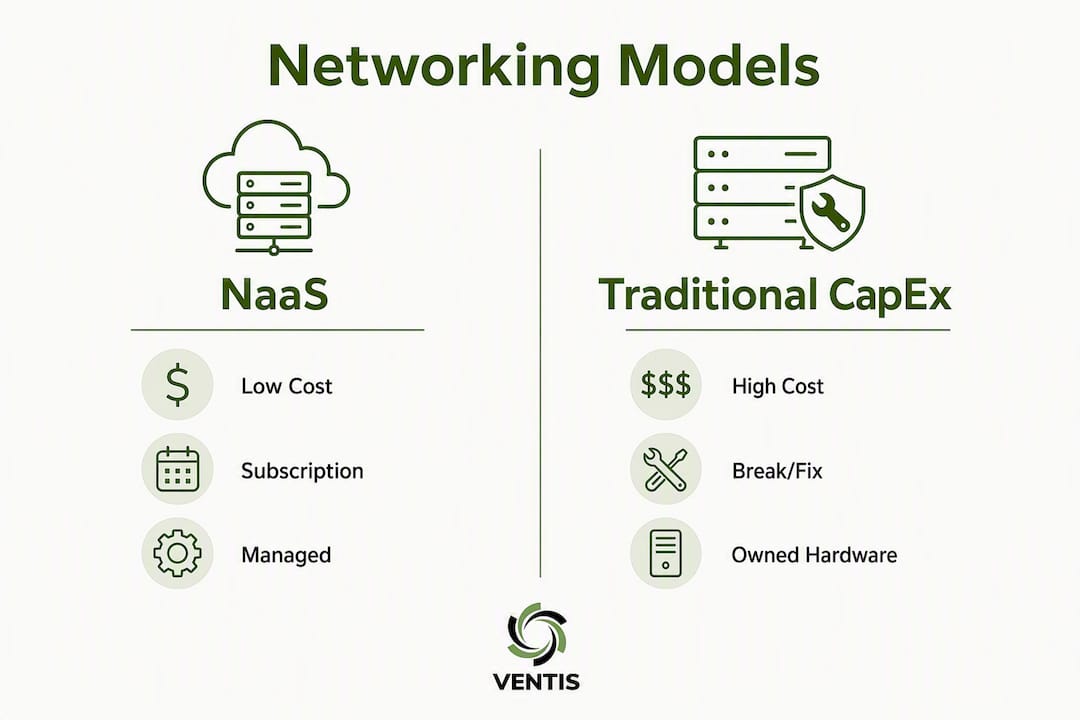
Pricing models vary: pure subscription NaaS, bundled hardware plus management with multi-year MSAs, and a-la-carte managed services each carry different implications for ownership and upgrade cycles. The right choice depends on your growth stage, number of locations, and internal IT capacity.
Pro Tip: NaaS makes the most financial sense when you are opening multiple locations within 12–18 months, have limited in-house networking expertise, or want to avoid a large capital outlay tied to equipment that will be obsolete in five years.
How do you evaluate and pick the right networking provider?
Use this checklist during vendor conversations. A provider that cannot answer these questions clearly is a red flag before you sign anything.

Questions to ask every vendor
| Question | Why it matters | Satisfactory answer |
|---|---|---|
| What does your discovery process look like? | Reveals whether they scope properly or sell a template | Structured assessment with documented findings |
| What is your escalation path for a site outage? | Tests real accountability | Named escalation tiers with defined response times |
| What MTTR do you commit to in the SLA? | Directly tied to business continuity | Specific hours, not "best effort" |
| How do you handle outage reporting? | Transparency during incidents | Proactive notification with RCA within 48 hours |
| Can you provide customer references or case studies? | Validates real-world delivery | At least two referenceable clients in similar industries |
SLA terms to negotiate
- Site uptime (99.9% or better for critical locations)
- Application-level uptime, not just raw internet link uptime
- MTTR commitment in hours, not days
- Scheduled maintenance windows with advance notice
Red flags to walk away from
- Vague SLA language with no defined MTTR
- No local escalation path or on-site support option
- Unclear hardware ownership at contract end
- No security integrations in scope
- Missing roadmap alignment or quarterly review cadence
A consultative provider aligns the technology roadmap with your business goals and includes regular roadmap reviews with documented milestones. If a vendor skips discovery and jumps straight to a quote, that is a signal they are selling a product, not a partnership.
What does onboarding and implementation actually look like?
Most full-service networking deployments follow a phased approach. Single-site projects typically run 4–8 weeks from signed agreement to SLA handover. Multi-site or SD-WAN rollouts often run 3–6 months, depending on carrier provisioning lead times.
- Discovery and assessment: Document existing infrastructure, application dependencies, and business requirements.
- Design and proposal: Produce a network design, hardware bill of materials, and project plan.
- Procurement and staging: Order hardware and carrier circuits; stage and pre-configure equipment off-site.
- Cutover: Schedule the migration window, execute the cutover, and validate connectivity and security controls.
- Stabilization: Monitor closely for 2–4 weeks post-cutover; address any performance issues.
- SLA handover: Transition to steady-state managed services with documented SLAs and a first roadmap review.
Budget for these cost components:
- Professional services (design, project management, cutover labor)
- Hardware (switches, routers, access points, firewalls)
- Carrier circuit installation fees and first-month costs
- Initial configuration, testing, and user acceptance testing
- Change management and staff training
Pro Tip: Always stage and test hardware before the cutover window. Running parallel circuits for 48–72 hours before decommissioning the old connection eliminates most cutover-night emergencies.
Security and compliance considerations for U.S. businesses
Outsourcing network operations does not transfer security responsibility. You need to verify that your provider's scope covers the controls your business actually requires.
Core security controls to confirm in scope:
- Network segmentation (guest, corporate, and IoT on separate VLANs)
- Managed firewall with policy review cadence
- VPN and zero-trust access for remote users
- MDR integration for threat detection and response
- Secure firmware and patch management with documented schedules
- Encrypted backup and documented disaster recovery procedures
Compliance checkpoints for U.S. SMBs:
- CMMC basics: Government contractors handling Controlled Unclassified Information need to verify their provider's practices align with CMMC Level 1 or Level 2 requirements.
- HIPAA considerations: Healthcare organizations must confirm the provider will sign a Business Associate Agreement (BAA) and that PHI never traverses unsegmented network paths.
- PCI scope reduction: Businesses processing card payments should segment cardholder data environments to reduce PCI DSS audit scope.
Contractual items to verify:
- Responsibility matrix for security incidents (who does what, and when)
- Breach notification timelines (U.S. state laws vary; confirm the provider meets your state's requirements)
- SOC 2 Type II report or equivalent third-party audit evidence
- Backup and DR expectations with tested recovery time objectives
Reviewing your provider's security responsibility framework before signing is one of the most overlooked steps in vendor selection. Ask for the responsibility matrix in writing.
This article provides general information, not legal or compliance advice. Confirm your specific obligations with a qualified compliance professional or the relevant regulatory body.
How Ventis Consulting Group approaches full-service networking
Ventis Consulting Group serves small to mid-sized businesses in Pittsburgh and the surrounding Western Pennsylvania region. The approach starts with a structured discovery session, not a generic quote, and produces a technology roadmap aligned to your business milestones.
What the engagement looks like:
- Discovery assessment covering existing infrastructure, application dependencies, and security posture
- Network design and NaaS proposal with transparent MSA and pricing terms
- Managed LAN/WAN, Wi-Fi, UC/VoIP, structured cabling, and managed security in a single contract
- Documented SLAs covering site uptime, MTTR, and application-level performance
- Quarterly roadmap reviews with measurable outcomes
Trust signals buyers should look for:
- Written MSA with clear hardware ownership and exit terms
- Documented SLAs and KPIs reviewed at every quarterly meeting
- 5-star client rating reflecting consistent service delivery
- Referenceable case studies from local and regional deployments
- On-site escalation capability for Pittsburgh-area clients
Ventis also offers unified communications solutions as part of its full-service model, covering VoIP, business phone service, and UC platforms alongside network infrastructure.
Can networking services be customized to fit your specific business?
Yes, and they should be. A provider selling a one-size package without a discovery phase is not doing full-service networking. They are selling a product.
Customization in a well-run managed network engagement covers several dimensions. Bandwidth and circuit type vary by location, application mix, and redundancy requirements. A medical practice needs different segmentation and compliance controls than a manufacturing facility. A retail business with 15 locations needs a different SD-WAN topology than a single-site professional services firm.
Ventis Consulting Group builds each engagement around the client's actual environment. That means hardware selection, SLA terms, security controls, and roadmap priorities are all scoped to your business, not pulled from a catalog. The tailored IT solutions approach is what separates a consultative partner from a commodity ISP.
Real-world examples of full-service networking deployments
Healthcare practice, Western PA: A multi-physician practice needed HIPAA-compliant network segmentation, managed Wi-Fi for clinical and guest traffic, and a VoIP system to replace an aging PBX. The engagement included structured cabling, firewall deployment with segmented VLANs, a SIP-based phone system, and a signed BAA. The practice eliminated three separate vendor relationships and moved to a single monthly invoice.
Professional services firm, Pittsburgh: A 40-person firm with two offices needed SD-WAN to consolidate connectivity, improve application performance for cloud-based tools, and reduce WAN costs. Discovery revealed that 60% of traffic was destined for Microsoft 365 and a cloud ERP platform. The SD-WAN design prioritized those applications, and the firm saw measurable improvement in application response times within the first month post-cutover.
Light manufacturing, regional: A manufacturer with five sites needed consistent Wi-Fi coverage across a large floor plan, IoT device segmentation, and centralized monitoring. The project included access point surveys, VLAN design for production and corporate traffic, and integration with the existing ERP system. Ongoing managed monitoring now catches bandwidth anomalies before they affect production scheduling.
Key Takeaways
A consultative NaaS partner delivers more than connectivity: it provides a documented roadmap, proactive lifecycle management, and a single point of accountability for network performance, security, and communications.
| Point | Details |
|---|---|
| Full-service scope matters | Verify that cabling, security, UC/VoIP, and SLAs are all in the contract, not sold separately. |
| NaaS shifts risk to the provider | Monthly subscription models replace CapEx hardware cycles and unpredictable break/fix costs. |
| SLA specificity drives accountability | Negotiate MTTR and application-level uptime, not just raw internet link uptime. |
| Security is not automatic | Confirm segmentation, MDR, patch management, and a responsibility matrix are in scope before signing. |
| Ventis Consulting Group | Offers discovery-led NaaS, managed security, and UC for Pittsburgh-area SMBs under a written MSA. |
What most buyers get wrong about full-service networking
The biggest mistake I see is treating the SLA as a formality. Buyers focus on price per month and hardware specs, then sign an SLA that says "best effort" for MTTR. Six months later, a four-hour outage becomes a two-day argument about who is responsible for what.
The second mistake is underestimating carrier lead times. Fiber circuits in many parts of Western PA can take 60–90 days to provision. If you plan a cutover without accounting for that, your project timeline falls apart before the hardware ships.
For a successful first 90 days post-cutover, focus on three things: run parallel circuits for at least 48 hours before decommissioning the old connection, complete user acceptance testing with actual staff before declaring the cutover done, and schedule your first roadmap review within 30 days of SLA handover while the discovery findings are still fresh.
The providers worth working with will push you to do all three. The ones who skip these steps are optimizing for their deployment speed, not your business continuity.
Ready to get a network assessment from Ventis Consulting Group?
Ventis Consulting Group gives Pittsburgh-area businesses a concrete starting point: a structured discovery session that produces a network assessment, a NaaS proposal with transparent pricing, and sample SLA language you can actually evaluate.
On the first call, you will walk through a discovery checklist covering your current infrastructure, application dependencies, security posture, and growth plans. You leave with a clear picture of what a managed network engagement would look like for your specific environment, including hardware ownership terms, MTTR commitments, and a roadmap outline.
To request your discovery session and view NaaS options, visit Ventis Consulting Group online or call the Pittsburgh office directly. If you are evaluating unified communications as part of the engagement, the UC solutions page covers VoIP, business phone, and platform options in detail.
Useful sources and further reading
- What are managed network services? | TechTarget — Authoritative definition of managed network services, NaaS models, SLA factors, and SMB adoption rationale.
- Network as a Service | Ventis Consulting — Ventis NaaS service descriptions, subscription model details, and procurement guidance for SMBs.
- Security Responsibility | Ventis Consulting — Shared security responsibility framework and contractual expectations for managed network clients.
- CloudSprout I.T & Digital Marketing Solutions — Regional partner resource for IT integration and digital services in local and distributed deployments.