

Managed detection and response (MDR) is defined as a cybersecurity service that combines 24/7 automated monitoring, advanced technology, and expert human analysis to detect, investigate, and actively contain threats in real time. Unlike passive security tools, MDR detects and responds across endpoints, networks, and cloud environments within your existing technology stack. For small and mid-sized organizations without a full security operations center, MDR delivers enterprise-grade protection at a fraction of the cost. Building an in-house SOC with round-the-clock coverage frequently exceeds $735,000 annually. MDR closes that gap with a predictable, outsourced model built around outcomes, not just alerts.
How does managed detection and response work in practice?
MDR operates through a layered combination of technology and human expertise running continuously. The service does not sleep, take weekends off, or miss a shift. That constant coverage is what separates it from most internal IT security setups.
The technology layer
MDR platforms pull signals from multiple sources simultaneously. Core components include Endpoint Detection and Response (EDR), Extended Detection and Response (XDR), Security Information and Event Management (SIEM), and live threat intelligence feeds. Each tool captures a different slice of your environment. EDR watches individual devices. SIEM correlates logs across your entire network. XDR ties cloud, email, and endpoint data together into one view. You can learn more about how EDR functions as a foundational MDR component.

The human analyst layer
Technology flags anomalies. Human analysts decide what those anomalies mean. MDR analysts perform threat hunting, validate alerts, investigate suspicious behavior, and take direct containment actions. Human expertise is the critical value in MDR. Deploying technology without skilled analysis produces alert overload, not improved security. Analysts also run automated playbooks that can isolate a compromised endpoint or block a malicious IP address within seconds of detection.
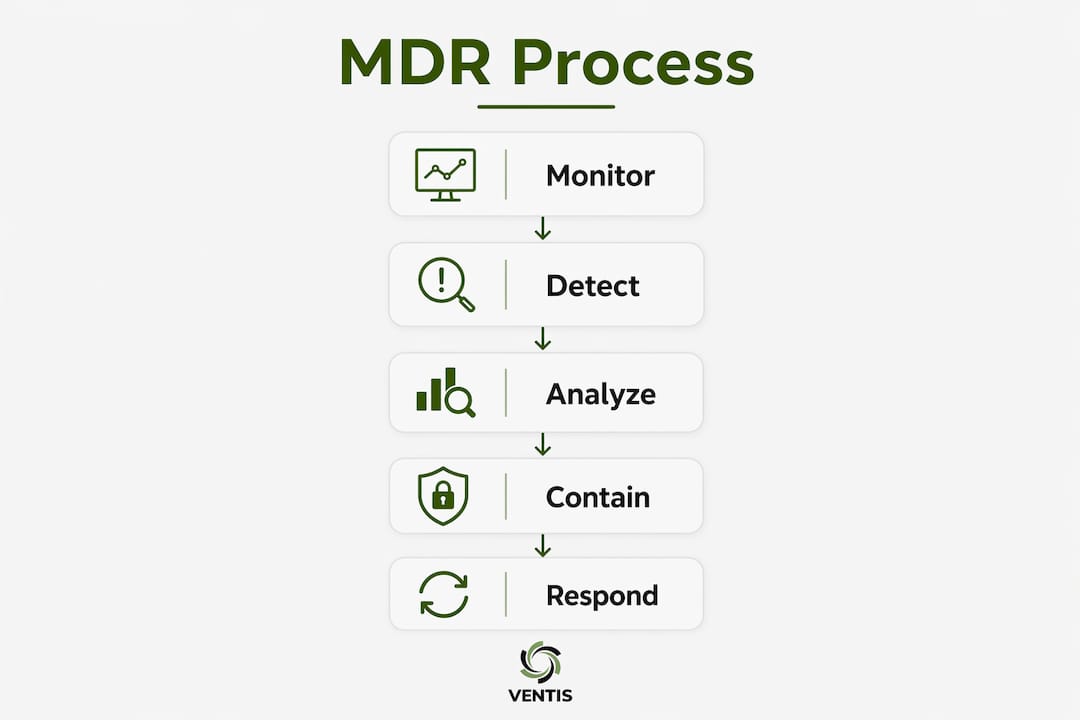
The operational sequence looks like this:
- Continuous data ingestion from endpoints, cloud workloads, and network traffic
- Automated correlation and anomaly scoring by the MDR platform
- Analyst review to separate genuine threats from false positives
- Active containment, such as endpoint isolation or credential revocation
- Incident report delivered to your internal team with remediation guidance
Pro Tip: Ask any MDR provider to walk you through a real incident from detection to containment. If they cannot show you that sequence clearly, their process is not mature enough to protect you.
What sets MDR apart from traditional security services?
The clearest way to understand MDR is to compare what happens after a threat is detected. Traditional managed security service providers (MSSPs) monitor your environment and send alerts. Your internal team then decides what to do. MDR providers take direct action like isolating infected systems, unlike MSSPs that only notify. That difference is not minor. It is the difference between a fire alarm and a fire department.
MDR vs. internal IT security
Most internal IT teams at small and mid-sized organizations handle infrastructure, helpdesk tickets, software updates, and security simultaneously. Asking that same team to perform 24/7 threat hunting is unrealistic. MDR complements internal teams by offloading continuous monitoring and triage, freeing your staff to focus on strategic work. MDR does not replace your IT team. It extends what your team can do.
| Capability | Traditional MSSP | MDR service |
|---|---|---|
| 24/7 monitoring | Yes | Yes |
| Alert notification | Yes | Yes |
| Threat investigation | Limited | Full |
| Active containment | No | Yes |
| Threat hunting | Rarely | Standard |
| Internal team integration | Minimal | Co-managed |
Pro Tip: When evaluating providers, ask specifically whether they perform full incident triage or simply forward enriched alerts. The answer tells you whether you are buying MDR or a more expensive MSSP.
What are the key benefits of MDR for small and mid-sized organizations?
The benefits of managed detection and response go beyond threat coverage. For organizations without dedicated security staff, MDR changes the economics and the outcomes of cybersecurity entirely.
- Cost control. Building an in-house SOC with 24/7 monitoring capability costs over $735,000 per year when you account for staffing, tooling, and training. MDR replaces that with a predictable monthly fee.
- Faster response. The average eCrime breakout time is 29 minutes, meaning attackers move from initial access to lateral spread in under half an hour. MDR's automated containment actions operate in seconds, not hours.
- Reduced alert fatigue. Basic MDR providers forward raw alerts, which overwhelms internal teams. Mature MDR services perform full incident triage, filtering noise and escalating only validated threats. Your team acts on real problems, not false alarms.
- Extended team capacity. Co-managed MDR models assign 24/7 threat hunting to the provider while your internal team handles infrastructure and policy. Neither side duplicates the other's work.
- Compliance support. MDR services generate detailed incident logs and reports that support frameworks like NIST CSF, HIPAA, and PCI DSS. Auditors want evidence of active monitoring. MDR produces it automatically.
- Proactive threat hunting. MDR analysts actively search for threats that have not yet triggered an alert. This catches attackers who are moving slowly to avoid detection, a tactic that passive tools miss entirely.
The 29-minute breakout time statistic deserves emphasis. Most organizations without MDR discover a breach days or weeks after it begins. MDR compresses that dwell time from weeks to minutes. That compression is where real damage prevention happens.
What should IT decision-makers consider when choosing an MDR provider?
Choosing the wrong MDR provider does not just waste budget. It creates a false sense of security while leaving real gaps in your defense. These are the criteria that matter most.
- Response authorization scope. Clear authorization protocols define whether the provider can autonomously isolate endpoints or must seek your approval first. If the provider needs your sign-off before acting, you lose the speed advantage that makes MDR valuable. Agree on authorization boundaries before signing any contract.
- Signal coverage. Ask which environments the provider monitors. Endpoint-only coverage misses cloud workloads and network traffic. True MDR ingests signals from endpoints, cloud logs, email, and network flows simultaneously.
- Triage depth. Full incident triage removes the burden from your team by validating and prioritizing threats before escalation. Alert enrichment without triage still dumps noise on your desk. Know which one you are buying.
- Tool integration. Effective MDR integrates with your SIEM, EDR, and cloud logs rather than requiring you to rip and replace existing tools. Providers that demand a full stack replacement are selling products, not services.
- Threat hunting maturity. Ask the provider how they hunt for threats that have not triggered automated alerts. Immature providers rely entirely on rule-based detection. Mature providers use behavioral analysis and adversary intelligence to find threats hiding in normal-looking traffic.
- Communication and escalation protocols. Define how and when the provider contacts you during an active incident. A 3:00 AM phone call with no context is not useful. A structured escalation with severity level, affected systems, and recommended action is.
Pro Tip: Request a sample incident report before you commit. A good MDR provider produces reports that your non-technical leadership can read and understand. If the report reads like a raw log dump, that provider is not built for your organization.
You should also build an internal incident response plan before MDR goes live. MDR handles detection and containment. Your team still needs to own recovery, communication, and business continuity.
Key Takeaways
MDR is the most cost-effective way for small and mid-sized organizations to achieve 24/7 threat detection, active containment, and expert-driven investigation without building an internal SOC.
| Point | Details |
|---|---|
| MDR definition | MDR combines automated monitoring, threat intelligence, and human analysts to detect and contain threats in real time. |
| Cost advantage | Building an in-house SOC exceeds $735,000 annually; MDR delivers equivalent coverage at a predictable monthly cost. |
| Speed matters | With eCrime breakout times averaging 29 minutes, only automated MDR containment acts fast enough to limit damage. |
| Triage quality | Choose providers that perform full incident triage, not just alert forwarding, to avoid overwhelming your internal team. |
| Authorization clarity | Define response authorization scope upfront so the provider can act autonomously when every second counts. |
MDR works best when you treat it as a partnership
I have seen organizations sign an MDR contract and then treat the provider like a black box. They assume the service runs itself and stop paying attention. That is the fastest way to waste the investment.
The organizations that get the most from MDR are the ones that stay engaged. They review incident reports. They update the provider when their environment changes. They hold quarterly calls to discuss threat trends and adjust coverage. MDR is not a set-it-and-forget-it product. It is a working relationship between your team and a group of security experts who need context to protect you well.
The other mistake I see regularly is choosing a provider based on price alone. A cheaper provider that forwards raw alerts without triage will generate more work for your team, not less. The cost savings evaporate the moment your staff spends hours chasing false positives. Pay for triage. It is the part of MDR that actually reduces your operational burden.
One more thing worth saying plainly: MDR does not make your internal IT team irrelevant. It makes them more effective. Your team knows your business, your users, and your risk tolerance. The MDR provider knows the threat landscape. Together, those two perspectives produce better security than either one alone. Protect that collaboration by defining security responsibilities clearly from day one.
— Greg
How Ventis Consulting Group supports your MDR needs
Ventis Consulting Group works with small and mid-sized organizations across Pittsburgh and the surrounding region to build cybersecurity programs that actually fit how they operate.

If you are evaluating managed detection services, Ventis Consulting Group offers a consultative approach that starts with understanding your current environment before recommending any solution. The team helps you assess coverage gaps, define response authorization, and integrate monitoring into your existing tools without disruption. Predictable pricing and local expert support mean you get enterprise-grade protection without enterprise-grade complexity. Visit the Ventis managed security agreement page to see how the service is structured and what it covers for organizations like yours.
FAQ
What is managed detection and response in simple terms?
MDR is a cybersecurity service where a team of experts monitors your systems around the clock, investigates threats, and takes direct action to stop attacks. It combines automated technology with human analysts to protect your organization in real time.
How does MDR differ from antivirus or firewall tools?
Antivirus and firewalls block known threats based on predefined rules. MDR actively hunts for unknown and emerging threats, investigates suspicious behavior, and responds to incidents that automated tools miss entirely.
Is MDR suitable for small businesses?
MDR is well-suited for small and mid-sized businesses because it delivers 24/7 expert security coverage without the cost of hiring a full internal security team. The outsourced model makes enterprise-level protection financially practical for smaller organizations.
What does "active response" mean in an MDR context?
Active response means the MDR provider takes direct containment actions, such as isolating a compromised device or blocking a malicious connection, rather than simply alerting your team and waiting for you to act.
How does MDR help with regulatory compliance?
MDR services generate detailed incident logs, investigation records, and response documentation that satisfy audit requirements under frameworks like NIST CSF, HIPAA, and PCI DSS. Continuous monitoring also demonstrates the active security posture that many regulations require. Learn more about managed security for SMBs and how it supports compliance goals.