

24/7 security monitoring is the continuous, real-time surveillance and analysis of security data by trained professionals and intelligent systems to detect and respond to threats the moment they appear. In the industry, this practice is formally called continuous security monitoring or managed detection and response (MDR). The role of 24/7 security monitoring goes far beyond recording events. It combines surveillance cameras, motion sensors, access control logs, and network data into a single, always-on defense layer. The global average breach cost reached $4.88 million in 2026, with organizations lacking continuous monitoring spending an average of 258 days just detecting and containing a single incident. That number alone makes the business case clear.
How does 24/7 security monitoring work?
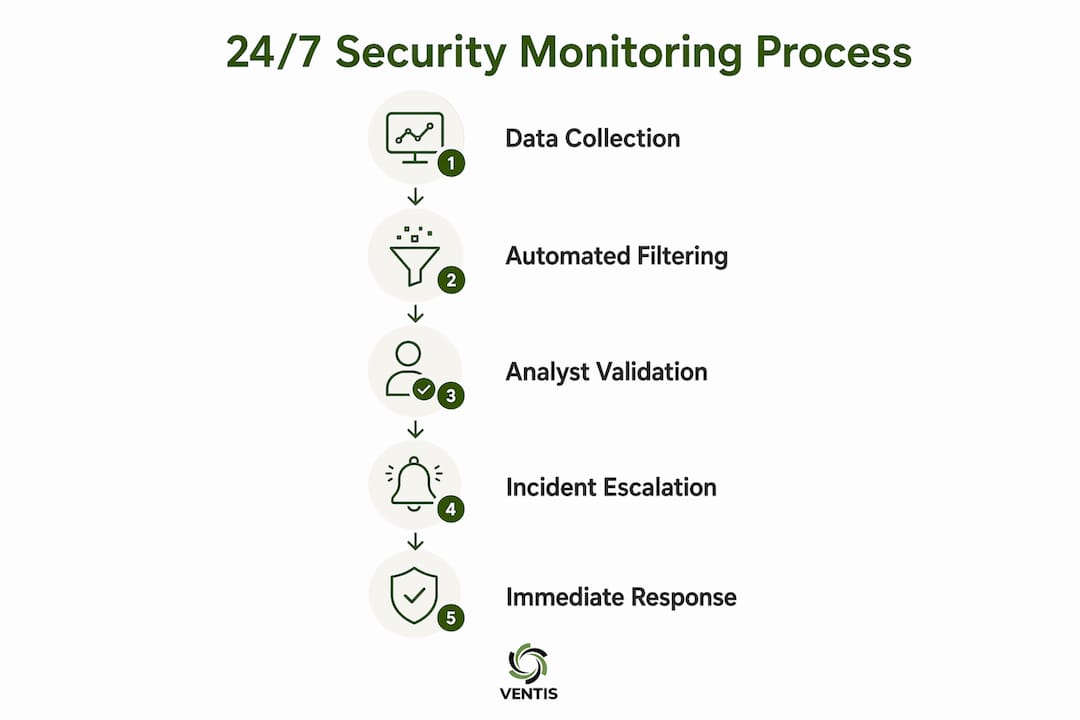
Continuous security monitoring pulls data from multiple sources at once. Surveillance cameras, door access logs, motion detectors, network traffic analyzers, and endpoint sensors all feed into a central monitoring platform. The system processes that data in real time, flagging anomalies for review.
Automated filtering handles the first pass. AI tools scan incoming alerts and separate routine activity from genuine signals worth investigating. This step is critical because a mid-sized business can generate thousands of alerts per day. Without filtering, human analysts would spend all their time chasing noise.
Human analysts then take over for validation. They review flagged alerts, apply context, and decide whether to escalate. High-performing monitoring services verify real security threats within 60 seconds of an alert firing. That speed matters because attackers move fast once inside a network.

Incident escalation follows a defined protocol. Verified threats trigger an immediate response chain: notify the business owner, lock down affected systems, and document the event for legal and insurance purposes. The monitoring center logs every action with timestamps.
Pro Tip: Never rely on automated alerts alone. Pair your monitoring platform with a human analyst team. Automated systems catch volume; humans catch context. The combination cuts false positives and stops real threats before they spread.
What are the key benefits of continuous security monitoring?
The benefits of continuous security monitoring show up in three areas: financial savings, faster response, and regulatory standing.
-
Faster breach detection. Without 24/7 SOC coverage, the global median attacker dwell time is about 10 days. With proper continuous monitoring, that drops to minutes. Every hour an attacker stays undetected increases the damage they can do.
-
Lower breach costs. Organizations using proactive AI and continuous security testing save nearly $2 million in breach costs annually compared to those relying on periodic assessments. The investment in continuous validation typically runs $300,000–$800,000 per year, well below the cost of a single major breach.
-
Regulatory compliance. Continuous monitoring is becoming a regulatory requirement under frameworks like NIS2 and DORA. Compliance frameworks now demand ongoing validation rather than annual snapshots. Businesses that already run continuous monitoring programs meet these requirements without scrambling.
-
Better insurance and legal outcomes. Verified incident footage from monitored CCTV systems improves prosecution success rates and insurance claims outcomes compared to raw, unverified recordings. Insurers trust timestamped, analyst-verified evidence far more than a raw video file.
The financial argument is straightforward. Paying for continuous monitoring costs a fraction of recovering from a breach. For small to mid-sized businesses in particular, a single major incident can be existential. Understanding proactive cyber risk management before an incident happens is the difference between a recoverable setback and a shutdown.
Why do human analysts matter in 24/7 monitoring?
The technology behind 24/7 monitoring is only as good as the people interpreting it. The primary factor that separates effective monitoring from ineffective monitoring is the human team and their processes, not the technology stack alone.
Here is what human analysts actually do that automated systems cannot:
- Alert triage. Analysts review flagged events and filter out false positives before anyone wastes time or money responding to a non-threat.
- Context application. A delivery truck arriving at 2 a.m. looks suspicious to an algorithm. An analyst who knows your business schedule recognizes it as a scheduled shipment.
- Escalation judgment. Not every alert needs a full incident response. Analysts decide what level of action a situation requires, saving resources and preventing overreaction.
- Pattern recognition. Analysts spot slow-burn attacks that automated tools miss because the individual events look normal in isolation.
Automated alerts without expert validation create high false alarm volumes. That leads to one of two outcomes: teams start ignoring alerts entirely, or they trigger costly emergency responses for non-events. Both outcomes are expensive. Learning how to respond to security alerts effectively requires trained judgment, not just software.
Pro Tip: When evaluating a monitoring provider, ask specifically about their analyst-to-alert ratio and average response time. A provider with strong technology but thin analyst coverage will leave you exposed during high-volume attack periods.
In-house vs. outsourced 24/7 monitoring: what should you choose?
Business owners face a real choice when implementing continuous monitoring: build an internal Security Operations Center (SOC) or outsource to a managed service provider. The right answer depends on your budget, team size, and risk profile.
| Factor | In-house SOC | Outsourced MDR/SOC |
|---|---|---|
| Upfront cost | High (staff, tools, infrastructure) | Low to moderate (subscription model) |
| Staffing requirement | 6–10 analysts for true 24/7 coverage | Handled by provider |
| Time to deploy | Months to years | Days to weeks |
| Regulatory documentation | Self-managed | Often included |
| Scalability | Slow and expensive | Fast and flexible |
Most small to mid-sized businesses cannot staff a true 24/7 internal SOC. Running round-the-clock coverage requires multiple analyst shifts, redundant tooling, and ongoing training. The cost is prohibitive for most organizations outside the enterprise tier.
Outsourced MDR services give you access to an expert team, proven tooling, and immediate deployment at a fraction of the internal cost. Continuous testing programs combine automated scanning, penetration tests, and control validation into a single ongoing program. That breadth is difficult to replicate with an internal team unless you have significant resources.
One practical point: integration matters. Your monitoring service needs to connect with your existing infrastructure, including your firewalls, endpoint tools, and cloud platforms. Before signing a contract, confirm that the provider supports your current tech stack. Reviewing cybersecurity compliance best practices alongside your monitoring setup helps you avoid gaps that regulators will find.
Ongoing validation also beats annual testing. Continuous security validation programs allow organizations to evolve alongside their threat environment, while annual tests only capture a single moment in time. For board-level reporting, quarter-over-quarter trend data from continuous monitoring is far more credible than a single annual snapshot.
Pro Tip: When budgeting for outsourced monitoring, factor in the cost of a breach, not just the cost of the service. Use the $4.88 million average breach figure as your baseline. Even a $50,000 annual monitoring contract looks like a bargain against that number.
For a deeper look at how dwell time affects breach outcomes, the difference between 10 days and 10 minutes of attacker access is the difference between a minor incident and a full data compromise. You can also explore AI-driven security assessments as a complement to your continuous monitoring program.
Key Takeaways
Continuous security monitoring reduces breach costs, cuts attacker dwell time from days to minutes, and satisfies regulatory requirements that annual testing cannot meet.
| Point | Details |
|---|---|
| Speed of detection | Effective monitoring verifies threats within 60 seconds, cutting dwell time from 10 days to minutes. |
| Financial impact | Organizations with continuous monitoring save nearly $2 million annually compared to breach recovery costs. |
| Human analysts are non-negotiable | Automated tools filter volume; human analysts provide the context needed to act on real threats. |
| Outsourcing beats in-house for most SMBs | Managed SOC services deploy faster and cost less than building an internal team. |
| Compliance is now a driver | NIS2 and DORA require continuous validation, making 24/7 monitoring a regulatory necessity, not just a best practice. |
Why I think most businesses are still getting this wrong
After working with small and mid-sized businesses across Pittsburgh and the surrounding region, I keep seeing the same mistake. Business owners invest in cameras and endpoint software, then assume the monitoring problem is solved. It is not. Technology records. People protect.
The attackers who cause the most damage do not strike at noon on a Tuesday. They probe systems at 2 a.m. on a Saturday, specifically because they know most businesses have no one watching. The significance of round-the-clock protection is not theoretical. It is the direct result of attackers mapping your monitoring gaps and exploiting them.
I also see businesses treat annual security assessments as a substitute for continuous monitoring. They are not the same thing. An annual test tells you where you stood on one day. Continuous monitoring tells you where you stand right now. Regulators are starting to enforce that distinction, and businesses that have not made the shift will feel it.
My advice: stop thinking of 24/7 monitoring as a cost and start treating it as a risk transfer. You are not buying software. You are buying the guarantee that a trained professional is watching your systems every hour of every day, ready to act before a threat becomes a crisis. That guarantee has a clear dollar value, and for most businesses, it is far cheaper than the alternative.
— Greg
Protect your business around the clock with Ventis Consulting Group
Your business does not stop running at 5 p.m., and neither should your security.

Ventis Consulting Group provides managed IT and security monitoring services built specifically for small to mid-sized businesses in Pittsburgh and the surrounding areas. Their team combines expert human analysts with proven monitoring tools to give you continuous coverage without the cost of building an internal SOC. Fast deployment, transparent reporting, and a consultative approach mean you get a program designed around your actual business, not a generic template. Contact Ventis Consulting Group today to design a monitoring program that fits your budget and your risk profile.
FAQ
What is 24/7 security monitoring?
24/7 security monitoring is the continuous, real-time analysis of security data from cameras, sensors, network logs, and access systems by trained analysts and automated tools. Its purpose is to detect and respond to threats immediately, before they cause significant damage.
How quickly can a 24/7 monitoring service respond to a threat?
High-performing services verify real threats within 60 seconds of an alert. That speed is critical because attacker dwell time without continuous monitoring averages 10 days, giving attackers significant time to cause damage.
What is the cost of 24/7 security monitoring vs. a breach?
Continuous monitoring programs typically cost $300,000–$800,000 annually for enterprise-level coverage. The global average breach cost reached $4.88 million in 2026, making monitoring a clear financial advantage for most businesses.
Do I need human analysts or is automated monitoring enough?
Automated monitoring alone creates high false alarm volumes and misses context-dependent threats. Human analysts triage alerts, apply business context, and make escalation decisions that automated systems cannot replicate reliably.
Does 24/7 monitoring help with regulatory compliance?
Frameworks like NIS2 and DORA now require continuous security validation rather than annual testing. A properly structured 24/7 monitoring program satisfies these requirements and provides the quarter-over-quarter trend data regulators and insurers expect.