

A data breach is defined as any incident in which unauthorized parties access, disclose, or steal sensitive business information, including customer records, financial data, or intellectual property. Understanding what does a data breach mean for business goes far beyond a technical definition. The impact of data breach events extends across finances, operations, legal standing, and customer trust simultaneously. Data compromises hit a record 3,322 events in 2025, a 79% increase over five years. That number tells you this is not a rare risk reserved for large corporations. It is a business reality every owner and manager must plan for.
What financial and operational risks does a data breach pose?
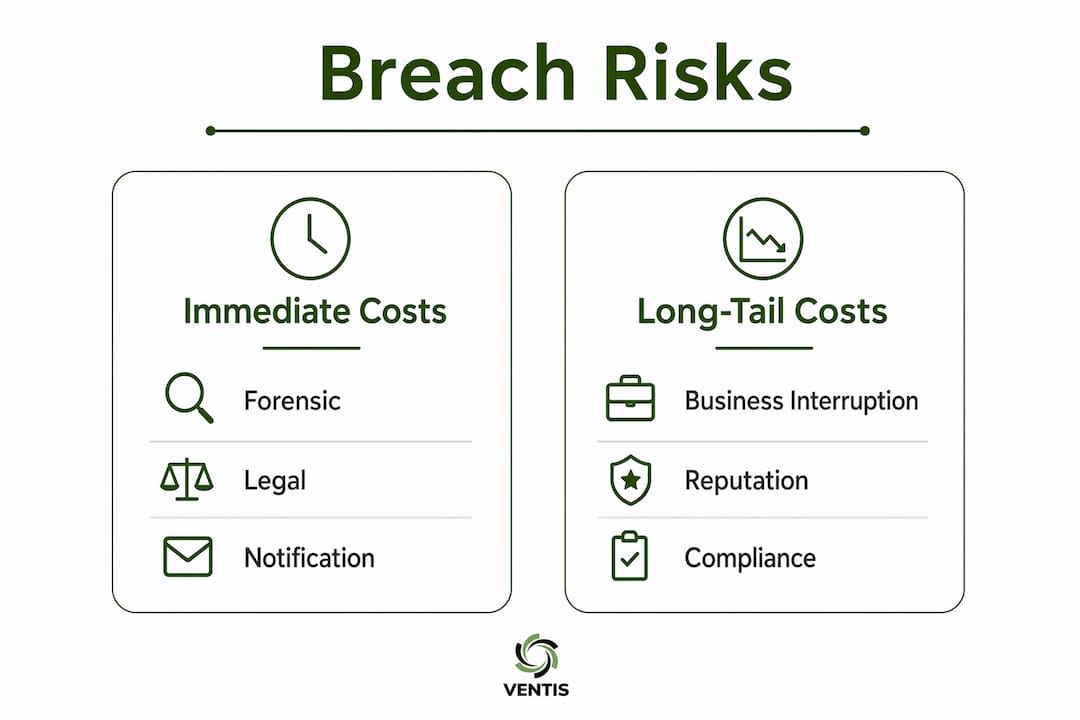
The financial damage from a breach is immediate and long-lasting. The median breach cost rose 80% to $110,000 in 2025, with the top 2.5% of incidents exceeding $22 million. For small businesses specifically, the median impact sits at $38,000, mid-market companies face around $96,000, and large enterprises average $238,000. Those numbers represent real cash that leaves your business, often without warning.
Costs split into two categories: immediate and long-tail. Immediate costs include forensic investigation, legal counsel, customer notification, and credit monitoring services. Long-tail costs are the ones that quietly drain resources over years. About 51% of total breach costs land in the first year, with the remainder accumulating over two to three years through litigation, regulatory monitoring, and remediation. That means the visible damage you see in month one is only half the story.

Operational disruption compounds the financial hit. Business interruption accounts for 24%–50% of total breach costs, making it the single largest loss driver. The average breach takes 241 days to identify and contain. During that window, your team is diverted from revenue-generating work to incident response, your systems may be offline, and your projects stall.
| Cost Category | Examples | Timing |
|---|---|---|
| Immediate costs | Forensics, legal, notification | First 30 days |
| Operational disruption | Downtime, project delays, staff diversion | Weeks to months |
| Long-tail costs | Litigation, audits, regulatory monitoring | 1–3 years |
| Reputational costs | Lost customers, reduced sales pipeline | Ongoing |
Pro Tip: Track your breach-related expenses in a separate ledger from day one. Insurers and regulators will request an itemized cost record, and having it ready reduces both legal exposure and claims processing time.
How do data breaches damage customer trust and brand reputation?
Customer trust is a financial asset, not just a sentiment. 66% of consumers lose trust in companies after a breach, and that erosion translates directly into customer churn and reduced revenue. Trust recovery, when it happens at all, takes years. The role of cybersecurity in customer trust is now a board-level concern, not an IT department footnote.
Reputational damage moves through three phases. The first is immediate backlash, driven by media coverage and customer notifications. The second is medium-term erosion, where prospects avoid your brand during their buying process and existing customers quietly defect. The third is long-term scarring, where your company name appears in breach databases and news archives that surface in every future Google search about your business.
The ripple effects reach beyond your customer base:
- Sales cycles lengthen as prospects demand security audits and third-party certifications before signing contracts.
- Recruitment suffers because top candidates research employers, and a breach signals instability.
- Investor confidence drops as shareholders price in regulatory risk and future litigation costs.
- Partner relationships strain when vendors and clients reassess the risk of being associated with a breached company.
"Security must be treated as an enterprise-wide risk, not just an IT issue. Customer trust is a valuable financial asset; losing it due to breaches significantly threatens revenue sustainability and long-term business viability."
Transparency is the most effective tool for limiting trust damage. Companies that notify customers quickly, explain what happened clearly, and outline concrete remediation steps consistently retain more customers than those that delay or obscure the facts.
What legal and regulatory consequences follow a data breach?
The legal exposure from a breach is layered and time-sensitive. U.S. businesses face notification obligations under state laws in all 50 states, each with different deadlines and requirements. Internationally, the General Data Protection Regulation (GDPR) imposes fines of up to 4% of global annual revenue for violations. The California Consumer Privacy Act (CCPA) and its successor, the CPRA, add statutory damages on top of that.
The notification clock starts immediately. Public companies must disclose material breaches on Form 8-K within four business days of determining a breach is material. Financial institutions face even tighter windows, sometimes as short as 36 hours. Missing these deadlines is itself a legal violation that compounds penalties and invites additional regulatory scrutiny.
The long-term legal burden is substantial. Here is what businesses typically face after a significant breach:
- State attorney general investigations triggered by consumer complaints and mandatory breach reports.
- Class-action lawsuits from affected customers. Settlements can exceed $100 million and take years to resolve, keeping the breach in public view.
- Federal regulatory action from agencies like the FTC or SEC, depending on your industry and the data involved.
- Mandatory remediation programs including third-party audits, security upgrades, and government monitoring that can last 10 or more years.
- Contractual penalties from clients and partners whose data was exposed in your breach.
Pro Tip: Build a breach notification checklist before an incident occurs. Map every jurisdiction where your customers live, identify the applicable notification law for each, and assign a legal contact responsible for each filing. Doing this under pressure after a breach is far slower and more expensive.
Data breach notification obligations vary by industry and jurisdiction, with complex layered deadlines. Missing them compounds the severity of penalties significantly.
How do breaches affect partnerships, insurance, and growth?
A breach does not just hurt your current operations. It reshapes your ability to grow. B2B contracts frequently include security standards clauses, and a breach can trigger immediate termination rights. Breach risk is a strategic contractual vulnerability that most business owners do not discover until a contract is already at risk.
The insurance market reacts harshly to breached companies. Understanding cyber liability insurance terms before a breach is critical, because after one, your options narrow fast. Businesses that experience a breach face:
- Premium increases of 50%–200% at renewal, sometimes more for repeat incidents.
- Higher deductibles that shift more of the next incident's cost onto the business.
- Coverage exclusions for specific attack types that were involved in the prior breach.
- Policy non-renewal in severe cases, leaving the business without cyber coverage entirely.
Credit ratings and investor relationships also take a hit. Lenders and investors view a breach as evidence of governance failure, not just a technical incident. That perception raises borrowing costs and makes equity raises harder. Intellectual property theft, which often goes undetected for months, creates a hidden competitive disadvantage that surfaces only when a competitor brings a similar product to market faster than expected.
What steps should business leaders take to reduce breach risk?
Cybersecurity is a business continuity issue for SMBs, not a technical checkbox. Business leaders who treat it as an IT department responsibility consistently underestimate their exposure. The most effective breach mitigation programs are led from the top and built into every department's operations.
Here is a practical framework for reducing your risk:
- Conduct a cybersecurity risk assessment. A formal risk assessment in 2026 identifies your highest-value data, your weakest access points, and the specific threats most likely to target your industry.
- Build and test an incident response plan. A plan that has never been tested will fail under pressure. Run tabletop exercises at least twice a year with your leadership team.
- Train staff regularly. Human error remains the most common breach entry point. Monthly phishing simulations and annual security training reduce that risk measurably.
- Invest in monitoring tools. Real-time threat detection shortens the 241-day average detection window. Faster detection means lower total costs.
- Secure cyber insurance before you need it. Coverage is easier to obtain and cheaper to maintain before a breach than after one.
- Know your notification obligations now. Map your legal requirements by jurisdiction and industry so your team can act within required deadlines without scrambling.
Pro Tip: The single highest-return investment in breach preparedness is a tested incident response plan. Companies with documented, rehearsed plans consistently face lower total breach costs than those responding ad hoc.
Knowing how to respond to a breach fast is as important as prevention. Speed of detection and containment directly determines how much of that 241-day window you can close.
Key Takeaways
A data breach is a cross-functional business crisis that generates financial, legal, operational, and reputational damage simultaneously, and preparation before an incident is the only reliable way to limit total harm.
| Point | Details |
|---|---|
| Financial damage is deep and long | Median breach costs hit $110,000 in 2025, with 49% of costs accumulating over 2–3 years. |
| Business interruption dominates costs | Operational downtime accounts for up to 50% of total breach losses, more than any other single factor. |
| Legal exposure is time-sensitive | Notification deadlines start immediately; missing them adds penalties on top of existing fines. |
| Customer trust loss is measurable | 66% of consumers lose trust after a breach, directly reducing retention and future revenue. |
| Preparation cuts total cost | Tested incident response plans and proactive risk assessments consistently lower breach impact. |
Why most business leaders still underestimate breach consequences
I have worked with business owners who genuinely believed a breach would not happen to them because they are "too small to be a target." That belief is the most expensive mistake in cybersecurity. The data is clear: there are only two types of companies, those that have been breached and those that will be. Attackers do not discriminate by company size. They target the easiest entry point, and small businesses often have fewer defenses.
What surprises most leaders I advise is not the immediate cost. It is the long tail. The litigation that drags on for three years. The insurance renewal that comes back at double the premium. The enterprise client who quietly removes you from their vendor list six months after the incident. These are the consequences that do not show up in the first press release.
My honest recommendation is this: stop treating breach preparedness as a cost center and start treating it as risk capital. The businesses that come through breaches with their reputation and operations intact are the ones that invested in response planning before they needed it. Resilience, not perfect prevention, is the realistic goal.
— Greg
Protect your business before a breach forces the issue
Running a business in Pittsburgh or the surrounding region means competing on trust and reliability. A single breach can undo years of that work in days.

Ventis Consulting Group works with small and mid-sized businesses to assess cybersecurity risk, build incident response plans, and maintain the kind of IT infrastructure that limits breach exposure. From managed IT services to full cybersecurity assessments, the team at Ventis Consulting Group delivers practical, personalized guidance, not generic solutions. If you want to know exactly where your business stands and what to do about it, a managed service agreement is the right starting point. Reach out to Ventis Consulting Group and get a clear picture of your risk before an attacker does it for you.
FAQ
What does a data breach mean for a small business?
A data breach means unauthorized access to your business's sensitive data, triggering financial costs, legal notification obligations, and customer trust damage. Small businesses face a median breach cost of $38,000, with top-end cases reaching 7% of insured revenue.
How long does it take to recover from a data breach?
Recovery takes years, not weeks. About 51% of breach costs land in the first year, with the remaining 49% accumulating through litigation, audits, and regulatory monitoring over two to three additional years.
What are the legal consequences of a data breach for businesses?
Businesses face mandatory breach notifications under state and federal law, GDPR fines of up to 4% of global revenue, class-action lawsuits, and long-term regulatory monitoring programs that can last a decade or more.
Does a data breach affect cyber insurance?
A breach typically triggers premium increases of 50%–200%, higher deductibles, coverage exclusions, and in some cases, policy non-renewal. Securing coverage before a breach occurs is significantly easier and less expensive.
How can businesses reduce the risk of a data breach?
Conducting a cybersecurity risk assessment, training staff on phishing and access hygiene, deploying real-time monitoring tools, and maintaining a tested incident response plan are the most effective steps for reducing breach risk and limiting damage when an incident occurs.