

A hybrid cloud environment is defined as an IT architecture that combines private on-premises infrastructure with one or more public cloud services, connected by high-speed networking and managed through a unified orchestration layer. The industry term for this model is "hybrid cloud," and understanding what is hybrid cloud environment means recognizing it as a single, integrated platform rather than two separate systems running side by side. For IT professionals and decision-makers at small to mid-sized businesses, this distinction matters. It determines whether your infrastructure gives you real control or just adds complexity. This guide breaks down the architecture, benefits, challenges, and emerging trends you need to make a confident decision.
What is a hybrid cloud environment and how does it work?
A hybrid cloud environment works by connecting your private data center or on-premises servers to one or more public cloud platforms through a unified management layer. That management layer, often called an orchestration layer, handles workload placement, data movement, and security policy enforcement across both environments. Without it, you are not running a true hybrid cloud. You are managing two separate systems, which defeats the purpose.
The key distinction between hybrid cloud and multi-cloud is scope. Multi-cloud means using multiple public cloud providers without necessarily integrating them with private infrastructure. A hybrid cloud definition always includes that private component and the unified management framework that ties everything together. Think of it this way: multi-cloud is a portfolio of cloud services, while hybrid cloud is a single operating model that spans your own hardware and the public cloud.
For SMBs, this matters because hybrid cloud architecture lets you keep sensitive data on your own servers while pushing elastic workloads, like web traffic spikes or batch processing, out to the public cloud. You get the control of private infrastructure and the flexibility of public cloud without having to choose one or the other.
What are the main components of hybrid cloud architecture?
A hybrid cloud setup has three core layers: the private infrastructure, the public cloud services, and the orchestration layer that connects them.

The private layer includes your on-premises servers, storage systems, and virtualization software. This is where regulated data, legacy applications, and latency-sensitive workloads typically live. The public layer includes services from major cloud platforms that provide compute, storage, and managed services on demand. The orchestration layer sits between them and handles everything from workload scheduling to unified security policy enforcement.
Data Fabric is one construct that enables this interoperability, allowing applications and data to move dynamically across cloud and on-premises components based on business needs. Modernizing your on-premises infrastructure to be API-compatible with public cloud services is a prerequisite for this to work smoothly.
| Component | Hybrid cloud | Public cloud only | Private cloud only |
|---|---|---|---|
| Infrastructure ownership | Mixed (owned + rented) | Fully rented | Fully owned |
| Data control | High for sensitive data | Lower | Highest |
| Scalability | High via cloud bursting | Highest | Limited |
| Cost model | Variable + fixed | Fully variable | Fully fixed |
| Compliance flexibility | High | Moderate | High |
Orchestration software is the critical element that makes this table a reality rather than a theory. Without it, the hybrid model collapses into siloed infrastructure.
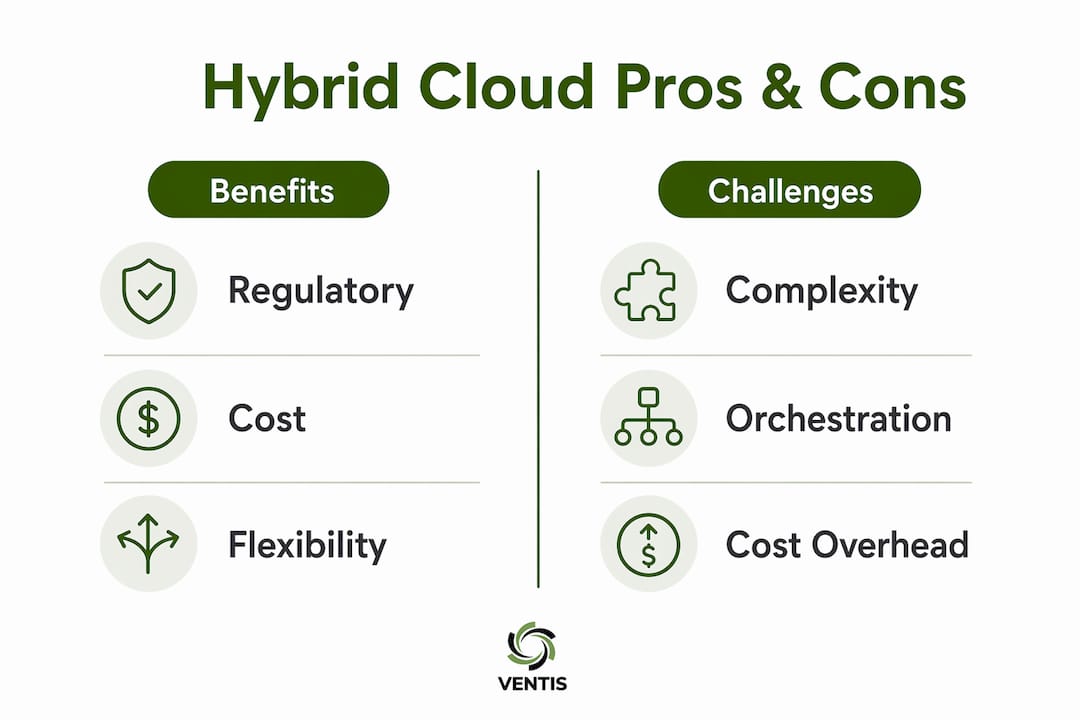
What are the key benefits of adopting a hybrid cloud?
The benefits of hybrid cloud go beyond cost savings. The architecture solves real operational problems that pure public or private cloud cannot address alone.
- Regulatory compliance. Keeping sensitive data on-premises satisfies requirements under frameworks like HIPAA, PCI-DSS, and state-level data privacy laws. Regulated industries like healthcare and finance use hybrid cloud specifically because it lets them meet compliance obligations without abandoning cloud flexibility.
- Cloud bursting. When demand spikes, workloads automatically expand into the public cloud and contract when demand drops. You pay for extra capacity only when you need it.
- Legacy system integration. Many SMBs run applications that cannot move to the public cloud without a full rewrite. Hybrid cloud lets those systems stay on-premises while newer workloads run in the cloud.
- Cost efficiency. Matching workloads to the right environment reduces waste. Predictable workloads run cheaply on owned hardware; variable workloads use pay-as-you-go public cloud pricing.
- AI and data workload support. AI training and inference jobs require large compute bursts. Hybrid cloud lets you run inference close to your data on-premises while using public cloud GPUs for training runs.
Pro Tip: Before moving any workload, classify it by sensitivity, latency requirement, and cost profile. That classification drives every placement decision and prevents expensive mistakes later.
What are the challenges of hybrid cloud implementation?
Hybrid cloud is not a plug-and-play solution. The advantages of a hybrid environment come with real operational complexity that you need to plan for before you start.
Latency and data synchronization are the most common operational pain points. When data lives in two places, keeping it consistent in real time requires caching strategies, replication policies, and careful network design. Edge computing can reduce latency for time-sensitive applications, but it adds another layer to manage.
The following challenges appear most frequently in SMB hybrid cloud deployments:
- Vendor lock-in. Proprietary orchestration tools from a single vendor can trap you in a pricing model that grows expensive over time. Open-source tools like K3s, OpenStack, and HashiCorp Terraform give you portability and cost control.
- Unified governance gaps. Security policies applied inconsistently across private and public environments create exposure. A unified security governance model that spans both environments is not optional. It is the baseline.
- Skill gaps. Hybrid cloud requires your team to understand both on-premises infrastructure and cloud operations. Many SMB IT teams are strong in one area but not both.
- Operational complexity. Managing two environments under one framework requires monitoring tools that provide visibility across both. AI-based monitoring platforms help, but they require configuration and ongoing tuning.
Pro Tip: Evaluate your orchestration framework before you sign any vendor contracts. The orchestration layer is harder to replace than the cloud services it manages. Choose open standards from the start.
The mindset shift is as important as the technical work. Unified management means treating private and public resources as one pool, not two separate domains with separate teams and separate tools. Organizations that keep those silos in place do not get the benefits of hybrid cloud. They get the costs of both models without the advantages of either.
How is hybrid cloud evolving with AI and edge computing?
AI workloads are reshaping hybrid cloud architecture faster than any other trend. Training large models requires massive, bursty compute that public cloud handles well. Running those models in production requires low latency and data proximity that on-premises infrastructure handles better. That tension is pushing organizations toward a three-tier architecture: public cloud for elasticity, on-premises for consistent production, and edge computing for low-latency inference.
This three-tier model changes how SMBs need to think about their infrastructure investments. The edge tier, which might be a small server in a retail location or a manufacturing floor, becomes a first-class part of the architecture rather than an afterthought. AI-driven workloads are also accelerating the shift away from cloud-first strategies toward hybrid-centric models where the question is not "should we use the cloud?" but "which workload belongs where?"
| Workload type | Best placement | Reason |
|---|---|---|
| AI model training | Public cloud | Elastic GPU access, pay-per-use |
| AI inference in production | On-premises | Low latency, data proximity |
| Real-time edge processing | Edge tier | Sub-millisecond response needs |
| Regulated data storage | Private/on-premises | Compliance requirements |
| Web traffic bursting | Public cloud | Variable demand, cost efficiency |
The economic trade-off is real. Initial hybrid cloud costs run higher than a pure public cloud setup because you are maintaining on-premises hardware alongside cloud subscriptions. Long-term, the optimization gains from placing workloads correctly outweigh that upfront investment. SMBs that treat hybrid cloud as a permanent operating model rather than a transition phase see the best returns. Tailored AI integration into hybrid environments is also accelerating, giving smaller organizations access to capabilities that were previously only viable at enterprise scale.
Key Takeaways
A hybrid cloud environment succeeds when private infrastructure, public cloud services, and a unified orchestration layer operate as one platform rather than separate systems.
| Point | Details |
|---|---|
| Core definition | Hybrid cloud combines private on-premises infrastructure with public cloud under one management framework. |
| Orchestration is non-negotiable | Without a unified orchestration layer, you manage silos, not a true hybrid environment. |
| Compliance drives placement | Regulated data stays on-premises; elastic and variable workloads move to the public cloud. |
| AI demands three tiers | Modern AI workloads require public cloud, on-premises, and edge computing working together. |
| Open-source tools protect flexibility | Tools like K3s, OpenStack, and HashiCorp Terraform prevent vendor lock-in and reduce long-term costs. |
What I've learned after years of watching SMBs get hybrid cloud wrong
Most SMBs I work with come to hybrid cloud with the right instinct but the wrong framing. They see it as a way to keep one foot in their data center while testing the cloud. That framing leads to half-measures. You end up with two environments that do not talk to each other, two sets of security policies that conflict, and a team that is confused about which system owns what.
The organizations that get hybrid cloud right treat it as a single platform from day one. They invest in the orchestration layer first, before they move a single workload. They define their data classification policy before they sign a cloud contract. And they build their security governance model to span both environments simultaneously, not sequentially.
The AI trend is making this more urgent, not less. SMBs that want to run AI applications at any meaningful scale will need hybrid architecture because the economics of running everything in the public cloud become prohibitive at production volumes. The edge tier is also becoming real for businesses outside of tech, including manufacturers, retailers, and healthcare providers who need real-time processing close to their operations.
My honest advice: do not let the complexity of hybrid cloud push you toward a pure public cloud model just because it feels simpler. Simpler is not always cheaper or safer. Get the architecture right, choose open standards, and treat the orchestration layer as your most important infrastructure investment.
— Greg
How Ventis Consulting Group supports your hybrid cloud strategy
Hybrid cloud decisions carry real risk for SMBs, especially when the orchestration layer, security governance, and workload placement strategy are not aligned from the start.

Ventis Consulting Group works with small to mid-sized businesses in Pittsburgh and surrounding areas to build practical, well-governed IT environments. Their managed IT services cover cloud strategy, cybersecurity, and infrastructure management, giving your team expert guidance without the overhead of a large internal IT department. Whether you are evaluating your first hybrid cloud deployment or tightening governance on an existing setup, Ventis Consulting Group brings the local expertise and hands-on support to get it right. Reach out to discuss your specific environment and get a clear plan forward.
FAQ
What is a hybrid cloud environment in simple terms?
A hybrid cloud environment connects your private on-premises servers to one or more public cloud platforms through a unified management layer, letting you run workloads in the location that best fits their security, cost, and performance requirements.
How does hybrid cloud differ from multi-cloud?
Hybrid cloud always includes private on-premises infrastructure integrated with public cloud services under one management framework. Multi-cloud uses multiple public cloud providers but does not necessarily include a private infrastructure component.
What are the main benefits of hybrid cloud for SMBs?
The primary benefits include regulatory compliance for sensitive data, cost efficiency through cloud bursting, legacy system integration, and the ability to support AI workloads that require both elastic compute and low-latency production environments.
What tools help avoid vendor lock-in in hybrid cloud?
Open-source orchestration tools like K3s, OpenStack, and HashiCorp Terraform provide portability across cloud providers and reduce dependency on proprietary vendor platforms.
Is hybrid cloud more expensive than public cloud?
Initial hybrid cloud costs run higher because you maintain on-premises hardware alongside cloud subscriptions. Long-term, placing workloads in the right environment reduces total spend compared to running everything in the public cloud.