

Most small and mid-sized businesses don't lack IT support. They lack IT leadership. That gap is exactly why businesses need virtual CIO services: a fractional, outsourced Chief Information Officer gives you executive-level technology strategy without the cost or commitment of a full-time hire.
A virtual CIO, commonly called a vCIO, handles the decisions your IT team doesn't have time or authority to make. Think technology roadmaps, cybersecurity governance, vendor negotiations, budget planning, and executive reporting. These aren't helpdesk functions. They're the strategic layer that turns your technology spending into a business advantage.
The financial case is straightforward. Full-time CIO compensation includes competitive executive-level salaries plus benefits, overhead, and recruiting costs that most SMBs simply cannot absorb. A vCIO delivers the same caliber of leadership on a fractional basis, at a fraction of that cost. For businesses in Pittsburgh and across the country, that access to senior IT guidance is no longer a luxury reserved for large enterprises.
Here are the ten most important reasons your business should consider virtual CIO services in 2026.
1. Why businesses need virtual CIO services starts with the leadership gap
Your IT team is good at keeping things running. What they often can't do is step back and ask whether the technology you're running actually fits where your business is headed. That's a leadership gap, and it quietly costs you money every quarter.
A vCIO fills that gap by providing the strategic direction your internal team needs to operate with purpose. They set priorities, build a multi-year technology roadmap, and give your IT staff the executive air cover to push back on bad decisions. Internal IT teams often know exactly where the problems are but lack the authority or bandwidth to fix them at a structural level.
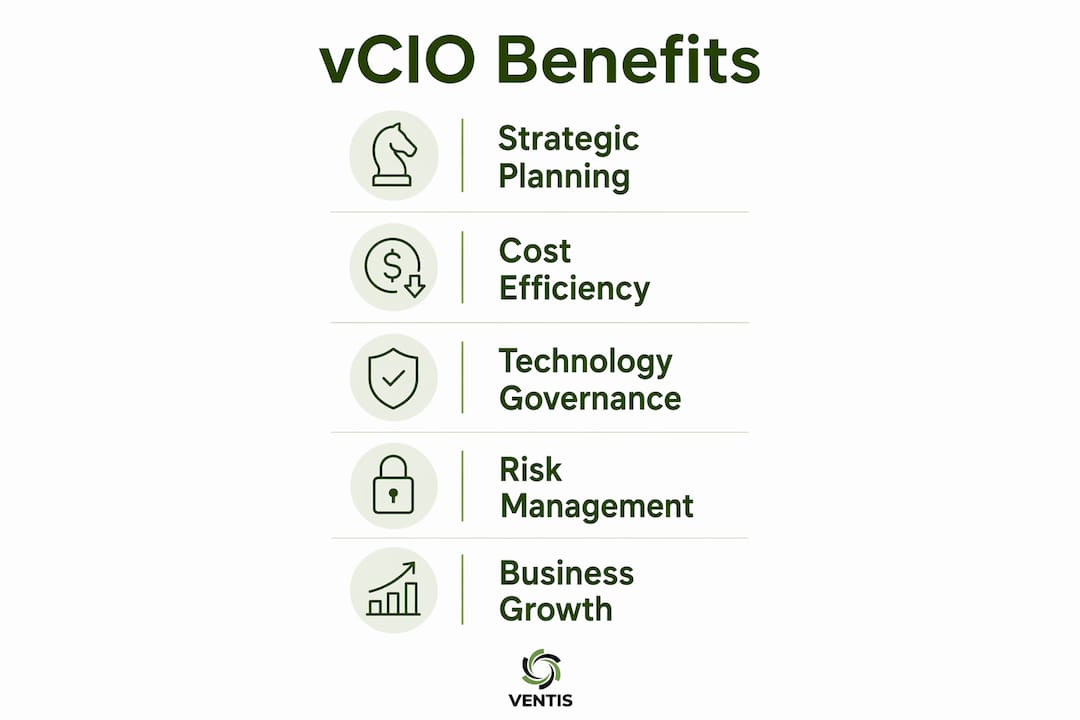
The result of leaving this gap open is predictable: reactive decisions, fragmented software purchases, and technology spending that nobody can justify to the board.
2. A vCIO handles the responsibilities that drive real business outcomes
Understanding what a virtual CIO actually does clarifies why the role matters so much. This isn't account management or quarterly check-ins. A vCIO takes ownership of the functions that connect your technology to your business goals.
Core responsibilities typically include:
- Technology roadmap development: Building a 12-to-36-month plan that sequences IT investments by business priority, not by what broke most recently.
- Cybersecurity governance: Owning the risk register, overseeing compliance with frameworks like HIPAA, CMMC, or SOC 2, and ensuring backup and recovery plans are tested.
- Vendor and contract management: Evaluating MSPs, SaaS providers, and telecom contracts, then consolidating overlapping services and negotiating better terms.
- Budget forecasting: Replacing unpredictable IT spending with a structured, defensible budget tied to measurable outcomes.
- Executive reporting: Translating technical risks into business language so leadership can make informed decisions without needing a computer science degree.
- Governance and compliance oversight: Setting policies for software procurement, access management, and staff offboarding to prevent the quiet security risks that accumulate without clear rules.
A vCIO is distinct from your MSP. MSPs run systems and resolve tickets; a vCIO sets the standards those systems should meet and holds vendors accountable to them. The two roles are complementary, not interchangeable.

3. The benefits of virtual CIO services go well beyond cost savings
The financial advantage is real, but it's only the beginning. Here's what growing businesses consistently gain from engaging a vCIO:
- Cost-effective executive leadership. You get CIO-level judgment without funding a full-time C-suite salary, benefits package, and recruiting process.
- Proactive IT planning. A vCIO shifts your organization from firefighting to forward planning, building a roadmap that anticipates needs before they become crises.
- Vendor rationalization. SaaS sprawl leads to redundant licenses and hidden security risks. A vCIO acts as a neutral evaluator, consolidating your vendor ecosystem and cutting waste.
- Improved cybersecurity posture. With a vCIO owning your risk register and governance policies, security stops being reactive and starts being a managed, measurable function.
- Clearer IT ROI. Every technology investment gets evaluated against business outcomes, so you stop funding projects that don't move the needle.
- Scalable engagement. As your business grows, your vCIO engagement scales with it. You're not locked into a fixed overhead cost.
- Executive-level risk visibility. Leadership gets clear dashboards and plain-language risk summaries instead of confusing technical reports.
Pro Tip: Ask any vCIO candidate to describe what you'll receive in the first 30–60 days. A solid engagement should include a current-state assessment, a prioritized roadmap, and defined KPIs. If the answer is vague, keep looking.
4. When should your business hire a virtual CIO?
Most businesses recognize they needed a vCIO about six months after the warning signs first appeared. Hiring a vCIO is often triggered by change, not crisis, but the following signals indicate the need is already here:
- Reactive IT decisions: Technology purchases are driven by vendor calls or whatever failed last week, not a structured plan.
- Unclear ROI on IT spend: Leadership can't point to what the technology budget is actually delivering.
- Cybersecurity gaps: A recent phishing incident, failed audit, or untested backup plan signals a governance problem, not just a tools problem.
- Rising, unpredictable costs: Surprise IT expenditures are a symptom of missing lifecycle planning and license oversight.
- Fragmented software stacks: Departments are buying their own tools, creating duplicate platforms and security blind spots.
- IT team overwhelmed with tickets: When your internal staff spends 90% of their time on support requests, there's zero capacity for planning.
- Growth events on the horizon: A new office, acquisition, compliance requirement, or rapid headcount increase will expose every gap in your current IT approach.
If two or more of these feel uncomfortably familiar, engaging a vCIO before your next growth phase is the right call. The importance of virtual CIO services becomes most visible when you're scaling and your systems can't keep up.
5. What does virtual CIO engagement actually cost?
Virtual CIO services are structured to fit SMB budgets, which is a large part of their appeal. Engagement models are flexible, ranging from monthly advisory retainers to project-based work to blended arrangements that combine both.
Common cost structures include:
- Monthly retainers: A fixed fee for ongoing strategic guidance, governance, and executive reporting. Predictable and easy to budget.
- Project-based engagements: Scoped work for specific initiatives like a cybersecurity assessment, cloud migration planning, or ERP selection.
- Blended models: A base retainer for ongoing leadership plus project fees for larger initiatives, giving you flexibility as needs evolve.
The comparison to a full-time CIO is where the financial case becomes obvious. A full-time CIO requires a competitive salary, benefits, bonuses, and recruiting overhead. A vCIO delivers the same strategic functions at a fraction of that annual cost, and many organizations recover the engagement fee through vendor savings and license rationalization within the first year.
For tech budget planning, the predictability of a retainer model alone is worth the investment. Surprise IT costs are one of the most common budget killers for SMBs.
6. Which industries and business sizes benefit most from virtual CIO services?
Virtual CIO services are particularly valuable when technology plays a growing role in operations but the scale doesn't yet justify a full-time CIO hire. That description fits a wide range of businesses.
Industries that consistently benefit include:
- Professional services firms: Law firms, accounting practices, and consulting companies rely on a vCIO to align technology investments with security requirements and client confidentiality obligations.
- Construction companies: Project management systems, ERP platforms, and field technologies all require coordinated leadership to scale alongside growing operations.
- Distribution companies: Integrated systems, automation, and cybersecurity strategies demand the kind of coordinated oversight a vCIO provides.
- Growing mid-market businesses: Companies scaling rapidly reach a point where technology decisions directly affect hiring, customer experience, and operational capacity.
- Healthcare organizations: HIPAA compliance, patient data security, and system integration create a constant need for executive IT governance.
- SaaS and technology companies: When your product lives in the cloud, your internal infrastructure needs the same discipline applied to your product.
In terms of company size, businesses in the 20-to-200 employee range are the most common users of vCIO services. This is the segment most likely to be running without IT leadership and most exposed to the consequences of that gap.
7. Virtual CIO versus full-time CIO: which fits your business?
The right choice depends on your size, budget, and how complex your IT environment has become. This comparison covers the key decision factors:
| Factor | Virtual CIO | Full-time CIO |
|---|---|---|
| Cost | Fraction of full-time salary | Six-figure salary plus benefits and overhead |
| Engagement | Fractional, flexible, scalable | Full-time, embedded in daily operations |
| Best fit | SMBs, growth-stage companies | Large enterprises with complex IT organizations |
| Speed to start | Weeks | Months (recruiting, onboarding) |
| Strategic depth | Executive-level guidance and governance | Deep organizational integration and people leadership |
| Transition path | Can evolve into full-time hire as business matures | Permanent role from day one |
For most businesses under 200 employees, a vCIO delivers everything a full-time CIO would provide strategically, without the fixed overhead. As a company scales past that threshold and IT complexity grows to enterprise levels, the case for a full-time hire strengthens. Many organizations use a vCIO engagement as a bridge, building the IT maturity and roadmap that eventually justifies bringing a CIO in-house.
8. How virtual CIOs create strategic value for small and mid-sized businesses
A vCIO does something that most IT support arrangements never attempt: it repositions technology from a cost center to a competitive advantage. That shift has real operational consequences.
Consider what happens when technical debt accumulates without strategic oversight. Unmanaged shortcuts and workarounds silently erode IT infrastructure until remediation becomes expensive and disruptive. A vCIO prevents that pattern through disciplined long-term planning, catching problems in the roadmap before they become emergencies in production.
Key strategic benefits that go beyond basic IT management:
- Alignment with growth goals: Every technology initiative is evaluated against where the business is headed, not just what's needed today.
- Prevention of technical debt: Proactive lifecycle planning and architecture decisions stop the accumulation of costly workarounds.
- Vendor accountability: A vCIO holds your MSP and other vendors to defined service levels, ensuring you're getting what you're paying for.
- AI and automation governance: As business teams adopt new tools, a vCIO sets the policy for what's approved, what's excluded, and how success is measured.
- Local expertise and personalized guidance: Providers like Ventis Consulting Group bring regional knowledge and a consultative approach that generic national providers can't replicate.
Pro Tip: A vCIO's value shows up most clearly in what doesn't happen: the outage that was caught in a quarterly review, the vendor contract that got renegotiated before auto-renewal, the compliance gap that was closed before an audit.
The advantages of virtual CIO engagement are most visible when you compare two businesses at the same growth stage: one with strategic IT leadership, one without. The gap in operational stability and technology ROI tends to widen quickly.
9. How do you measure the ROI of virtual CIO services?
ROI from a vCIO engagement is measurable, but you need to track the right indicators. The most direct financial returns come from vendor rationalization, license cleanup, and avoided project failures. Many organizations find that these savings offset a significant portion of the engagement cost within the first year.
Beyond direct savings, the metrics that matter include:
- IT budget variance: Are you hitting your technology budget, or still getting surprised by unplanned costs?
- Project completion rate: Are IT initiatives finishing on time and on scope, or stalling because priorities keep shifting?
- Security incident frequency: Is your cybersecurity posture improving, measured by fewer incidents and cleaner audit results?
- Executive reporting quality: Can leadership make technology decisions with confidence, or are they still relying on gut feel?
- Uptime and system reliability: Are outages decreasing, and when they happen, is recovery faster and more structured?
A well-run vCIO engagement establishes a quarterly governance cadence that tracks these metrics consistently. That cadence is itself a deliverable: it creates shared visibility across leadership so technology decisions are grounded in data, not anecdote. For IT consulting best practices, establishing measurable KPIs from day one is the single most effective way to demonstrate and sustain vCIO value.
10. Common misconceptions about virtual CIO engagement
A few persistent misunderstandings keep businesses from engaging vCIO services sooner than they should.
"We already have an IT team, so we don't need a vCIO." Your IT team handles operations. A vCIO handles strategy. These are different functions, and a vCIO makes your existing team more effective by giving them clear priorities and executive support, not by replacing them.
"Virtual CIO services are just for large companies." The opposite is true. The vCIO model was specifically designed to make executive-level IT strategy accessible to businesses that can't justify a full-time CIO. The 20-to-200 employee range is the sweet spot.
"A vCIO is the same as our MSP." An MSP runs your systems. A vCIO governs them. vCIOs complement managed service providers by adding the strategic oversight and governance layer that MSPs typically don't provide.
"We'll hire a vCIO when we're bigger." Waiting until you're bigger is exactly when the damage from missing IT leadership becomes most expensive to fix. Technical debt, vendor lock-in, and compliance gaps all compound over time. Engaging a vCIO early in a growth phase prevents the bottlenecks that slow scaling later.
"Virtual means less committed." A vCIO operates on defined deliverables, governance cadences, and measurable KPIs. That structure often produces more accountability than an internal hire whose priorities shift with every new request from the executive team.
Is Ventis Consulting Group the right partner for your IT leadership needs?
Ventis Consulting Group works with small and mid-sized businesses in Pittsburgh and the surrounding region to provide the kind of IT leadership that actually moves the needle. Whether you need a full technology roadmap, cybersecurity governance, or a clearer picture of where your IT budget is going, the team at Ventis brings local expertise and a consultative approach to every engagement.
If your technology decisions feel reactive, your IT costs keep surprising you, or your team is too busy fighting fires to plan ahead, it's time to talk. Explore how Ventis can bring strategic IT leadership to your business without the overhead of a full-time executive hire.
Key Takeaways
Virtual CIO services give small and mid-sized businesses executive-level IT leadership, strategic planning, and governance at a fraction of the cost of a full-time CIO hire.
| Point | Details |
|---|---|
| Leadership gap is the core problem | Most SMBs have IT support but lack strategic IT leadership, which is the gap a vCIO fills. |
| Cost advantage is significant | Full-time CIO compensation includes competitive executive-level salaries and overhead; vCIOs deliver equivalent leadership at a fraction of that cost. |
| Flexible engagement models | vCIO services range from monthly retainers to project-based work, scaling with your business needs and budget. |
| Early engagement prevents costly problems | Engaging a vCIO before a growth phase prevents technical debt, vendor lock-in, and compliance gaps from compounding. |
| ROI is measurable | Track budget variance, project completion rates, security incident frequency, and uptime to quantify vCIO value over time. |