

IT outsourcing is defined as contracting an external provider to manage your technology infrastructure, support, and security in place of an in-house team. For small business owners asking why outsource small business IT, the answer comes down to three concrete advantages: lower costs, access to certified specialists, and stronger security without the overhead of a full-time hire. Managed IT services typically run $100–$200 per user monthly, compared to $75,000–$110,000 annually for a single in-house IT employee. That gap alone changes the math for most small businesses. This guide breaks down every major benefit, addresses common misconceptions, and gives you a clear framework for deciding whether outsourcing fits your business.
Why outsource small business IT? The cost case
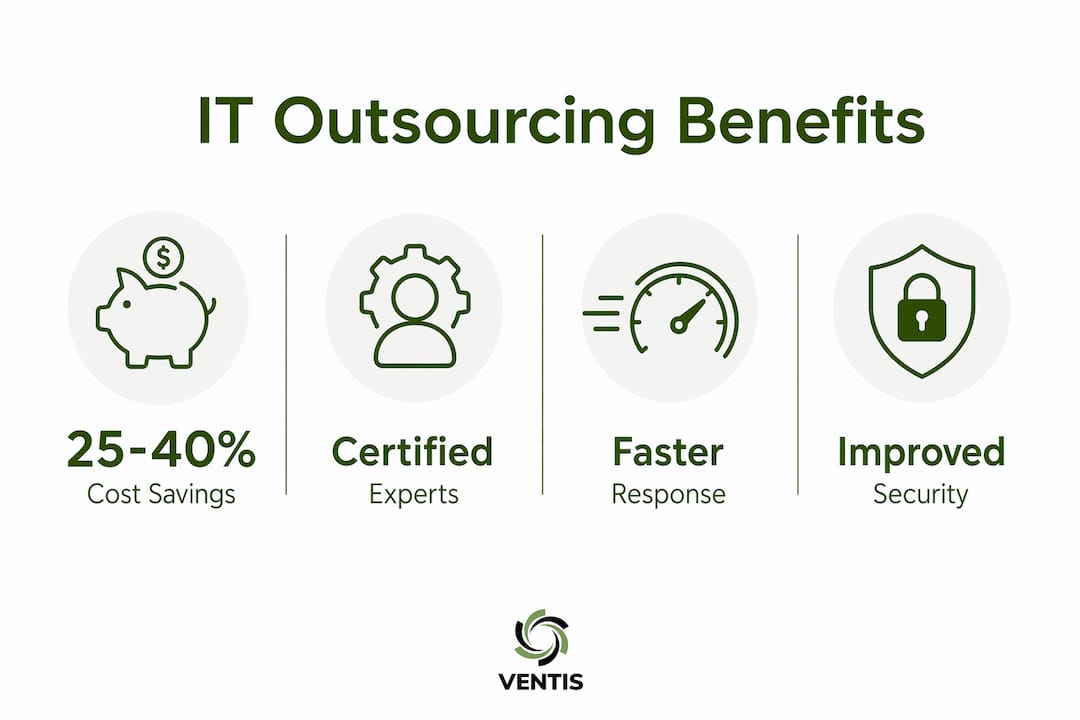
The most direct reason small businesses outsource IT is cost reduction. Outsourcing IT cuts costs by 25–40% compared to maintaining an in-house team. That figure reflects not just salary savings but also the elimination of benefits, training, equipment, and turnover costs.
The cost model also shifts in a way that helps with planning. In-house IT is a fixed capital expense. Outsourced IT converts that into a predictable monthly operating cost. That shift matters for cash flow, especially when your revenue fluctuates seasonally or you are in a growth phase.
Here is a straightforward comparison of what each model typically costs:
| Cost Category | In-house IT | Outsourced IT (MSP) |
|---|---|---|
| Annual staff cost | $75,000–$110,000 | Included in service plan |
| Benefits and overhead | $15,000–$25,000 | Not applicable |
| Monthly per-user fee | Not applicable | $100–$200 |
| Training and certifications | $2,000–$5,000/year | Included |
| After-hours coverage | Overtime or on-call pay | Included in most plans |
The table makes one thing clear: for a business with fewer than 20 employees, the per-user model almost always costs less than a single full-time hire. You also get broader coverage, including after-hours support, which a solo in-house hire rarely provides.
Pro Tip: When building your IT budget, use the tech budget planning guide to map your current spending before requesting managed IT quotes. Knowing your baseline makes it easier to measure actual savings.
What expertise do small businesses gain by outsourcing IT?
Outsourcing gives you immediate access to a team of certified specialists. Small businesses that access certified IT specialists through managed service providers get professionals trained in ITIL, CompTIA A+, and vendor-specific credentials from day one. Hiring that depth of expertise internally would require multiple full-time roles.

Managed service providers (MSPs) also bring tools that most small businesses cannot afford independently. Automated monitoring platforms, security patching systems, and remote management software are standard in professional MSP contracts. These tools catch problems before they cause downtime.
The experience factor is equally significant. An MSP engineer who manages dozens of client environments diagnoses issues faster than a generalist hire who only sees your single environment. That breadth of exposure translates directly into faster resolution times.
"Organizations switching to managed IT outsourcing see an 18% improvement in customer satisfaction within 12 months, with guaranteed response times under one hour for critical issues and average remote response times for non-critical issues often below 30 minutes during business hours."
The customer satisfaction improvement is not accidental. Faster IT resolution means fewer disruptions to your team, which means better service delivery to your own clients. That chain of reliability is what makes outsourced expertise a business performance issue, not just a technology issue.
How does IT outsourcing improve security and compliance?
Cybersecurity is the area where small businesses are most exposed and least equipped. Outsourced IT providers improve security through endpoint protection, compliance audits, and continuous monitoring, which directly reduces the risk of cyber threats. Security is the top reason most small businesses ultimately make the switch.
The compliance side is equally demanding. Regulatory frameworks like NIST and industry-specific standards require documented controls, regular audits, and tested recovery plans. Most small businesses lack the internal capacity to maintain those requirements consistently.
A professional provider handles this through a structured process:
- Endpoint protection deployment. Every device on your network gets monitored and protected against known threat signatures.
- Compliance audit scheduling. Providers align your controls with relevant standards, whether that is NIST, HIPAA, or PCI-DSS, depending on your industry.
- Backup monitoring and testing. Many small businesses assume they have reliable backups. Professional providers actively test and validate those backups as part of disaster recovery planning.
- Continuous threat monitoring. 24/7 monitoring catches anomalies before they become breaches.
- Incident response planning. Providers document and rehearse response procedures so your team knows exactly what to do if an incident occurs.
The backup point deserves extra attention. Backup validation is one of the most common blind spots for businesses managing IT internally. A backup that has never been tested is not a backup you can rely on. Professional outsourcing contracts treat backup testing as a standard deliverable, not an afterthought.
Pro Tip: Use the cybersecurity assessment checklist to audit your current security posture before engaging an MSP. It gives you a clear picture of your gaps and helps you ask better questions during provider evaluations.
For a deeper look at how security connects to business continuity, the cybersecurity and business continuity resource covers the full picture for small and mid-sized businesses.
How does outsourcing IT support growth and operational focus?
Outsourcing IT transforms technology from a constant distraction into a background function that simply works. Outsourcing shifts IT from an unpredictable expense into a reliable, scalable asset, freeing owners from troubleshooting to focus on revenue-generating operations. That shift is the real strategic value.
The scalability benefit is concrete and immediate. When your business grows, adding IT capacity through an MSP requires a phone call, not a hiring process. Small businesses can handle growth by adding new offices or remote workers without hiring new internal staff. That flexibility is impossible to replicate with a fixed in-house headcount.
The operational benefits stack up quickly:
- Reduced downtime. Proactive monitoring catches issues before they take systems offline.
- Predictable uptime. Service level agreements (SLAs) define guaranteed availability, giving you something to hold your provider accountable to.
- Faster scaling. New employees, locations, or devices get onboarded without delays tied to internal capacity.
- Leadership focus. When your team is not fielding IT problems, they spend that time on customers, sales, and operations.
- Business continuity. Documented recovery plans mean a hardware failure or cyberattack does not stop your business for days.
The uptime and continuity points connect directly to customer satisfaction. Every hour your systems are down is an hour your customers experience degraded service. Outsourcing reduces that exposure significantly.
What misconceptions do small business owners have about IT outsourcing?
The biggest misconception about IT outsourcing is that it means handing over control of your business decisions. Outsourcing covers operational execution, not business judgment. Your provider manages the technology. You still own the strategy.
The distinction matters in practice. Businesses that outsource without maintaining internal IT ownership often experience miscommunication with their providers. Someone inside your organization needs to understand your business goals well enough to translate them into technology requirements. That person does not need to be a technical expert, but they do need to be engaged.
Common pitfalls to watch for when selecting a provider:
- No defined SLAs. If a provider cannot commit to specific response and resolution times in writing, that is a warning sign.
- Unclear backup policies. Ask directly how often backups are tested and what the recovery time objective is.
- Poor onboarding documentation. A professional provider documents your environment thoroughly at the start of the engagement.
- No compliance experience in your industry. If you operate in healthcare, finance, or retail, your provider needs relevant regulatory experience.
Pro Tip: Before signing any managed IT contract, review the IT support checklist to confirm the provider covers every critical function your business depends on.
The website security best practices resource is also worth reviewing before finalizing any provider agreement, particularly if your business operates an e-commerce or client-facing web platform.
Key Takeaways
Outsourcing IT gives small businesses access to certified specialists, predictable costs, and stronger security at a fraction of the cost of an in-house team.
| Point | Details |
|---|---|
| Cost reduction is measurable | Outsourcing cuts IT costs by 25–40% compared to maintaining an in-house team. |
| Expertise comes included | MSPs provide certified specialists in cybersecurity, compliance, and infrastructure from day one. |
| Security requires active management | Backup testing, continuous monitoring, and compliance audits are standard in professional contracts. |
| Scalability is built in | Adding users, locations, or devices requires no new hires and no delays. |
| Strategy stays internal | Outsource execution, not decision-making. Keep an internal owner aligned with your provider. |
What I have learned from watching small businesses outsource IT
Working with small businesses over the years, I have noticed a consistent pattern. The owners who benefit most from outsourcing are not the ones who hand everything over and walk away. They are the ones who stay engaged at the strategy level while letting the provider handle the execution.
The businesses that struggle are usually the ones that outsource because they are exhausted by IT problems and just want someone else to deal with it. That mindset leads to poor provider selection, weak SLAs, and eventually the same problems under a different label.
The technology needs of small businesses have changed significantly. Cybersecurity alone has become a full-time discipline. Expecting a single generalist hire to cover networking, security, compliance, cloud infrastructure, and end-user support is not realistic in 2026. Outsourcing is not a workaround for that reality. It is the correct structural response to it.
The businesses I have seen thrive after outsourcing share one trait: they treat their MSP as a partner, not a vendor. They schedule regular reviews, share their growth plans, and hold their provider accountable to documented outcomes. That relationship is what turns outsourcing from a cost-cutting tactic into a genuine growth enabler.
— Greg
Ventis Consulting Group: managed IT built for small businesses
Small businesses in Pittsburgh and the surrounding region have a local option that combines the depth of an enterprise MSP with the responsiveness of a neighborhood partner.
Ventis Consulting Group provides managed IT services covering cybersecurity, cloud solutions, network management, and end-user support, all under a predictable monthly cost structure. The team holds a 5-star service rating and works directly with small business owners to align technology with their actual operational goals. For businesses that also need communication infrastructure, the Unified Communications solutions package integrates voice, messaging, and collaboration tools into a single managed service. Reach out to Ventis Consulting Group to discuss what your business needs and get a clear picture of what outsourcing would actually cost you.
FAQ
What does IT outsourcing cost for a small business?
Full managed IT services typically cost $100–$200 per user monthly. That compares favorably to the $75,000–$110,000 annual cost of a single in-house IT hire, excluding benefits and overhead.
Is IT outsourcing secure for small businesses?
Professional managed IT providers deliver endpoint protection, continuous monitoring, and compliance audits as standard services. Security is the primary reason most small businesses choose to outsource IT.
Will I lose control of my IT if I outsource?
Outsourcing covers operational execution, not business strategy. You retain full control over technology decisions while your provider handles day-to-day management and support.
How quickly can an outsourced IT provider respond to issues?
Most managed IT contracts guarantee response times under one hour for critical issues. Average remote response times for non-critical issues are often below 30 minutes during business hours.
Can outsourced IT scale with my business as it grows?
Outsourced IT scales without hiring delays. Adding new employees, locations, or devices is handled by your provider, typically with no changes to your contract structure beyond adjusting the per-user count.