

Your employees are your strongest defense against cyber threats, or your biggest vulnerability. The difference comes down to training. Security awareness training, the practice of educating staff to recognize and respond to cyber threats, is the single most direct way to close the gap that attackers exploit most: human error. Here is what that means in practice:
- Trained employees catch phishing emails, business email compromise (BEC) attempts, and social engineering tactics before they cause damage.
- Human error drives the majority of data breaches, and targeted education addresses that vulnerability at the source.
- Technical controls like firewalls and endpoint protection cannot stop an employee who clicks a malicious link or shares credentials under pressure.
- A well-trained workforce reduces financial exposure, protects your reputation, and helps satisfy regulatory requirements under frameworks like HIPAA, GDPR, and PCI DSS.
- Consistent training builds a culture where security is everyone's responsibility, not just the IT department's problem.
If you manage a team, this is where your cybersecurity investment pays off most directly.
Why security awareness training is urgent for organizations right now
The financial stakes have never been clearer. The average data breach now costs $4.44 million, according to IBM's 2025 Cost of a Data Breach Report. For a small or mid-sized business, that figure is not just painful, it can be fatal to operations.
Technology alone does not solve this. Attackers exploit human trust and psychological triggers, bypassing even well-configured technical defenses. A phishing email that mimics your CEO's writing style does not trigger a firewall alert. It triggers a human response, and without training, that response is often the wrong one.

The threat environment is also getting more complex. AI-generated phishing messages are now nearly indistinguishable from legitimate communications, and deepfake audio has already been used to impersonate executives in wire fraud schemes. Organizations that rely on annual compliance checkboxes are not keeping pace.
Several factors make training urgent right now:
- Regulatory mandates under GDPR, HIPAA, and PCI DSS require documented employee security education.
- Cyber insurance providers increasingly require proof of active training programs before issuing or renewing policies.
- Remote and hybrid work has expanded the attack surface, putting more employees in less controlled environments.
- AI-powered attacks lower the cost and skill barrier for attackers, meaning more frequent and more convincing attempts.
A data breach can cost millions on average. For most small businesses, one incident at that scale is not recoverable without significant disruption.
Effective tactics for running security awareness training that actually works
One-time annual training does not change behavior. Continuous, role-relevant training significantly improves incident detection rates and builds the habits that stick. The goal is not to check a compliance box. It is to change how your employees think and react under pressure.
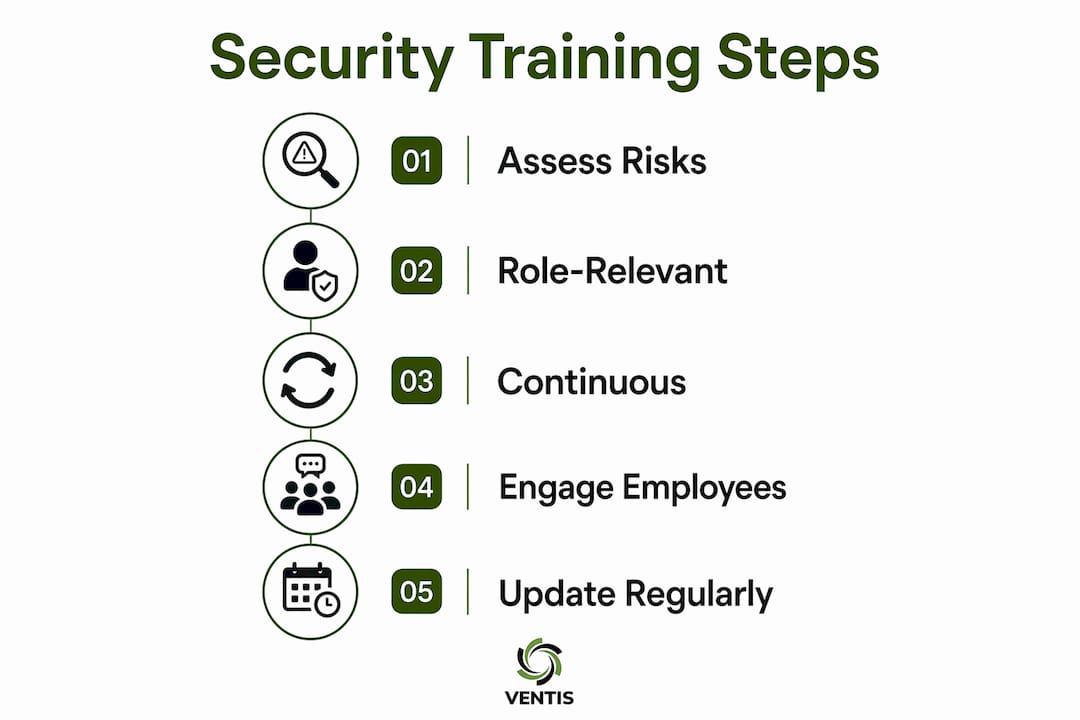
The most effective programs share a few common traits. They deliver content in short, focused bursts rather than hour-long sessions. They test employees with realistic simulations rather than hypothetical scenarios. And they treat security as an ongoing conversation, not a one-time event.
Tactics that consistently produce results:
- Microlearning modules: Five-to-ten-minute lessons focused on a single threat type retain attention and improve recall far better than long sessions.
- Phishing simulations: Ongoing phishing simulations can reduce employee click rates from over 30% to under 5% within twelve months.
- Multi-channel testing: Simulation exercises covering email, phone (vishing), SMS (smishing), and deepfake scenarios provide the most thorough behavioral conditioning.
- Gamification: Leaderboards, badges, and friendly competition increase participation rates and make training feel less like a chore.
- Role-specific content: A finance team member faces different threats than a warehouse employee. Tailoring content to job function increases relevance and retention.
- Positive reinforcement: Recognizing employees who report suspicious activity encourages the behavior you want, rather than punishing those who fall for simulations.
Pro Tip: Avoid the trap of generic, one-size-fits-all content. Poor or irrelevant training can actually worsen security behaviors by creating false confidence. If your training does not reflect the actual threats your team faces, it may do more harm than good.
What topics should your security training program actually cover?
A well-rounded program covers the threats employees encounter most often, plus the emerging ones gaining traction in 2026. The goal is practical recognition and response, not theoretical knowledge.
Core topics every program needs:
- Phishing, spearphishing, and social engineering: Employees need to recognize urgency tactics, spoofed sender addresses, and requests that bypass normal approval processes.
- Password hygiene and multi-factor authentication (MFA): Weak or reused passwords remain a leading entry point. Training should cover password managers and why MFA is non-optional.
- Safe data handling: Who can access what, how to share sensitive files securely, and what to do when a document ends up in the wrong hands.
- Incident reporting: Employees must know exactly how to report a suspected breach or phishing attempt, and feel safe doing so without fear of blame.
- Shadow IT risks: Personal devices, unauthorized apps, and unsanctioned cloud storage create blind spots that attackers actively target.
Emerging threats to add in 2026:
- AI-generated phishing: Messages crafted by large language models are grammatically perfect and contextually convincing. Employees need to verify through secondary channels, not just read carefully.
- Deepfake audio and video: Attackers have used synthetic voice cloning to impersonate executives in real-time calls. Training should include verification protocols for any unusual financial or access request.
- QR code phishing (quishing): QR codes in emails or physical spaces redirect employees to credential-harvesting sites. This vector bypasses many traditional email filters entirely.
How to implement security training across your organization
Getting a program off the ground requires more than purchasing a training platform. It requires a plan that fits your organization's size, risk profile, and culture. Here is a practical path forward.

Start with a risk assessment. Before you build anything, understand where your vulnerabilities actually are. Which roles have access to sensitive data? Where have near-misses occurred? A cybersecurity assessment gives you a baseline and helps you prioritize content.
Build training into onboarding. New hires are statistically among the most vulnerable employees. They want to be helpful, they do not yet know internal processes, and they are easy targets for social engineering. Security awareness should be part of day one, not an afterthought.
Schedule regular refreshers. Quarterly modules keep knowledge current and reinforce habits. Annual training alone fades within weeks. Programs combining microlearning, simulations, and metrics tracking create lasting behavioral change versus single-event approaches.
Use technology to track progress. Modern training platforms let you monitor completion rates, simulation results, and knowledge gaps by department. That data tells you where to focus next and gives you documentation for compliance audits.
Additional implementation steps worth prioritizing:
- Secure visible leadership buy-in. When executives participate in training, adoption rates across the organization rise.
- Set clear expectations in your acceptable use policy so employees know what is required, not just recommended.
- Address resistance directly. Some employees view training as a distraction. Framing it around protecting their own data, not just the company's, tends to shift that perspective.
- For small businesses, managed IT security services can handle program delivery and tracking without requiring a dedicated internal security team.
How do you build a security culture that outlasts any single training program?
Training events teach knowledge. Culture determines whether that knowledge gets used. The two work together, but culture is what sustains behavior between training sessions.
NIST's guidance frames security awareness training as the foundation for individual accountability, transforming employees from the weakest link into an active layer of defense. That transformation does not happen through a single course. It happens when security becomes part of how your organization operates every day.
Practical ways to build that culture:
- Non-punitive reporting: Employees who fear punishment for mistakes stay silent. A no-blame reporting environment surfaces incidents early, when they are still containable.
- Leadership modeling: When managers and executives visibly follow security protocols, lock their screens, use MFA, and report suspicious emails, it signals that these behaviors matter at every level.
- Security champions: Designating a point person in each department creates peer accountability and gives employees a local resource for questions without escalating to IT every time.
- Embedded policies: Security expectations written into workflows, not just handbooks, make secure behavior the path of least resistance.
- Ongoing communication: Regular security updates, brief threat alerts, and internal newsletters keep awareness high between formal training cycles.
Treating training as a culture shift rather than a compliance requirement produces better incident reporting and faster detection. That shift is the difference between catching a breach in hours versus discovering it months later.
The business and risk management case for investing in security training
The numbers make a compelling argument on their own. The $4.44 million average breach cost dwarfs the cost of any training program by orders of magnitude. For small and mid-sized businesses, the math is even more stark because they typically lack the reserves to absorb that kind of loss.
NIST's cybersecurity specialists describe security awareness training as foundational for building individual accountability within organizations. Their framework positions training not as a supplementary measure but as a core component of any defensible security posture.
The human factor is the most exploited attack vector in cybersecurity. Technical controls are necessary but insufficient when attackers specifically engineer their approaches to bypass them by targeting people instead of systems. Training closes that gap.
Phishing simulation data reinforces the ROI case directly. Organizations running ongoing phishing simulations see click rates drop from over 30% to under 5% within twelve months. Fewer clicks mean fewer incidents, fewer incident response costs, and fewer regulatory penalties.
How do you measure whether your security training is actually working?
Measuring training effectiveness requires more than tracking completion rates. Completion tells you who sat through the course. It does not tell you whether behavior changed.
Metrics that actually reflect impact:
- Phishing simulation click rates: Track these over time by department and role. A downward trend confirms the training is working. A flat or rising trend signals a content or delivery problem.
- Incident reporting volume: More reports is often a good sign, not a bad one. It means employees are noticing suspicious activity and feel comfortable flagging it.
- Time to report: How quickly do employees escalate a suspected incident? Faster reporting reduces breach containment costs.
- Knowledge assessment scores: Pre- and post-training quizzes measure what employees actually learned, not just whether they clicked through slides.
- Policy compliance rates: Audit password hygiene, MFA adoption, and data handling practices to see whether training translates into day-to-day behavior.
Tie these metrics to business outcomes where possible. Reduced incident frequency, lower IT support tickets related to security events, and cleaner audit results all translate into dollars saved. That framing helps you make the budget case to leadership and sustains investment over time.
Common challenges in security training and how to get past employee resistance
Resistance is predictable. Employees are busy, training feels like extra work, and many people genuinely believe they are too savvy to fall for a scam. That confidence is exactly what attackers count on.
The most common obstacles and practical responses:
- "I don't have time." Short microlearning modules, delivered during natural breaks in the workday, remove the time objection. Five minutes is a much easier ask than an hour.
- "This doesn't apply to my job." Generic training earns this response. Role-specific content that mirrors the actual threats a particular employee faces eliminates it. A customer service rep needs to know about vishing. An accountant needs to understand BEC.
- "I already know this stuff." Simulation results often prove otherwise. Showing employees their own click data from a phishing test is one of the most effective ways to reset overconfidence without embarrassing anyone publicly.
- Fear of punishment: If employees believe reporting a mistake leads to discipline, they will hide mistakes. Building a no-blame culture, where reporting is rewarded rather than penalized, is the single most important cultural shift you can make.
- Leadership disengagement: When executives skip training or treat it as optional, the rest of the organization follows their lead. Mandatory participation at every level, including the C-suite, removes that excuse.
Framing also matters. Training positioned as protecting employees' own financial accounts, personal data, and professional reputation lands differently than training framed purely as corporate policy compliance.
Legal and compliance requirements that make security training mandatory
Security training is not optional for most regulated industries in the United States. Several major frameworks explicitly require it, and the penalties for non-compliance can exceed the cost of a breach itself.
Key regulatory requirements:
- HIPAA: Healthcare organizations must provide security awareness training to all workforce members, including contractors with access to protected health information (PHI). The requirement covers both initial training and ongoing updates as threats evolve.
- PCI DSS: Any organization that processes payment card data must train employees on security policies and procedures. Requirement 12.6 specifically mandates a formal security awareness program.
- GDPR: While primarily a European regulation, GDPR applies to any U.S. business handling data from EU residents. Article 39 requires data protection officers to promote security awareness, and supervisory authorities have cited inadequate training in enforcement actions.
- CMMC (Cybersecurity Maturity Model Certification): Defense contractors working with the U.S. Department of Defense must demonstrate security awareness training as part of their certification requirements.
- State-level laws: California's CCPA, New York's SHIELD Act, and similar state regulations increasingly include employee training provisions as part of reasonable security measures.
Beyond regulatory penalties, courts and insurance providers look at training records when assessing negligence after a breach. Documented, consistent training programs demonstrate due diligence. The absence of documentation, even if training occurred informally, can work against you in litigation or a claims dispute. For a practical overview of cybersecurity compliance for SMBs, the requirements vary by industry but the training obligation appears across nearly all of them.
Real breaches that happened because employees were not trained
These are not hypothetical scenarios. They are documented cases where the absence of security awareness training was a direct contributing factor.
The 2020 Twitter hack: Attackers used phone-based social engineering to convince Twitter employees to hand over credentials to internal tools. The breach compromised accounts belonging to Barack Obama, Elon Musk, and Apple, among others, and was used to run a Bitcoin scam. No technical vulnerability was exploited. The attack succeeded entirely through human manipulation.
The 2016 Bangladesh Bank heist: Attackers sent $81 million out of Bangladesh Bank's account at the Federal Reserve Bank of New York by exploiting weak internal controls and employees who were unfamiliar with SWIFT authentication protocols. Basic security awareness around authentication procedures could have flagged the anomalous requests.
The 2014 Sony Pictures breach: Investigators found that employees had stored thousands of passwords in a folder literally named "Passwords." The breach exposed sensitive employee data, unreleased films, and executive communications. Password hygiene training is among the most basic elements of any security program.
Everyday phishing at small businesses: High-profile cases get the headlines, but the more common scenario is a small business employee who receives a convincing invoice from what appears to be a known vendor, approves a wire transfer, and discovers the fraud days later. These incidents rarely make the news but collectively account for billions in annual losses across the U.S.
Each of these cases had a training solution. Recognizing social engineering, verifying unusual requests through secondary channels, and following basic password protocols are all teachable behaviors.
How to keep security training fresh with ongoing refreshers
A training program that runs once and stops is not a program. It is a document. Threats evolve, employees forget, and new staff arrive without any context. Sustained protection requires sustained education.
Strategies for keeping training current and effective:
- Quarterly themed modules: Rotate focus areas each quarter, covering phishing one cycle, password security the next, then data handling, then incident response. Rotation prevents fatigue and ensures broad coverage over time.
- Just-in-time alerts: When a new threat emerges, such as a novel phishing campaign targeting your industry, send a brief alert immediately rather than waiting for the next scheduled module. Timeliness makes the lesson concrete.
- Annual curriculum review: Threat landscapes shift. Review your training content at least once a year and update scenarios to reflect current attack methods, including AI-generated content and new social engineering scripts.
- Post-incident debriefs: When a security event occurs, even a near-miss, use it as a teaching moment. A brief, anonymized debrief with the affected team reinforces lessons more effectively than any hypothetical scenario.
- Refresher simulations: Run phishing simulations at irregular intervals so employees cannot predict when they are being tested. Predictable testing creates test-taking behavior, not genuine vigilance.
Adaptive security training frameworks built for 2026 emphasize continuous adaptation as a core design principle, not an optional add-on. The organizations that treat training as a living program rather than a static checklist consistently outperform those that do not on every measurable security metric.
For small businesses that lack an internal security team, partnering with a managed IT provider to handle training delivery, scheduling, and tracking is a practical way to maintain consistency without adding headcount. Website security practices for small businesses often start with exactly this kind of structured, ongoing education as the first line of defense.
Key Takeaways
Employee security training is the most direct way to reduce breach risk because it addresses human error, the leading cause of incidents, through continuous, role-specific education that complements your technical defenses.
| Point | Details |
|---|---|
| Financial risk is concrete | The average data breach costs $4.44 million, making training one of the highest-ROI investments available. |
| Simulations drive measurable results | Ongoing phishing simulations reduce employee click rates from over 30% to under 5% within twelve months, according to Verizon DBIR and security training research. |
| Compliance is not optional | HIPAA, PCI DSS, CMMC, and state laws require documented security training programs for most U.S. businesses. |
| Culture sustains behavior | Non-punitive reporting, leadership modeling, and security champions extend training impact between formal sessions. |
| One-time training is not enough | Quarterly refreshers, just-in-time alerts, and irregular simulations maintain vigilance as threats evolve. |
Ready to build a stronger security posture for your team?

Ventis Consulting Group works with small and mid-sized businesses across Pittsburgh and the surrounding region to build practical, sustainable cybersecurity programs. From initial risk assessments to ongoing managed IT support, the team at Ventis Consulting Group provides the guidance and tools your organization needs to protect what you have built.
Whether you are starting from scratch or looking to strengthen an existing program, managed IT services from Ventis Consulting Group give you expert support without the overhead of an in-house security team. Reach out today to find out where your biggest vulnerabilities are and what it actually takes to address them.