

Every startup should have a basic cloud disaster recovery posture in place before it needs one. The cost of not having it, measured in lost revenue, customer churn, and investor confidence, almost always exceeds the cost of setting it up. A lean startup can implement automated cross-region backups and a working runbook in a few days. Your next step: run a quick business impact analysis (covered in section 5) or spin up a sandbox this week to validate your backups actually restore.
Key evidence at a glance:
- Unplanned outages carry real financial penalties, and for a startup with a thin cash runway, even a short one can be existential.
- Cloud DR eliminates the need for a physical secondary data center, cutting infrastructure overhead dramatically.
- Low-cost options like scheduled cross-region backups and pay-as-you-go DR-as-a-Service (DRaaS) have removed the "it's only for enterprises" excuse.
- Investors and enterprise customers increasingly ask for documented recovery plans during due diligence.
Table of Contents
- What cloud disaster recovery actually is (and how it differs from backups)
- Why startups specifically face higher DR risk than established companies
- Core Cloud DR components and the key metrics founders must know
- How to assess your startup's Cloud DR needs
- Practical Cloud DR approaches: which one fits your startup?
- What Cloud DR typically costs and how long it takes to implement
- How to test and maintain your Cloud DR plan
- Regulatory and investor considerations that affect your DR choices
- When to bring in a managed IT partner for Cloud DR
- Key Takeaways
- The case for treating DR as a product feature, not an IT checkbox
- Ventis Consulting Group can assess and implement your Cloud DR plan
- Useful sources and further reading
What cloud disaster recovery actually is (and how it differs from backups)
Cloud disaster recovery is a framework of technologies and best practices that uses cloud-hosted replication, orchestration, and automated failover to restore your systems and data after a disruptive event. The cloud part matters because it replaces the traditional secondary data center with scalable, regional infrastructure you pay for only when you need it.
Backups, DR, and business continuity are not the same thing. A backup is a point-in-time copy of your data. Cloud DR is the orchestrated process that gets your systems running again after a failure. Business continuity is the broader organizational plan that keeps essential functions going while recovery happens. You need all three, but in different proportions depending on your stage.
Here is where founders get tripped up: a nightly database snapshot is a backup, not a disaster recovery plan. A full DR plan combines those backups with orchestration, runbooks, and tested failover procedures. If your entire production environment goes down and your only asset is a snapshot sitting in the same cloud region, you have a backup with no recovery path.
A practical example: a SaaS company accidentally deletes a production database table. A backup solves that in minutes. But if an entire AWS region goes offline and your app, database, and DNS all live there, you need orchestrated failover to a secondary region, not just a file restore. That distinction determines whether you need a simple backup tool or a proper DR strategy.
Why startups specifically face higher DR risk than established companies
The honest answer is that startups are more exposed, not less, despite having fewer resources to absorb a hit. Several factors compound the risk:
- Single points of knowledge. One engineer often knows how the infrastructure works. If that person is unavailable during an incident, recovery stalls.
- Thin cash runway. A multi-day outage can cost a startup a significant portion of its operating budget; for context, Secureframe research shows the median cost of a startup IT outage is substantial, highlighting the urgency of having disaster recovery measures in place.
- Fast-moving product changes. Deployments happen daily or weekly, which means the gap between your last tested backup and your current production state is constantly widening.
- Heavy reliance on a handful of SaaS tools. Your CRM, project management, and customer support data all live in third-party platforms. SaaS vendors maintain DR for their own infrastructure, not for your team's mistakes, accidental deletions, or broken integrations.
- Ransomware and accidental deletion. Both are far more common than region-level outages, and both require application-level recovery that vendor SLAs typically do not cover.
The reputational and investor consequences are just as serious. A startup that goes dark for 48 hours during a growth phase loses customer trust that takes months to rebuild. During fundraising, a prospective investor or enterprise customer asking "what's your recovery plan?" and getting a blank stare is a red flag that can kill a deal. Tying DR readiness to your investor commitments and customer SLAs is not paranoia; it is table stakes at Series A and beyond.
For a deeper look at how data breaches compound downtime risk, the overlap between security incidents and recovery failures is worth understanding early.
Core Cloud DR components and the key metrics founders must know
Two metrics govern every DR decision you will make.
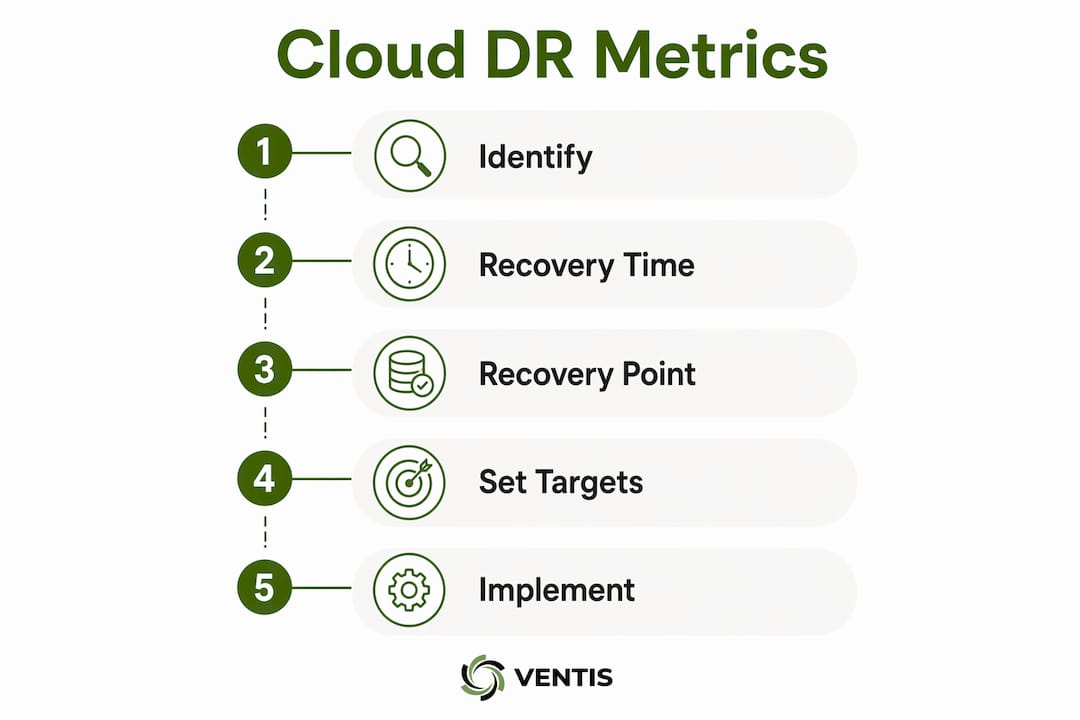
Recovery Time Objective (RTO) is the maximum acceptable time your systems can be down after a failure. If your RTO is four hours, you need a recovery process that gets you operational within four hours, every time.
Recovery Point Objective (RPO) is the maximum acceptable data loss measured in time. An RPO of one hour means you can tolerate losing up to one hour of transactions or changes. Anything older than that must be recoverable.
RTO and RPO are the primary metrics that determine how much to invest in recovery. A tighter RTO requires more standby compute. A tighter RPO requires more frequent replication. Both cost more, so setting realistic targets based on actual business impact, not theoretical perfection, is the right approach for a startup.
The core technical components that deliver on those targets:
- Replication (block or object level): continuously copies data to a secondary location so your RPO stays tight.
- Snapshots: point-in-time captures of volumes or databases, typically scheduled hourly or daily.
- Orchestration: the automated logic that sequences failover steps in the right order (DNS cutover, database promotion, app restart).
- Automated failover and failback: triggers recovery without manual intervention, then returns traffic to the primary environment once it is healthy.
- Offsite storage: backups stored in a separate region or account, isolated from the primary environment so ransomware cannot reach them.
- DR runbooks: step-by-step recovery playbooks that any team member can execute under pressure.
| Application category | Target RTO | Target RPO | Notes |
|---|---|---|---|
| Customer-facing web app | 1–4 hours | — | Revenue and reputation impact is immediate |
| Payment processing | — | Near-zero | Regulatory and contractual exposure is high |
| Core product database | 1–2 hours | — | Drives RTO for all dependent services |
| Analytics and reporting | — | — | Non-customer-facing; lower urgency |
| Internal tools | 8–— | 4–8 hours | Operational impact, not customer-facing |
Pro Tip: Set your RTO and RPO by asking one question per system: "If this is down for X hours and we lose Y hours of data, what does that cost us in revenue, customer churn, or legal exposure?" That answer, not a vendor's default setting, should drive your targets.
How to assess your startup's Cloud DR needs
A business impact analysis (BIA) does not need to take a week. A focused founder can complete a working version in one to two hours. Here is how:
-
List every system and data asset your business depends on. Include cloud infrastructure, SaaS tools, databases, and third-party APIs. Do not skip the tools that "just work" — those are often the ones with no backup at all.
-
Estimate the impact of each going down. For each asset, answer: How much revenue is at risk per hour? How many customers are affected? Is there a legal or contractual obligation tied to uptime? Does losing this data trigger a breach notification?
-
Map dependencies. Your payment processor depends on your auth service. Your auth service depends on your database. A dependency map shows you which failures cascade and which are isolated.
-
Assign a tier to each asset:
- Tier 1: Payments, authentication, core product database — protect first, tightest RTO/RPO.
- Tier 2: Customer data stores, core application servers, customer-facing APIs.
- Tier 3: Analytics pipelines, internal dashboards, non-critical integrations.
-
Set RTO and RPO targets per tier. Use the revenue and churn estimates from step 2 to justify the targets. Tier 1 systems typically warrant a short RTO and a tight RPO to minimize downtime and data loss. Tier 3 systems can tolerate longer recovery times compared to critical systems.
-
Identify gaps. Compare your current backup and recovery setup against each tier's targets. The gaps are your implementation roadmap.
-
Align with fundraising commitments. If you have signed SLAs with enterprise customers or made uptime commitments to investors, those numbers become hard floors for your RTO/RPO targets.
The Ready.gov BIA framework provides a structured template for linking recovery objectives to business priorities, which is worth bookmarking for your first formal BIA.
Practical Cloud DR approaches: which one fits your startup?
Four main paths exist, and the right one depends on your team's technical depth, budget, and regulatory exposure.

Cloud-native replication and snapshots use the built-in tools of your cloud provider (AWS S3 Cross-Region Replication, Azure Backup, Google Cloud Storage Transfer) to copy data to a secondary region automatically. This is the lowest-cost starting point and works well for Tier 2 and Tier 3 assets. The trade-off: orchestration is manual unless you build it yourself, and failover is not automated out of the box.
Scheduled cross-region backups with a runbook is the practical minimum for most early-stage startups. Automate nightly or hourly snapshots to a separate region or account, write a one-page runbook documenting the restore steps, and test it quarterly. A practitioner can set this up in a few days. It covers accidental deletion, ransomware, and most single-service failures.
DR-as-a-Service (DRaaS) moves the orchestration and failover logic to a managed provider on a pay-as-you-go model. You pay for standby capacity only when a failover event occurs, which keeps costs low during normal operations. DRaaS is the right choice when your Tier 1 systems need sub-hour RTO but you lack the internal DevOps capacity to build and maintain orchestration yourself.
Managed provider with full runbook ownership is appropriate when your infrastructure spans multiple clouds or regions, when compliance requirements demand documented evidence of tested recovery, or when your engineering team simply does not have the bandwidth. Hybrid and multicloud environments increase orchestration complexity significantly and often require specialized skills that a managed partner brings ready-made.
| Dimension | Cloud-native snapshots | Scheduled cross-region backups | DRaaS | Managed provider |
|---|---|---|---|---|
| RTO | Hours to days | Hours | Minutes to hours | Minutes to hours |
| RPO | Hours | Hours | Minutes | Minutes |
| Cost model | Pay-per-storage | Pay-per-storage | Pay-per-use + standby | Monthly retainer |
| Scalability | High | High | High | High |
| Automation | Low (manual failover) | Medium | High | High |
| Ease of testing | Low | Medium | High | High |
| Compliance support | Low | Low | Medium | High |
| Vendor support | Self-service | Self-service | Vendor SLA | Dedicated team |
One practical note: SaaS application data sits outside your cloud infrastructure entirely. Your project management, CRM, and support tools need application-level backups that are independent of what the vendor provides. Vendor SLAs cover platform uptime, not your team's data mistakes.
As your startup grows and your infrastructure scales, your DR approach should evolve alongside it. The cloud infrastructure scaling guide from Ventis Consulting Group covers how DR planning fits into that growth arc.
What Cloud DR typically costs and how long it takes to implement
Cost and timeline vary widely, but the ranges are more accessible than most founders expect.
Primary cost drivers:
- Storage and data egress: Cross-region replication charges for both storage and data transfer. Lifecycle policies that move older snapshots to cheaper storage tiers (like AWS S3 Glacier) can cut storage costs significantly.
- Standby compute: A warm standby (a secondary environment running at reduced capacity) costs more than a cold standby (infrastructure spun up only during failover). Most startups start cold.
- Orchestration and licensing: Cloud-native tools are often included in your existing cloud spend. Third-party DRaaS platforms add licensing fees on top.
- Managed services fees: A managed provider charges a monthly fee that covers implementation, testing, and runbook maintenance. For startups without internal DevOps, this often replaces a full-time hire.
- Testing overhead: Quarterly failover drills consume compute time and engineering hours. Budget for this explicitly.
Realistic implementation timelines:
- 2–3 days: Automated cross-region backups for Tier 1 and Tier 2 assets, plus a one-page runbook. This is the minimum viable DR posture for startups, as confirmed by practitioner reports.
- 2–4 weeks: Automated failover proof-of-concept for your core application, with a tested runbook and a first restore drill.
- 6–8 weeks: Full DR runbooks across all tiers, automated failover testing, and documented evidence suitable for investor or audit review.
To keep costs manageable, start with targeted protection for Tier 1 assets only. Apply downtime reduction tactics in parallel to shrink the blast radius of any incident. Use lifecycle policies to move aging snapshots to cold storage automatically, and consider pay-as-you-go DRaaS for Tier 1 systems where you need tight RTO but cannot justify a warm standby.
How to test and maintain your Cloud DR plan
An untested backup is not a backup. Silent backup failures, where a scheduled job appears to succeed but produces a corrupt or incomplete file, are common and only surface when you actually try to restore. Regular restoration tests are what separate startups that survive incidents from those that do not.
Four types of tests to run:
-
Restore-from-backup drill: Pull a specific snapshot and restore it to a test environment. Verify data integrity and measure how long the restore takes. This is your baseline and should run monthly for Tier 1 datasets.
-
Partial failover simulation: Fail over a single service (say, your database) to the secondary region while keeping everything else in place. Confirm the application handles the switch correctly and measure actual RTO against your target.
-
Full failover simulation: Fail over the entire environment to the secondary region. Run this quarterly. It is the only way to know whether your orchestration, DNS cutover, and runbook actually work end-to-end.
-
Communication and war-room drill: Practice the human side of recovery. Who declares the incident? Who owns the runbook? Who communicates with customers? Run this annually or whenever your team changes significantly.
Recommended cadence:
- Monthly: automated restore test for Tier 1 datasets.
- Quarterly: partial failover simulation and runbook review.
- Annually: full-scope failover simulation and communication drill.
Runbook rules that actually hold up under pressure:
- Keep the quick-start section to one page. Longer runbooks get skipped during incidents.
- Store runbooks in version control (Git) and in an out-of-band location (a shared drive or printed copy) that is accessible even if your primary systems are down.
- Assign a named owner for each runbook section. Ambiguity kills recovery speed.
After every test, run a short postmortem: What failed? What took longer than expected? What would have been unclear to someone unfamiliar with the system? Update the runbook before the next sprint ends. Pairing your DR runbooks with a formal cybersecurity incident response plan shortens recovery windows and clarifies who owns what during a crisis.
Regulatory and investor considerations that affect your DR choices

Compliance is not optional for most startups past the seed stage, and DR is directly tied to several U.S. regulatory frameworks.
HIPAA (healthcare data) requires covered entities and business associates to implement contingency plans that include data backup, disaster recovery, and emergency mode operation procedures. An untested backup does not satisfy HIPAA's contingency plan standard.
GLBA and FINRA (financial data) require financial institutions and broker-dealers to maintain business continuity plans with documented recovery capabilities. Startups in fintech often underestimate how early these obligations apply.
State breach notification laws in all 50 states require timely notification when personal data is compromised. A DR plan that includes offsite, encrypted backups and a tested restore process directly supports your ability to contain and respond to a breach quickly, which affects your notification timeline and liability exposure. Reviewing cybersecurity compliance best practices alongside your DR planning helps you build evidence that satisfies both auditors and investors.
Investor due diligence increasingly includes DR readiness. Series A and B investors, and enterprise customers running security reviews, commonly ask: What is your RTO? What is your RPO? When did you last test your recovery plan? Who owns the runbook? A startup that can answer these questions with documented evidence stands out.
Customer SLAs add another layer. If you have signed uptime commitments (99.9% or higher), your DR plan must be capable of meeting them. That means your RTO must be shorter than the downtime your SLA permits in a given month, and your RPO must be tight enough to avoid data loss that would breach the agreement.
When to bring in a managed IT partner for Cloud DR
A few clear signals tell you it is time to stop DIY-ing your recovery plan.
- Your team has no documented runbook, or the runbook has never been tested.
- A restore drill failed or produced unexpected results and no one had time to investigate.
- Your engineering team is too stretched to own DR testing alongside product development.
- You are growing into multiple cloud regions or adding compliance requirements faster than your internal capacity can absorb.
- An investor or enterprise customer has asked for DR evidence and you do not have it.
A managed provider like Ventis Consulting Group handles the full lifecycle: BIA, cross-region replication setup, orchestration, scheduled testing, runbook documentation, and evidence packaging for audits or investor review. The value is not just the technical work; it is having a team that owns the process so your engineers can focus on the product.
When evaluating a managed DR provider, ask these questions directly:
- What RTO and RPO can you guarantee under your SLA, and how is that measured?
- How often do you run restore and failover tests, and can you show me the last test report?
- How do you handle a widespread incident that affects multiple clients simultaneously?
- Where is my data stored, and can you meet our data residency requirements?
- What is your escalation path and response time if a real incident occurs?
- Can you provide a reference from a client at a similar stage and in a similar industry?
A practical way to start: scope a 2–4 week pilot that covers your Tier 1 assets, requires a documented test plan upfront, and ends with a written report you can hand to an investor. That deliverable alone often justifies the engagement. For a broader view of how IT consulting engagements are scoped and structured, the Ventis Consulting Group blog covers the methodology in detail.
Key Takeaways
Cloud disaster recovery is not an enterprise luxury. For startups, it is one of the lowest-cost ways to protect revenue, customer trust, and investor confidence, and a basic posture can be in place within days.
| Point | Details |
|---|---|
| Tier your assets first | Identify Tier 1 (payments, auth, core DB) and protect those before anything else. |
| Set RTO and RPO by business impact | Base targets on actual revenue and churn risk, not theoretical perfection. |
| Test restores monthly | Silent backup failures are common; only a real restore drill confirms your backups work. |
| Start in 2–3 days | Automated cross-region backups plus a one-page runbook is a viable minimum viable DR posture. |
| Ventis Consulting Group | Offers managed DR assessments, pilot implementations, and documented test evidence for startups in Pittsburgh and surrounding areas. |
The case for treating DR as a product feature, not an IT checkbox
Most startup founders treat disaster recovery the way they treat health insurance: something to sort out later, once things are more stable. The problem is that "later" is exactly when an incident hits, and by then the cost of not having a plan is orders of magnitude higher than the cost of building one.
What I find most founders underestimate is not the technical complexity of Cloud DR. It is the human complexity. The runbook that lives in one engineer's head. The backup job that has been silently failing for three months. The restore drill that was scheduled for Q3 and quietly dropped when a product sprint ran long. These are not infrastructure failures; they are process failures, and they are far more common than region-level outages.
The startups that handle incidents well share one trait: they treated their DR plan like a product. They assigned an owner, set a cadence, ran tests on a schedule, and updated the runbook after every change. They did not wait for a disaster to find out whether their backups worked.
Cloud DR is also one of the few investments that pays off in multiple directions simultaneously. It reduces downtime risk. It satisfies investor due diligence. It supports compliance obligations. And it gives your team a clear playbook when things go wrong, which they will. Building that posture early, when your infrastructure is still simple and the stakes are lower, is the most cost-effective time to do it.
Ventis Consulting Group can assess and implement your Cloud DR plan
Startups that want DR done right without pulling engineers off the product roadmap have a practical option. Ventis Consulting Group provides managed DR assessments and pilot implementations specifically for small to mid-sized businesses, including early-stage startups that need documented recovery capabilities but do not have a dedicated IT team to build them.

A typical engagement starts with a focused BIA to identify your Tier 1 assets and set realistic RTO/RPO targets. From there, Ventis Consulting Group implements cross-region replication, configures automated failover for your critical systems, and runs a documented restore test before the pilot closes. You walk away with a working recovery plan, test evidence you can share with investors or auditors, and a runbook your whole team can execute. The pilot scope is fixed, the timeline is 2–4 weeks, and there are no open-ended commitments.
Ready to know whether your backups actually work? Book a DR assessment with Ventis Consulting Group and get a clear picture of your recovery posture within the week.
Useful sources and further reading
A short list of vetted resources worth bookmarking as you build your DR plan:
- IT Disaster Recovery Plan | Ready.gov: The U.S. government's practical BIA framework, including how to link RTO/RPO targets to business priorities. A solid starting point for your first formal BIA.
- What is Disaster Recovery? | IBM: Clear definitions of Cloud DR, how it differs from traditional approaches, and why eliminating a physical secondary data center matters for cost.
- What Is a Disaster Recovery Plan? | IBM: Explains the components of a full DRP (backups, orchestration, runbooks, testing) and why backups alone do not constitute a recovery plan.
- Startup Disaster Recovery Playbook | FounderOperator: Startup-focused guidance on business continuity, outage cost benchmarks, and how to build a DR posture on a lean budget.
- Disaster Recovery Planning for Startups on AWS | easecloud blog: Practitioner walkthrough of a 2–3 day setup for basic cloud recovery on AWS, including cross-region backup configuration and a starter runbook.
- Disaster Recovery Plan for Startups | VeldSystems: Honest practitioner guidance on silent backup failures, restore testing cadence, and what distinguishes startups that survive incidents from those that do not.
- What Is a Disaster Recovery Plan? | Kyndryl: Enterprise-grade perspective on hybrid and multicloud DR orchestration, useful as your infrastructure grows more complex.
- Ventis Consulting Group: Managed IT, cloud solutions, and cybersecurity services for SMBs and startups in Pittsburgh and surrounding areas, including DR assessments and pilot implementations.